Many political scientists are oddly uninterested in politics. Their fascination is at a level of theory; but the means through which decisions are made in practice, through specific conversations and arguments and accommodations between actual people, strike them as so much gossip – or, worse, journalism.
Jan-Werner Müller, a professor of politics at Princeton, best known to general readers for his trenchant, well-timed and comfortingly short What Is Populism?, here wanders like a niche flȃneur through the territory in between the personal and the theoretical: the ways in which people and politicians are variously welcomed, channelled, liberated and constrained by their concrete environments.
What messages are sent by statues and monuments – and who decides which stand and which fall?
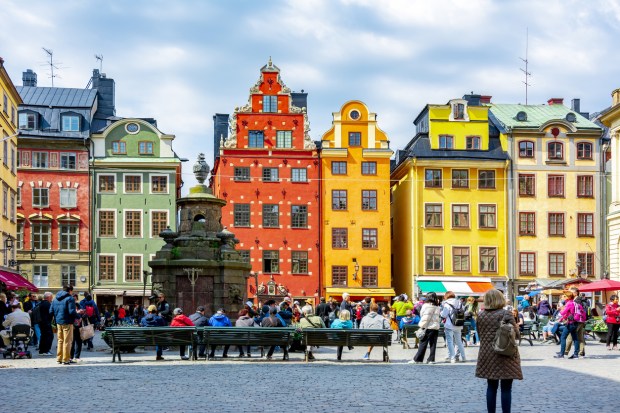
He maps out the three zones of the title. Squares are where political views are informally created; palaces are where formal, collectively binding decisions are taken with appropriate ceremony (Westminster is the model here, not Buckingham Palace); and the street is a more mundane, less avoidable, less theatrical version of the square. In each space he looks at the iconography and the signalling power of the ways in which architecture has been used to promote democracy – and how autocrats and populists use it differently.
Müller’s is a global account, starting with Louis Kahn’s parliament building in Dhaka, taking in the Athenian agora, the Roman forum, the storming of the Capitol, barricades in the streets of Paris and all points between. The United Kingdom barely features, apart from a fascination with Enric Miralles’s Scottish Parliament building. But it is easy to find local instances of the questions he poses. Is public prayer in Trafalgar Square inclusive or an act of ‘domination’? What messages are sent by statues and monuments – and who decides which stand and which fall?
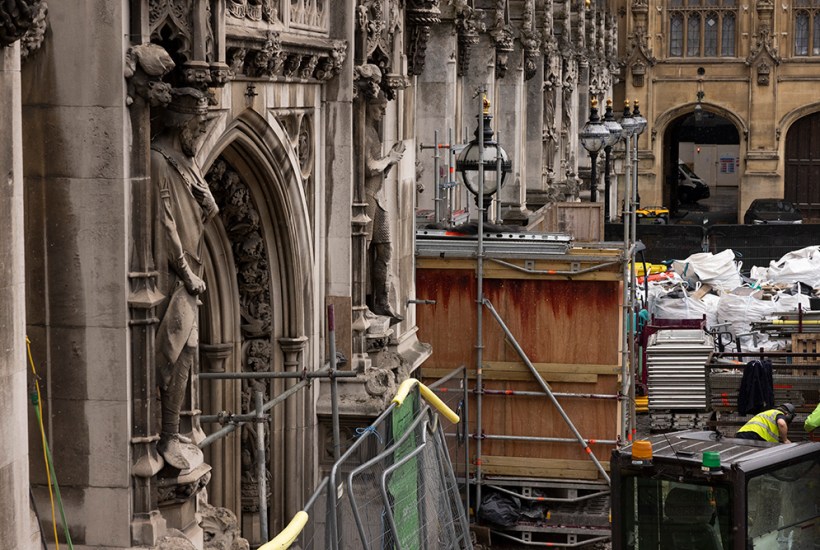
What does it say about Britain that the Palace of Westminster is crumbling and unpopular decisions about its infrastructure are endlessly postponed? How well suited are its chambers – which pre-suppose a two-party system – to a multi-party reality? In which streets is a march a legitimate form of mass protest and where is it a provocation? Why do people who hang flags on public lamp posts decry graffiti – and vice versa? And how should we think about the balance between the physical public realm and its digital equivalents? As Müller says, the last time you had a political discussion with a stranger it was probably on the internet.
It makes sense that he begins with the square. As the political scientist Henry Farrell has argued, the defence of democracy requires the citizenry to have visibility of each other’s opinions in order to resist any tyrant’s impression of inevitability. Mass demonstrations are a powerful Schelling point – which is why squares have become synecdoches for political movements. (Maidan; Tahrir; Tiananmen.) Although some of that function is now replicable through online petitions, cyberspace, Müller argues, is a less effective version of a physical space because it is not clear how many of the accounts swarming behind one cause or another are people and how many are bots or foreign agents; and also because the algorithms that make some voices prominent at the expense of others are opaque. (Also, perhaps, because online activism is so costless it has essentially no rhetorical power.)
But parallel drawbacks also apply to mass demonstrations: they are a form of spectacle that is often mistaken for an opinion poll – or worse, a vote. ‘A million people marched against this but the government still went ahead’ you hear. Well yes; but many millions didn’t march; and anyway that’s what being the government gives you the right to do.
This is what the palace signifies: the authority vested by the political process in people who make decisions. Older legislative palaces tended to emphasise continuity and authority, with classical architecture recalling ancient Greece or republican Rome. Recently designed ones emphasise transparency: there is a lot of glass; visiting citizens are given privileged views of the legislators at work. The glass dome of the Reichstag, from which you can look down on the chamber below, symbolises this (although the actual experience of accessing that dome is tedious and uncomfortable). That said, ‘attempts to make all spaces fully transparent’, writes Müller, ‘will only result in politicians finding new spaces for secrecy’.
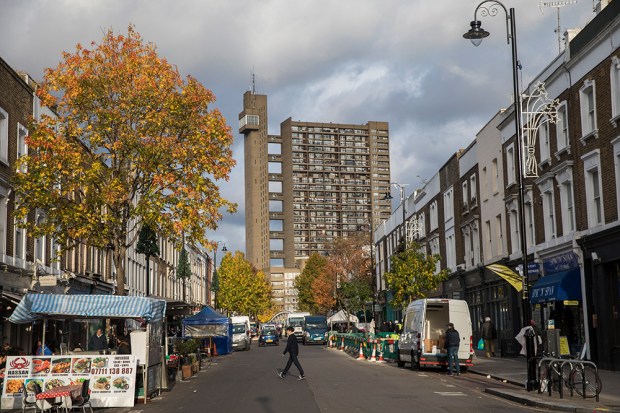
The street functions as a third space, available for politics but for the most part offering opportunities for anonymity and for the commerce that is required for democracy to function at all. Müller notes the champions of street life – Jane Jacobs, inevitably; but also the undersung Holly Whyte – but is also alert to the risks of Jacobs’s ‘eyes on the street’, both in the form of social control and of state surveillance. His sympathies are with Virginia Woolf’s ‘republican army of anonymous trampers’ and with the flȃneurs. ‘Protected spaces,’ he writes – meaning spaces that afford privacy – are important because they
allow for reflection and for experimentation with ideas… The shadows of arcades and the stoa in ancient Athens… are a physical precondition for eventually asserting a public role in the glaring light of democratic assemblies.
To which we might add that spaces that are free of politics, give or take the odd barricade, are also a precondition for refinding a sense of proportion.
Got something to add? Join the discussion and comment below.
You might disagree with half of it, but you’ll enjoy reading all of it. Try your first month for free, then just $2 a week for the remainder of your first year.