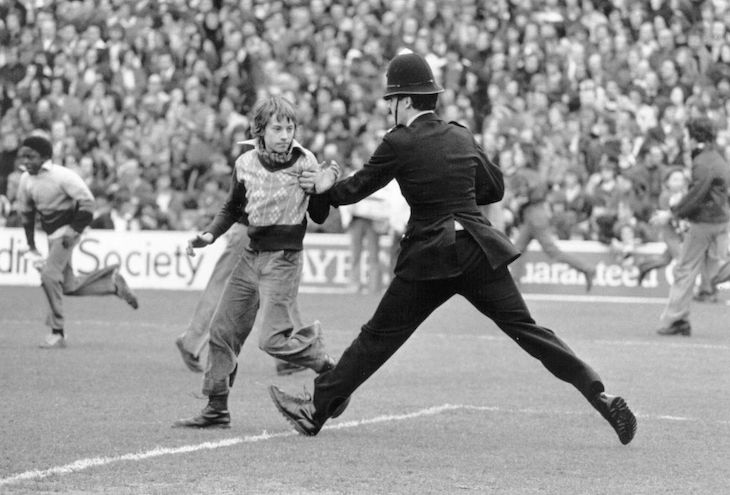
It was long a highlight of the football calendar when, every May, on the final day of the season, supporters would be allowed to swarm onto their team’s pitch. This annual frolic was a rite of spring, like Morris dancing or chasing wheels of cheese down steep hills – and it was glorious fun.
This annual frolic was a rite of spring, like Morris dancing or chasing wheels of cheese down steep hills
Even though they have been banned for almost four decades, I still find myself at this time of the season recalling those old pitch invasions. One episode in particular lives in the memory as perhaps the most joyous ending to a football match I ever saw, as well as one of the strangest. And that was the final match played by Liam Brady, some 36 years ago this month.
Brady, a skilful midfielder, had spells in Italy, at Juventus, Sampdoria and Inter Milan, and played many times for Ireland, but was best known here for his time at Arsenal, most memorably his role in their classic 1979 3-2 FA Cup win over Manchester United. But if that final had had an exciting ending it was still not nearly as dramatic as the final kick of Brady’s career.
By 5 May 1990, he was 34, in his third year at West Ham, then in the old second division, and Brady had announced his intention to retire. This end-of-season home game, at their smaller and more intense old ground, the Boleyn at Upton Park, against Wolves, was to be his swansong.
Late in the second half, with West Ham cruising at 3-0, Brady received a pass just inside the Wolves half, and advanced on their penalty area. Two Wolves defenders tried half-heartedly to close him down but Brady threw a dummy to create enough space to shoot. He let rip with his left foot from 25 yards – what they call, in the football vernacular, ‘a trademark curler’ of the ‘you knew as soon as it left his boot it was going in’ variety.
And Brady did seem to know instantly that he had scored. He didn’t break his stride, but just kept running in celebration. And the crowd en masse began running too, thousands leaping over the barriers and advertising hoardings to engulf Brady. Soon there were West Ham fans all over the pitch, me among them.
The reason it was strange as well as joyous is that there were at this point still only 88 minutes on the clock – and so there were two more minutes plus injury time left to play. Technically then, between them, the referee, police and stewards should have made a concerted effort either to clear the pitch and complete the game or declare the match ‘abandoned’ and the result void.
They did neither. Both teams were mid-table and the result had no bearing on anything except the records. So they just didn’t bother. The result stood even though the match was never formally completed – the only time I have ever encountered such a thing.
I was reminded of all this when Ipswich secured promotion back to the Premier League earlier this month – and their delighted fans celebrated by invading the pitch. It was quite wonderful to watch.
The spectacle made me recall what fun it used to be to be allowed to do this, because it was allowed, more or less.
So regular and accepted were pitch invasions that one even played a pivotal role in the most famous game ever played in this country, at Wembley on 30 July 1966, as described by Kenneth Wolstenholme’s equally famous commentary: “Some people are on the pitch…They think it’s all over…It is now!”
And some people were often on the pitch, even that pitch. There’s a classic photo of Rod Stewart partaking in the regular mid-seventies invasions of Wembley by Scotland fans who were exuberant while also tired and emotional, for example.
Before that, and long before my time, West Ham were involved in the granddaddy of all pitch invasions, in the very first match at Wembley: the 1923 ‘white horse’ Cup Final, which we lost to Bolton. So many of the 300,000 who turned up spilled out of the stands that the dense crowd came up to the touchline throughout. Hence the role of that horse; it was keeping them back.
This fans-on-the-touchline at Wembley scenario had been repeated in the final minutes of normal time in the Mersey derby 1989 Cup Final after a surge from the Everton stands following a late equaliser. But although we didn’t know it during that carefree romp on the Upton Park grass in the spring sunshine of 1990, this long tradition would very soon be over forever.
Because the same day that we at West Ham were trying to hoist Brady onto our shoulders, something much less wholesome was unfolding 100 miles west. Leeds United were also in the Second Division that season. But they weren’t mid-table – in fact they would be champions if they won at Bournemouth that afternoon while their hosts would be relegated if they lost.
The consequence of Leeds’ disorderly day out by the seaside was The Football Offences Act. Pitch invasions have been banned ever since
The prospect of a big day out at the seaside on a bank holiday weekend proved rather too intoxicating for the Leeds faithful to resist. The then Bournemouth ground, Dean Court, had a capacity of just 11,000, with most designated for home fans, but as many as 15,000 Leeds supporters had flocked to the Dorset coast – and rioted. Missiles were thrown, the town besieged, pubs and shops were smashed up. The trouble continued outside and inside the stadium. Over 100 were arrested, 12 police officers injured.
Leeds won 1-0 and the pitch was a sea of white as their by now even more intoxicated supporters stormed it.
It was the worst possible disaster at the worst possible time; just a year on from Hillsborough, just a month before England with their notorious hooligans would be competing in the World Cup in Italy – and just as English clubs were trying to overturn the ban on them competing in Europe which had been in place since Heysel in 1985.
The consequence of Leeds’ disorderly day out by the seaside was The Football Offences Act (1991). Pitch invasions have been banned ever since.
I wrote here during the Euros two summers ago about my hope that we may one day repeal the ban on football fans having a drink within sight of the pitch (illegal since 1985). I still live in hope on that one. But there’s no chance of even tacit acceptance of pitch invasions again, I fear.
When there last was a flurry of them, in 2022, it didn’t go well, particularly at Crystal Palace when Everton fans ran onto the pitch and one menaced their home team’s manager, Patrick Vieira. Not a good look.
I can’t be too sanctimonious about Leeds though. My own team has had more than its share of issues in this vein. And I would have no confidence at all that were our fans allowed to run onto the pitch after our final home game of this season that it would pass off peacefully – not least as we will almost certainly have just been relegated, and because today we are playing…Leeds.
So benign pitch invasions, like affordable housing or Britain winning the Eurovision Song Contest, are just one more of those things we can tell our children that we once enjoyed that they will, unfortunately, never know.