If you’ve ever strolled to the Wallace Collection or hurried to an appointment in Harley Street, fled an overcrowded Selfridges or sat on a sunny bench in Cavendish Square Gardens, you’ll probably have walked past the Wigmore Hall. It’s easy to miss – a wrought-iron canopy and a small mosaic embedded in the pavement the only signage. But this ‘modest building tucked away behind a busy London shopping street’ contains multitudes.
Now celebrating its 125th birthday, it has been variously described as ‘London’s most sumptuous temple of music’ and the symptom of a ‘faded, bombed-out world’; ‘a place where it was possible to experience the exotic, unfamiliar and bizarre’ and one filled with ‘too many dull concerts and too many indifferent debut pianists’. It has hosted royalty and refugees, broken taboos and reinforced traditions, and kept its doors open through two world wars and a global pandemic.
Julia Boyd’s compact new history isn’t the first book to tell the Wigmore’s story. But where the celebratory The Wigmore Hall 1901-2001, edited by Julia MacRae, was more of a joyful, chaotic collage of first-person memories, photographs and posters, Boyd’s more orderly, arm’s-length account sets the hall in its wider context – part of a long history of London concert venues and an even longer history of cultural rituals, characters and mores.
In a Tristram Shandy-esque twist, the hall isn’t even built until Chapter 3. (Originally the Bechstein Hall, it was renamed and reclaimed from German ownership during the first world war). These early chapters take us on an archaeological and anthropological search for the ‘lost’ concert halls of London. A suggestion was first made in 1676 for music to be performed in purpose-built public venues ‘to avoid persons of quality being crowded-up, squeezed and sweated among people of inferior rank’. The most popular informal early example was a ‘converted loft above a coal merchant’s shop’, with the coal merchant himself as impresario. Eventually London got its ‘first major concert hall’ – York Buildings Great Room, near the Strand – refurbished by Richard Steele, the co-founder of the original Spectator.
As Boyd moves through the centuries, we see the concert hall as a mirror to each age (often gilded, sometimes deceptively flattering). The first half of the 19th century’s ‘quiet, serious and thoughtful’ audiences demanded an intimate new kind of venue, while the second half’s democratisation of culture yielded behemoths such as the Royal Albert Hall and the Crystal Palace. Later, as the postwar Wigmore drifted into a ‘gentle and genteel decline’, we see it eclipsed by a shiny new rival, the Royal Festival Hall, and at serious risk of closure without substantial reinvention.
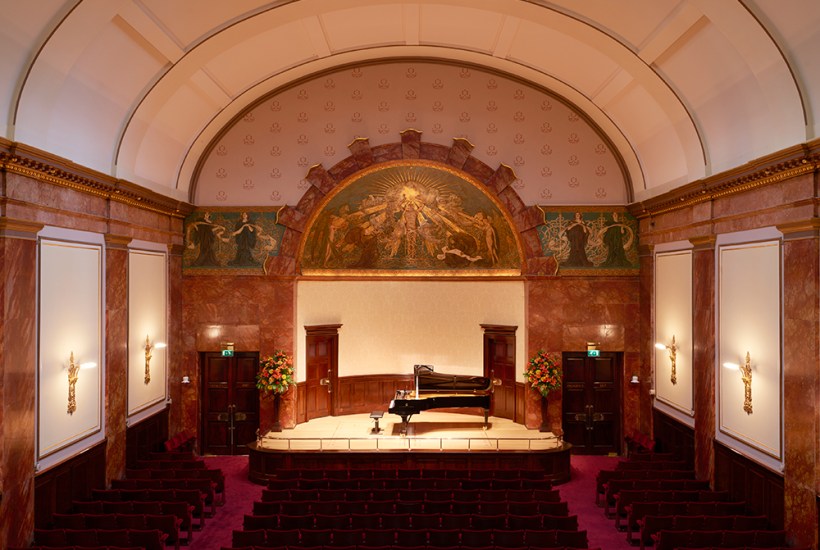
Every concert-convention becomes a touchstone: dress (the Bechstein Hall’s opening saw the building filled with ‘bejewelled ladies in sumptuous evening dresses’); programming (one 1907 concert featured 18 soloists singing music by 26 different composers); women (it’s bracing to read how numerous female composers were in the hall’s early decades); and design. Any fellow heretic who remains unpersuaded by the hall’s Milano-salami marble sunburst and Pre-Raphaelite frieze will take comfort in no less an ally than Kenneth Clark. Consulted after the second world war, he declared that salvaging the hall’s ‘wretched decorations’ was a ‘hopeless business’.
The biggest shift, however, was one of philosophy, transforming the hall from a venue for hire to a space with its own centralised and quality-controlled identity and output. Anyone used to a diet of German lieder and string quartets may be shocked to learn that earlier offerings included magic acts, occultists and quacks, a professional whistler, and even a Native American, who made a fire on the stage with the aid of two sticks. And reactionaries who harrumph at today’s bolder musical strands – the African concert series, regular jazz concerts, a residency for the Grammy-winning American folk musician Rhiannon Giddens – should know that this kind of breadth is far from new. The hall championed Ravi Shankar to London audiences, hosted black musicians long before it was the norm and witnessed David Bowie ‘performing a balletic dance’ (sadly we’re offered no further information about this).
Boyd’s affectionate history is at root a story about the human need not so much for entertainment as nourishment. The Wigmore Hall, she reminds us, is ‘a sanctuary for the human spirit’, a cultural and spiritual home for exiled Jews during the second world war and a springboard for careers and self-confidence. Its history of survival against the odds and constant reinvention is that of classical music itself – or should be. It’s odd that Boyd, who rightly casts ACE (and its predecessor CEMA) as one of the ever-looming bogeymen in her tale, doesn’t mention the hall’s triumphant, pioneering divorce from public funding under John Gilhooly. But perhaps that will be an encore. Always leave them wanting more, and all that.
Got something to add? Join the discussion and comment below.
You might disagree with half of it, but you’ll enjoy reading all of it. Try your first month for free, then just $2 a week for the remainder of your first year.