There is something infinitely melancholy in hearing what political ambition does to perfectly nice people. I awoke on Monday to hear Danny Kruger (an MP, formerly Conservative, now defected to Reform) defending his party’s candidate in the Makerfield by-election, one of whose past social media posts was simply too disgusting for me to repeat here.
True, Mr Kruger was not defending the post itself, but the candidate’s right to a ‘private’ (protested Kruger) history of such social media comments. Well, maybe. But I seem to remember Kruger’s past speeches have been especially admired for their high moral tone – he is a strong Christian – and so his being forced to defend a candidate’s right to a history of filthy misogyny in a public forum will have hurt him. Or at least I hope it did. I can recall making a ‘lock ’em up and throw away the keys’ kind of speech about law and order to the Matlock Conservative branch, hearing the applause and feeling ashamed.
He really is a nice man, but his whole career is shortly to turn sour and end finally in bitterness, anger and failure
Democratic politics degrades its practitioners and must always do so to some degree. The compensation the individual may hope for is that political success may enable him or her to achieve at least something positive in public affairs. Rob a politician of the feeling that at least they did some good for the country, and you rob them of everything, for they have lost a part of themselves in the attempt.
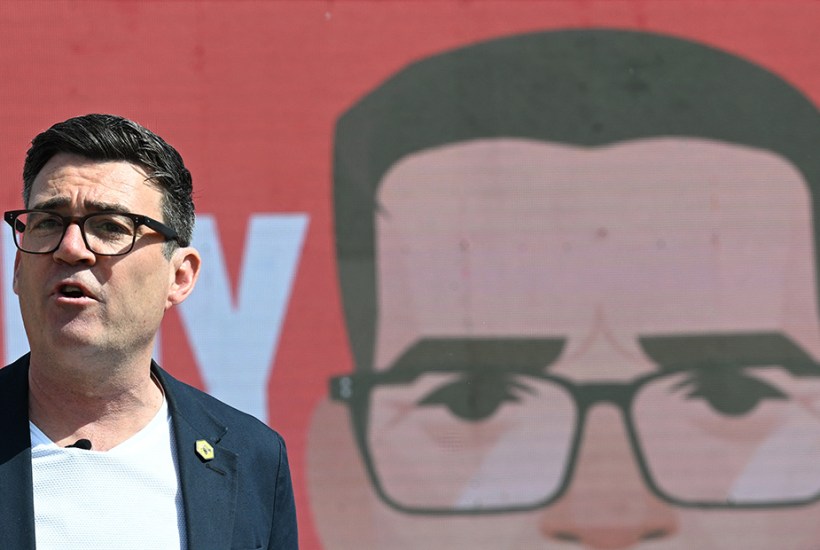
So I’ve recently experienced something unexpected: a feeling of sympathy for Andy Burnham. I’ve concluded he really is a nice man, but that his whole career is shortly to turn sour and end finally in bitterness, anger and failure: a spoiled life, and – worst of all – spoiled to no purpose. By which I mean he’s highly likely to be our next prime minister, and it won’t work out; and that, having done some good in Manchester, he doesn’t deserve the epitaph he’ll get.
Why not? Well, finding out more about him has changed my opinion of his nature and personal strengths. As a parliamentary sketchwriter and afterwards, I’ve always been rather rude about the mayor of the Manchester region and former cabinet minister. I’ve enjoyed joking about his gorgeous eyelashes and dismissing him as a shallow political chameleon and eternal lightweight. I believe it was I who first put into print (in the Times on 23 September last year) the now well-worn joke about the Blairite, the Brownite and the Corbynite walking into the Manchester bar, and the barman asking: ‘What are you drinking, Andy?’ There was (I thought) nothing to him.
But I’ve been doing some further reading, especially of a long essay by Joshi Herrmann just published in the online newspaper the Mill. Do read it. Its author has been following Burnham for six years and, with many examples, sets out what he concludes to be his strengths and weaknesses. It’s a mostly affectionate account, and if I can sum up what both surprised and persuaded me in Herrmann’s assessment, it’s his sense that Burnham’s warmth, energy, down-to-earth-ness, dedication and instinct for reading the weather are not the self-serving skillset of a shallow politician, but the deeply rooted attributes of a real human being.
Herrmann is clear Manchester’s success in recent years owes almost everything to Sir Richard Leese (the former leader of the city council) and his chief executive, the late Sir Howard Bernstein. But I did say ‘almost’ everything. Though slight in itself, what Burnham has been able to add (Herrmann argues) has been catalytic: a finger on the region’s pulse and a remarkable ability to humanise and explain; so that (though the relationship with Leese was often scratchy) this proved a team effort, reliant on Burnham’s capacity both to hear the voice and be the voice of the region’s population. This, Herrmann thinks, has been a case of the right person in the right job at the right time, and it has run sweetly with the grain of Burnham’s sincere nature. I am persuaded.
But in that Times column (don’t look it up because it wrongly concludes that Burnham was unlikely to lead his party – a mistake I made about Boris too) I adduced the Peter Principle, framed by Laurence J. Peter in a 1969 book. This asserts that ‘in a hierarchy every employee tends to rise to his level of incompetence’. This is because promotion usually depends on how well people perform in their current job, so they keep moving up until they fail.
Though it’s not certain, most analysis and commentary suggest Burnham will win the Makerfield by-election. All analysis and commentary would then expect him to become his party’s leader, and therefore prime minister. PM, that is, of a country heading into great financial difficulty, with a consequent need for – oh dear me no, not empathy in a prime minister, not for cordiality, not for a listening ear, not for a talent for sensing what the country and his party want, but for the tin-eared gumption to tell the country the hard truth about what it needs.
For this, Burnham will be precisely the wrong man in the wrong job at the wrong time. There is no known instance on record of this man spitting out unwelcome truths. It’s not what he does, not what he is, not what he feels himself to be in politics for.
Burnham will have an absolutely miserable time in Downing Street. He will live to see his friends desert him, his admirers repent of their admiration, his party’s hope go sour, and the national electorate, unlike his beloved Manchester, turn against him. He will be regarded in the end as some kind of imposter who insinuated himself into leadership on false pretences.
And that will be unfair. This is a good man – not without a little vanity or appetite for applause, but harmlessly so – who sincerely thinks he can help. But he can’t. And it will be horrible for him. And it couldn’t happen to a nicer man.
Got something to add? Join the discussion and comment below.
You might disagree with half of it, but you’ll enjoy reading all of it. Try your first month for free, then just $2 a week for the remainder of your first year.