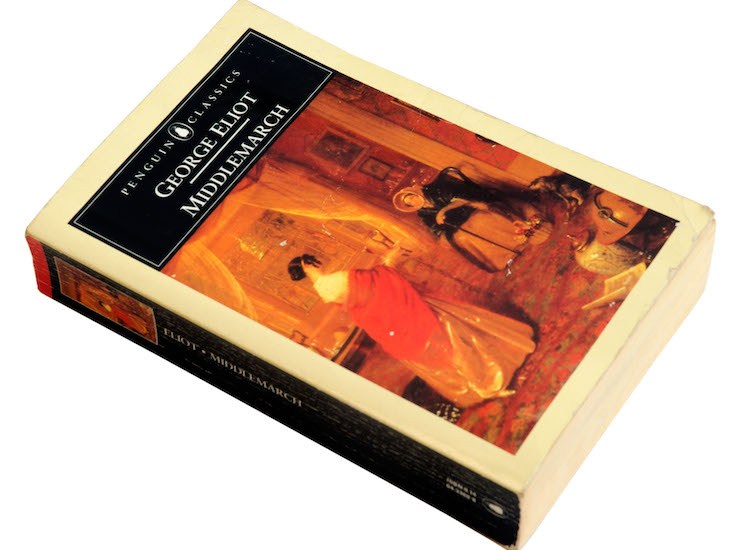
Middlemarch, which a Guardian poll of ‘experts’ has named as the best novel ever, is overrated. I enjoyed reading it when I was seventeen. I probably re-read it in my twenties. Then I grew up. I became a bit more sceptical of the para-religious sentimentalism-on-stilts that defines George Eliot’s ouvre, and this novel in particular.
This is a pile of nonsense with a grain of truth in it
Of course I was in love with Dorothea Brooke as a teenager. So high-minded, and considerate and so wisely accepting of her misfortunes, and rather pretty too. But nowadays she strikes me as a blue-stocking bore (I far prefer the feisty Gwendolyn from Daniel Deronda (partly thanks to Romola Garai’s portrayal of her).
Let’s put it simply. Dorothea embodies the assumption that post-Christian agnostics with an interest in the arts are the supreme human beings. That’s roughly how I saw myself at seventeen: the Christianity of my upbringing seemed something I was moving on from, to higher braver things. Religion seemed the old packaging of morality; the modern task was to salvage religion’s moral truth from the wreckage.
Unlike the average heroine, her prime concern is not whom to marry, but how to live a life of practical goodness. Her idealism leads her astray, into a bad marriage, which lends her a tragic aura. Then her moral quest resumes, in a more sombre key. She tells her admirer Will Ladislaw that she isn’t sure if she believes in anything supernatural any more, unless you can call the power of goodness supernatural. Her core belief is ‘that by desiring what is perfectly good, even when we don’t quite know what it is and cannot do what we would, we are part of the divine power against evil – widening the skirts of light and making the struggle with darkness narrower.’ This, she goes on, ‘is my life. I have found it out and cannot part with it. I have always been finding out my religion since I was a little girl. I used to pray so much – now I hardly ever pray.’ The implication is that religion is a stage one might progress beyond, to a purer moral idealism.
Of course this reflects George Eliot’s views. She was raised, as Mary Ann Evans, in a strict evangelical home in a small town in the Midlands, in the early nineteenth century. In those days evangelical meant a pious ‘low church’ form of Anglicanism, deeply versed in the Bible and suspicious of Catholic stirrings in the Church of England. As a manically bookish teenager she lost her faith, causing a painful rupture with her father. Or rather, she secularised her faith. She had been reading a couple of German theologians, in the original of course, who were ripping up the discipline. One of these, Ludwig Feuerbach, argued that the inner meaning of Christianity was humanism. The story of God becoming human really meant that humanity was divine. Mary Ann glimpsed a grand semi-religious task: to forge a humanism that was not dry and rational but imbued with religious sentiment; to renew the supreme moral idealism, after the demise of its traditional religious base.
She claimed that literature was a moral force. Through helping us to imagine other lives, reading novels can help us to become better people. As she put it, “the greatest benefit we owe to the artist, whether painter, poet, or novelist, is the extension of our sympathies”. This worldview has appealed to arty agnostics ever since. The arts can replace religion.
This is a pile of nonsense with a grain of truth in it. The novel did have a moral function in its heyday but that was only because of the Christian culture it drew on.
This is the conclusion of the Guardian editorial, piously puffing the poll-topping novel:
‘This is a novel about what it means to be good. And it is impossible to emerge from it unchanged. It is a celebration of the quiet heroism of unremarkable lives, all those who “rest in unvisited tombs” as the melancholy last line has it. With Middlemarch, Eliot showed what a novel could do.’
In the preceding paragraph it quotes Martin Amis: Middlemarch ‘renews itself for every generation.’ Did Amis learn how to be ‘good’ from reading it? Maybe without reading it he would have been even more of a cocky little man-slut?
It’s a load of dated bunk, the conflation of literature and morality. Grow up.