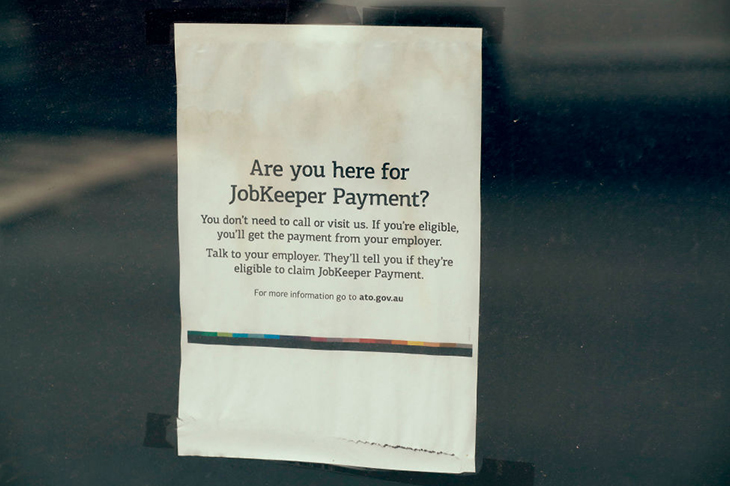
Since the turn of the millennium, Australia has produced a long catalogue of poorly considered and badly designed public policies. The NBN. The NDIS. Gonski. Snowy 2.0. The list is extensive and expensive. Yet the Morrison government’s JobKeeper scheme deserves to sit near the top, ranked among the worst economic policy failures in Australia’s history.
The reason is not merely its staggering cost, though that alone helped push Commonwealth debt towards the trillion-dollar mark. The deeper problem was that JobKeeper institutionalised something profoundly destructive: the large-scale payment of citizens to not work. Worse still, it created a moral hazard that made the country’s ruinous lockdowns possible.
The name was a deception. ‘JobKeeper’ implied the preservation of productive employment relationships through a temporary emergency. In practice, vast numbers of Australians were paid regardless of whether any meaningful work was being performed, whether their employer remained viable, or whether the lockdowns themselves had any rational economic justification.
Some firms whose revenues barely declined collected enormous subsidies. Others that genuinely suffered fell through the cracks. Some companies later booked record profits while quietly retaining taxpayer support. A surprising number of workers earned more on the scheme than they had in employment. In the end, future taxpayers will be forced to pay the bill.
The contrast with Sweden, which rejected prolonged lockdowns, kept much of society functioning and treated adults as capable of assessing risk, could not be sharper. Australia embraced the opposite model: an increasingly coercive and economically illiterate regime in which governments deliberately shut down production while paying millions not to participate in it.
For as long as JobKeeper existed, the political economy of lockdowns changed entirely. It is difficult to imagine Daniel Andrews imposing what became one of the longest cumulative lockdowns on earth without massive federal compensation flowing into Victoria. Closing an economy for months would ordinarily produce overwhelming political pressure as businesses collapsed and unemployment surged. Canberra removed that pressure by socialising the costs nationally.
Victoria could pursue extreme restrictions only because the Commonwealth borrowed on a historic scale to mask the costs.
The historical comparison is humbling. The 1918-19 influenza pandemic was vastly more lethal than Covid, particularly for working-age adults, killing tens of millions globally in a far smaller world population. Liberal democracies did not respond by freezing economic life, paying citizens not to work, or accumulating unprecedented peacetime debts. Yet a century later, a wealthier and supposedly more sophisticated Australia behaved as though output could be suspended indefinitely while living standards were maintained by the printing press.
For a brief, intoxicating moment, the illusion worked. Household savings rose. Insolvencies fell. Consumption recovered when restrictions eased. Politicians took bows for having ‘saved’ the economy.
But the costs did not vanish. They were deferred, and then they arrived. Public debt exploded. Asset prices, particularly housing, inflated grotesquely. Labour shortages spread across the economy almost the moment activity resumed, because workers had been paid to detach from productivity for so long that mobility itself had collapsed.
Productivity growth weakened and has never properly recovered. Inflation surged towards seven per cent destroying real wages and forcing the sharpest interest rate increases in a generation. Australians are still paying, every month, for the experiment of financing economic inactivity through borrowing and monetary expansion. Almost all of it was predictable and was predicted, inflicting extensive damage to the Coalition’s economic management credentials.
JobKeeper’s defenders fall back on the claim that policymakers were operating under uncertainty. This is true, but uncertainty does not justify abandoning elementary economics. Incentives matter even in crises. Paying people not to work acts like a sedative, reducing political resistance to extending the conditions under which they cannot work. Once governments discovered they could borrow and spend on an extraordinary scale without immediate electoral punishment, fiscal discipline largely evaporated, and has not returned.
The scheme is still routinely described as a success because measured unemployment did not collapse. This confuses symptoms with causes. If the state pays firms and workers vast sums to preserve nominal employment relationships while simultaneously shutting the economy, the unemployment rate becomes a worthless guide to economic health. The serious question is whether the policy improved long-term national welfare relative to less destructive alternatives. Sweden’s experience suggests it did not.
There is a deeper philosophical wound as well. Liberal market economies depend on a presumption in favour of voluntary activity, decentralised decision-making and individual responsibility. Covid policy inverted those principles. Governments determined who could work, where citizens could travel, which businesses could open, and on what terms human beings could see one another. JobKeeper was the financial mechanism that made this extraordinary expansion of state power sustainable. Without it, the coercion would have collapsed under its own economic weight within weeks.
That is the most damaging legacy of all. Future governments, confronted with the next large-scale shock, will look at the precedent and conclude that mass income replacement and economy-wide shutdowns are politically viable instruments.
Which brings us to the strangest feature of the entire episode: the architects of the scheme were not merely forgiven but rewarded.
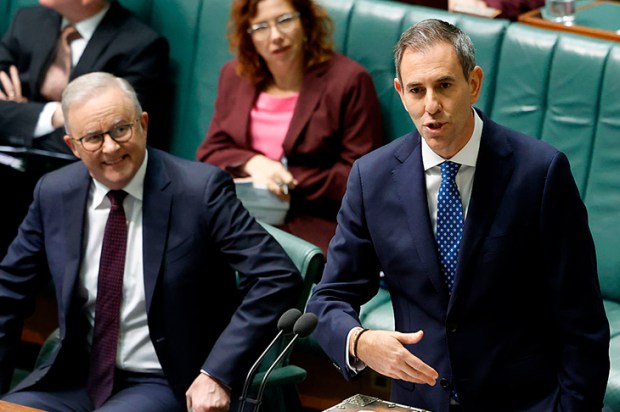
Jenny Wilkinson, then a senior Treasury official and one of the principal designers of JobKeeper, received a Public Service Medal in 2021 for her role in the Covid response. She was subsequently elevated to Secretary of the Department of Finance, and in June 2025 promoted again, becoming the Secretary to the Treasury and member of the RBA Monetary Policy Board.
If the 2025-26 budget she has helped shape is any guide, her appetite for structurally higher spending, persistent deficits and intergenerational wealth transfer remains undiminished. Gross debt is projected to be above a trillion dollars with deficits as far as the medium-term eye can see, while productivity languishes and bracket creep, rather than spending restraint, is quietly assigned to do the work of fiscal repair. Behold, an architect of one of Australia’s costliest peacetime policy errors is now the most senior economic adviser in the country. This matters because it confirms that within the senior bureaucracy, JobKeeper is not regarded as a cautionary tale but a template.
Australia’s Covid response, in the end, revealed a profound loss of confidence in the resilience of a free society. Rather than trusting citizens to manage risk and adapt voluntarily, governments defaulted to coercion underwritten by debt. The bill for that experiment has not disappeared. It arrives slowly, in higher mortgage rates, weaker real wages, falling productivity and a Treasury still run by those who designed the original error and see no reason to disown it.
Got something to add? Join the discussion and comment below.
Peter Swan AO is at the UNSW-Sydney Business School. Dimitri Burshtein is at Eminence Advisory.
You might disagree with half of it, but you’ll enjoy reading all of it. Try your first month for free, then just $2 a week for the remainder of your first year.