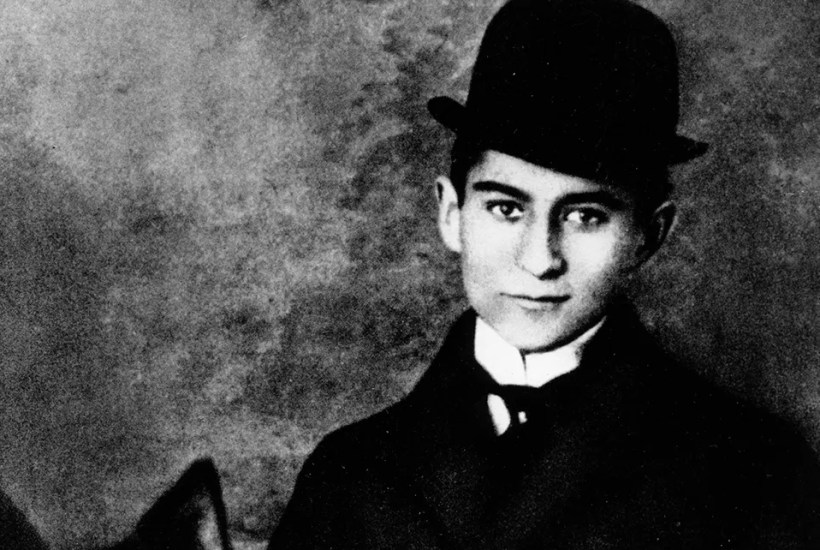
Rainer Maria Rilke’s claim that fame is the ‘sum of all misunderstandings’ is certainly true of Franz Kafka, whose life, work and reception have long been plagued by myriad misunderstandings. Despite publishing comparatively little in his all-too-short lifetime (1883-1924), Kafka gained a reputation as a writer’s writer, whose work was met with keen appreciation by, among others, Rilke, Hermann Hesse and Thomas Mann.
In Kafkaesque, which first appeared in French under the title Dix versions de Kafka, Maïa Hruska charts Kafka’s afterlife through the perspective of ten ‘first’ writer-translators. These range from luminaries such as Jorge Luis Borges, Bruno Schulz and Primo Levi to lesser known but intriguing figures such as Kafka’s friend and briefly lover Milena Jesenská, who translated some of his stories into Czech, and Melech Ravitch, who translated him into Yiddish, a language of which Kafka was an early and passionate advocate.
In this remarkably polished first book, Hruska, a versatile Franco-Czech journalist who works for a literary agency in London, brings a welcome freshness of vision and a dashing style to shelves groaning with soberly written Kafka studies. Her family history, which traces back to German- and Czech-speaking Jews in Prague, energises her literary explorations. Her grandmother, Ludmilla Kafka (so far no proven relation), survived the 1930s and 1940s in Nazi-occupied Bohemia.
Not least among Hruska’s rediscoveries is the self-described ‘notoriously unknown’ French novelist Alexandre Viallate. He, while employed by a journal in the Rhineland, came across Kafka’s work in 1926 on opening an unsolicited parcel containing Max Brod’s posthumous edition of The Castle. Vialatte’s insights about Kafka, whose oeuvre he would spend much of his life translating and promoting, have lost none of their pertinence. Faced with proliferating commentaries, and commentaries on commentaries, about Kafka, he writes ruefully: ‘I thought I was launching a prince of humour, but they turned him into a king of darkness.’
Vialatte’s resolutely upbeat response to Kafka could not contrast more strikingly with that of the Auschwitz survivor Levi, who, cajoled by Italo Calvino in the early 1980s, translated The Trial – its third Italian version – despite the ‘repulsion’ of a ‘psychoanalytical nature’ aroused in him by Kafka, whom he likened to ‘the prophet who tells you the day you will die’. That day came in April 1987 when Levi threw himself from a spiral staircase in his home. Hruska concludes this sad story by wondering rhetorically whether translating Kafka hadn’t ‘demolished the walls of Levi’s pojok’, a Czech term, and a personal as well as literary leitmotif in this book, meaning both home and peace or tranquillity.
Hruska can be disarmingly candid, admitting, for instance, that it was only while researching the book that she discovered the work of the formidable German-language poet and Auschwitz survivor Paul Celan, who translated one of Kafka’s stories into Romanian. Yet she writes insightfully about Celan, drawing parallels between his celebrated Auschwitz poem ‘Todesfuge’ (‘Death Fugue’), and Marc Chagall’s seemingly whimsical paintings. Like Levi, Celan, who described his poetry as coming from ‘within the language of Death itself’, took his own life, jumping from a bridge into the Seine.
Hruska’s admiration for Vialatte’s pioneering translations leads her to neglect a fact that we translators of modern classics must in all modesty accept: namely, that our translations will eventually age in ways that the original works will not. Like many readers who discover modern classics through early translations, which tend to make the authors more approachable by ‘domesticating’ their prose style, Hruska remains partial to the ease of those first versions. Although Vialatte deserves great credit for introducing Francophone readers to Kafka, his elegant translations make Kafka sound more dreamlike and fluid in French than his spare, unadorned and at times startling German warrants. Hence no doubt Hruska’s tabloid-like indictment of recent French translations of Kafka for erasing traces of ‘Vialatte’s presence’ as if they were ‘cleaning up a crime scene’.
At times, Hruska gets carried away by her own rhetoric and makes misleading assertions, such as that ‘all’ German and Austrian Holocaust survivors ‘felt a deep sense of shame at having contributed… to the spread of this language that had sentenced their loved ones to death’. No doubt some felt that way, but others did not, including those Jewish refugees from the Third Reich who went on to become distinguished professors of German at universities throughout the anglophone world. As for the writers, some, such as Aharon Appelfeld, who switched to Hebrew, adopted other languages, while others wrote in German, including Nelly Sachs, Jurek Becker, Peter Weiss, and, however ambivalently, Celan.
While it would be unfair to fault Hruska for not reading exhaustively about each of her large and colourful cast, the Kafka sources she lists are skimpy, outdated and, in one case, questionable. Surprisingly, given her fascination with biography, she nowhere mentions Rainer Stach’s rightly acclaimed three-volume life of Kafka but includes Conversations with Kafka by Gustav Janouch, a passing acquaintance whom Kafka characterised in a letter to his eventual fiancée Felice Bauer as ‘awfully tiresome’.
Janouch’s credibility was demolished with forensic precision in 1978 by Eduard Goldstücker – a prominent Czech scholar and prime mover of a Kafka conference that ushered in the Prague Spring, during which Goldstücker served as Czech culture minister before going into exile in Britain, where he was appointed professor of comparative literature at Sussex. Goldstücker demonstrates that certain ideas and phrasings which Janouch puts into Kafka’s mouth stem principally from Leon Trotsky’s book, The Revolution Betrayed (1931), which appeared seven years after Kafka’s death. Some enterprising student of German should translate Goldstücker’s devastating takedown, the better to avoid further credulous reliance on Janouch’s bogus ‘conversations’, even by a writer as well-informed as Zadie Smith.
In spite of such weaknesses, these astutely linked essays are provocative and illuminating, thanks to Hruska’s insights and imaginative associations. Her engaging, elegant prose is deftly recreated in Sam Taylor’s beautiful translation. Admirably succinct, Kafkaesque is bound to appeal both to Kafka devotees and to readers curious about how he became a global icon.
Got something to add? Join the discussion and comment below.
You might disagree with half of it, but you’ll enjoy reading all of it. Try your first month for free, then just $2 a week for the remainder of your first year.