Gianandrea Noseda conducted the London Symphony Orchestra last week in a programme of Stravinsky, Chopin and Borodin. The Stravinsky was a relative rarity – the divertimento from The Fairy’s Kiss – and Chopin’s F minor concerto was played by Seong-Jin Cho, a pianist with a large following and a soaring reputation. Full disclosure: I was there for the Borodin, his Second Symphony of 1877. What a masterpiece, and what a man! Alexander Borodin was a scientist of international standing and a campaigner for women’s rights. Deeply in love with his wife, and an inveterate rescuer of stray cats, he was, he confessed to Liszt, ‘only a Sunday composer’. ‘But after all,’ replied the wizard of Weimar, ‘Sunday is a special day.’
Everything that Borodin composed exudes character; even the fragments that he left, orphaned, when his heart failed suddenly at the age of 53. Alone among the ‘Mighty Handful’ of St Petersburg composers his raw inspiration was on a par with that of his (equally doomed) friend Mussorgsky, and only the fact that Borodin’s genius was sunny where Mussorgsky’s was dark has denied him a comparable level of acclaim. As a melodist, Tchaikovsky was his only serious rival, though they were very different animals. Borodin’s melodies pour out, molten and sweet, aching with nostalgia even while they shine with hope.
As for the Second Symphony, it’s so direct, so stirring and so irrepressibly loveable that it’s easy to overlook just how original it is. Borodin’s materials and construction methods – his rugged blocks of brass, the honey-and-garlic harmonies, that luminous woodwind writing – hurl their cues down the decades to Stravinsky, Shostakovich and Ravel. Hearing this miniature epic played live for the first time in years (not for want of trying), it struck me that there’s hardly a bar where you could mistake Borodin for any of his western contemporaries. ‘Magnificently courageous, in expression and no less in restraint’ was how Hubert Foss described Borodin’s Second, back in 1950, and how right he was; how very, very right.
Anyway, apologies: you want to know about the concert. Well, the LSO and Noseda were born to handle the primary colours and rhythmic trip hazards of middle-period Stravinsky, and if the audience was lukewarm, it wasn’t the performers’ fault. The Fairy’s Kiss dates from 1928, and it’s derived from Tchaikovsky – an awkward, cubist mash-up that falls straight into the uncanny valley between Tchaikovsky’s heartfelt warmth and (Vaughan Williams’s term) Stravinsky’s modernist monkey tricks.
Next it was over to Cho and Chopin, with Noseda and his orchestra doing everything in their considerable power to lift the teenage composer’s classroom orchestral writing on to the level of the pianism. Are we still allowed to call piano playing ‘aristocratic’? Cho’s was: sensitivity coupled to dignity, with a natural sense of rhythm and occasional wholly unaffected flashes of fantasy. He bowed to the orchestra, hand clasped to heart, and it was good to see that virtuosity as self-effacing as this can still draw such uninhibited applause.
Finally we came to the Borodin and, yes, I was determined to enjoy it. Noseda and the LSO did it proud, from the strings’ mordant down-bows in the opening motif to the thunder of the timpani (proper horsemen-across-the-steppe stuff) as the first movement gathered pace. In the Scherzo, the cellos practically swung their off-centre melody. The yearning horn and clarinet solos in the Andante were tender and proud, and Noseda took the finale – the most exhilarating of all Russian symphonic finales – at a fair lick, but with enough lift and spring for it to feel like a dance. The audience, again, seemed underwhelmed. Perhaps we don’t hear Borodin as much as we used to (or ought to). At any rate, there was one happy critic.
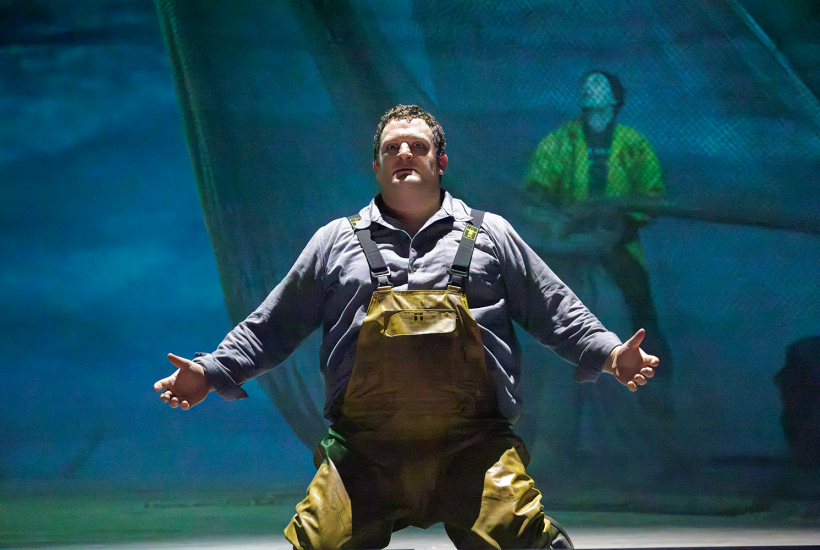
Opera North has revived Phyllida Lloyd’s 2006 production of Peter Grimes, which ‘bowled over’ my late Spectator colleague Michael Tanner, and still comes across powerfully two decades later. True, it looks more familiar now. Lloyd was not to know that a bare stage and an enveloping blackness (even in the Sunday morning scene) would become the default visual style for productions of Grimes. It must have seemed very original back when it was new.
But the revival director, Karolina Sofulak, has retained Lloyd’s focus on storytelling, and while that makes for a less layered narrative, it doubles the emotional punch. There’s no doubt here that Grimes (John Findon) is basically blameless, or that his relationship with Ellen (Philippa Boyle) is sincere. Findon captures Grimes’s lumpen bewilderment, with a voice that shades from muted bluntness to the vaulting, half-mad gleam of a man who can see beyond the horizon, but can’t negotiate human society. The Opera North orchestra under Garry Walker mirrors his mood swings: one minute rough-cut and raw, then breaking open in sprays of iridescent, aqueous beauty. Well worth catching, if you can.
Got something to add? Join the discussion and comment below.
You might disagree with half of it, but you’ll enjoy reading all of it. Try your first month for free, then just $2 a week for the remainder of your first year.