Even if Schoenberg’s song cycle Pierrot Lunaire is never going to feature on anyone’s Desert Island Discs, it stands as a work of rich and complex resonance shot through with all the neurotically introverted obsessions behind expressionism. Through Albert Giraud’s 21 opaque lyrics, scored atonally for a soprano who declaims rather than sings them, accompanied by seven instruments, it presents some sort of parable of the tormented artist adrift in a hostile world. Perhaps one can’t be charmed by the result, yet its power is undeniable: it grips even when it baffles and repels.
Perhaps one can’t be charmed, yet its power is undeniable: it grips even when it baffles and repels
Glen Tetley’s ballet, dating from 1962 but still fresh and forceful, makes Pierrot Lunaire’s obscurities more palatable and approachable. Without making much attempt to illustrate visually the symbolist imagery of the German texts, it constructs a simple narrative in which the lonely, guileless, romantic Pierrot falls prey to the scheming of the worldly-wise Brighella and Columbine – though what they want from him is never made clear.
Tetley intended to show in Pierrot someone who, like himself, was ‘as much inspired by life at one time and terrified by life at another time, who wants to encounter life but repeatedly recoils from it as well’. The stage is bare except for a square tower of steel scaffolding, designed by Tetley’s regular collaborator Rouben Ter-Arutunian. It has multiple significances for Pierrot – his childish playing frame, a perch from which he swings, a point of safety and observation, but also a cage that traps him. At one point, Brighella and Columbine take control of this structure, becoming puppet masters who string Pierrot up and dance him around like a marionette. At the abrupt conclusion, all three characters stand together on a high rail, Brighella and Columbine flanking Pierrot in what could be interpreted as either a happy resolution or an unhappy coercion.
Tetley has rather fallen out of fashion since he died in 2007, but here I was reminded what a fine choreographic craftsman he was. Born in Cleveland, Ohio, he served in the navy during the war and then attended medical school before dance captivated him. Prominent among his early mentors were Jerome Robbins and Martha Graham, from whom he inherited an aesthetic grounded in clarity and simplicity. There’s no decoration or clutter in Tetley’s style: it is precisely disciplined, with everything made firmly legible and purposefully carved, stripped almost clinically to its essence and perhaps short of warmth. Virtuosity for its own sake he deplored, and I guess he would deem most of today’s dance-makers to be mere gimmick-mongers.
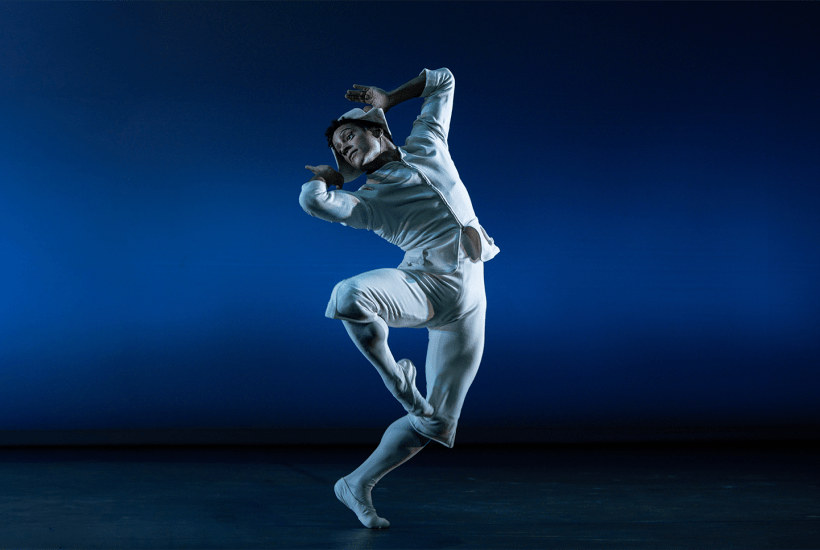
I missed Pierrot Lunaire when it was last produced by the Royal Ballet on the main stage in 2007, but I am so old that I have vivid memories of Christopher Bruce in the title role for Rambert’s production in the 1970s. Marcelino Sambe won’t efface them. Coached by Bruce, he danced the title role with impeccable assurance, but didn’t pitch it right expressively for the modest dimensions of the Linbury – his facial suggestions of the pathos of bruised vulnerable innocence seemed excessively semaphored and externalised.
As his tormentors Brighella and Columbine, Matthew Ball and Mayara Magri were spot-on in conveying corrupt glamour, and the musical performance was first-class, with Alexandra Lowe a marvellously poised soloist. An intriguing alternate cast includes Joshua Junker, Natalia Osipova and the company’s exciting new signing Patricio Reve.
I can’t say that I madly enjoyed it, but Pierrot Lunaire is a serious work, and this revival, honouring Tetley’s centenary, must rank as a highlight of the Royal Ballet’s otherwise very dull season.
Got something to add? Join the discussion and comment below.
You might disagree with half of it, but you’ll enjoy reading all of it. Try your first month for free, then just $2 a week for the remainder of your first year.