The quartet is the basic unit of string chamber music. Two violins, a viola and a cello: subtract any one of those, and you’re walking a tightrope. Add further players and the issue is redundancy: you’d better know precisely what you want to do with those additional voices, because otherwise they’ll congeal like cold gravy. When it comes to the string octet – two string quartets fused together – only the 16-year-old Mendelssohn really cracked it, going all out for transparency, daring and youthful verve.
The Romanian George Enescu took the opposite approach. His Octet of 1900 is chamber music as epic construction project, wrought from steel, not spindrift. ‘No engineer launching his first suspension bridge across a river can have agonised more than I did as I filled my manuscript paper with notes,’ wrote the young composer, who confessed himself ‘crushed’ by the effort. A planned première was abandoned as too difficult, and Enescu ended up sanctioning a version for string orchestra – the ultimate admission of defeat for any serious chamber composer.
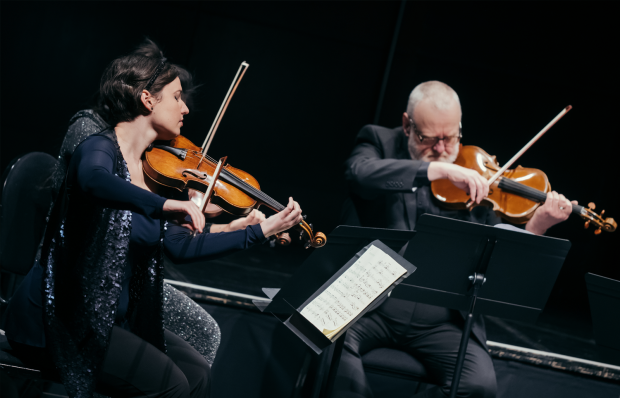
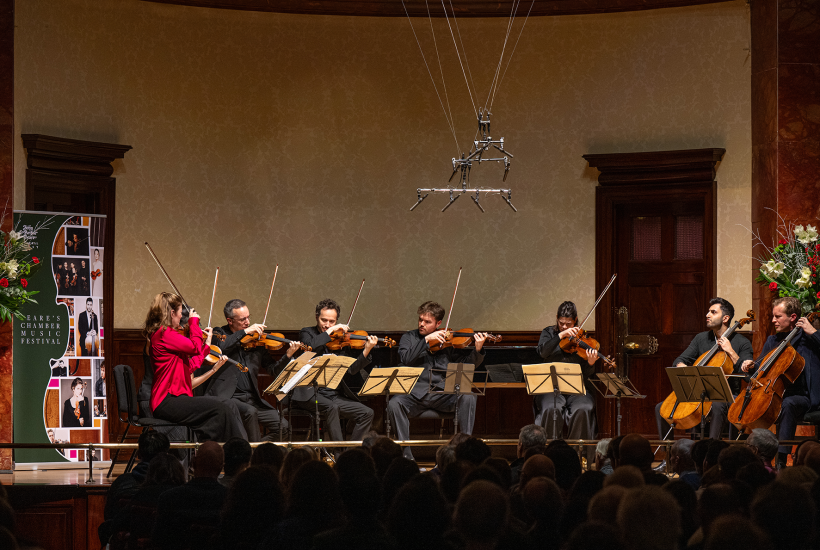
No fear of that at the Wigmore Hall, where the Beare’s Chamber Music Festival had assembled a string supergroup. Sounds tacky, I know, but what else can you call an octet led by Janine Jansen with Clara-Jumi Kang and Alexander Sitkovetsky on fiddles, Timothy Ridout leading the violas and Kian Soltani playing first cello? These are A-list names; merely getting them in the same room must have been a feat. And if the result – as with so many supergroups – ended up feeling like less than the sum of its parts, the two movements that I heard before I had to sprint for the last train (maddeningly early, when a concert runs late) contained some breathtaking playing.
Enescu, a violinist, tends to think in terms of the top line, allocating his sultry melodies primarily to the first violin and first viola. It’s hard cheese on the cellists and Soltani and his colleague, the Swedish virtuoso Daniel Blendulf, diligently anchored the ensemble, smiling as they played. But Jansen swooped and soared up top, playing with needlepoint finesse. Ridout, meanwhile, almost upstaged her through sheer understatement as his viola bathed the whole scene in mellow, golden tone. There was no understatement in the scherzo; an electrical storm of angular, proto-modernist writing, delivered with fearsome bravura. At times the whole group dropped to a whisper; seconds later, splinters of melody were scything through the air like shrapnel. It was all faintly terrifying, though undeniably impressive.
The audience rose in the kind of ovation that isn’t supposed to happen at the Wigmore Hall
Still, when you feast with lions, you can hardly stand on subtlety. Technically, there was little to fault in the performance of Dvorak’s Terzetto that had opened the evening, with the Chinese superstar violinist Ning Feng plus Sitkovetsky and Amihai Grosz (currently the principal viola of the Berlin Philharmonic). The Terzetto is the opposite extreme of the chamber music spectrum; Dvorak walking the three-player tightrope with inimitable craft and charm, and the Beare’s all-stars projected the music bodily into the hall – luscious, glistening and impeccable. Intimate? Not so much, though Dvorak originally wrote the piece to perform at home with friends. This was magnificent, but it wasn’t chamber music.
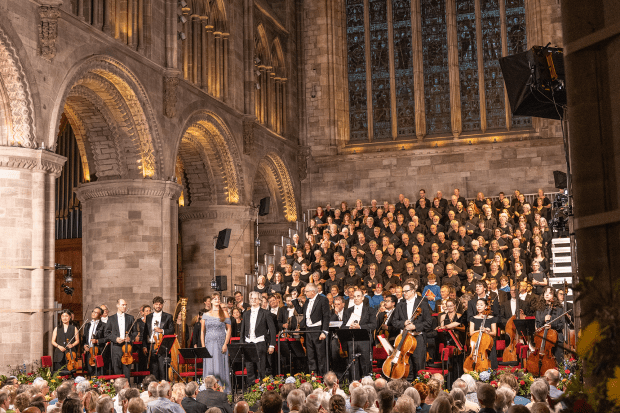
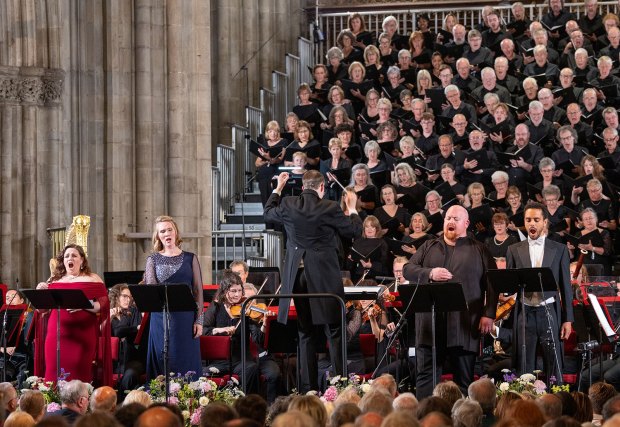
And then Quatuor Ebène took the stage, and with them the musical intelligence of an ensemble that plays and thinks together full-time. They were joined by the pianist Sunwook Kim for César Franck’s volcanic F minor Piano Quintet, and I don’t think I’ve heard a more imposing performance. Lush Wagnerian harmonies were coolly deconstructed, and Franck’s torrential climaxes were rendered as towering ice sculptures: austere and very much the opposite of what you might expect at the heart of such a high-calorie programme. Kim played with heroic reserve, and the Ebènes responded en bloc. The final bars were as stark as Sibelius, and the audience rose in the kind of ovation that isn’t supposed to happen at the Wigmore Hall.
Over at Covent Garden, the big sinful Christmas treat was the return of Anna Netrebko, this time as Turandot. Her Calaf, on this occasion, was her former husband Yusif Eyvazov, and both of them sounded shaky at first. But by the climax of ‘In questa reggia’ the famous Netrebko radiance was coming up to full beam, and it stayed there until the end of the opera, when her face cracked into a megawatt smile.
Under revival director Jack Furness, Andrei Serban’s vintage staging feels tighter than it has in years. Ping, Pong and Pang are active (and interestingly ambiguous) players in the drama, and the conductor Daniel Oren isn’t afraid of the odd rough edge. But it was the melting tenderness of Masabane Cecilia Rangwanasha as Liu that really lodged in the memory. It speaks volumes that on a night as starry as this she was the one singer who inspired spontaneous applause, and actually stopped the show.
Got something to add? Join the discussion and comment below.
You might disagree with half of it, but you’ll enjoy reading all of it. Try your first month for free, then just $2 a week for the remainder of your first year.