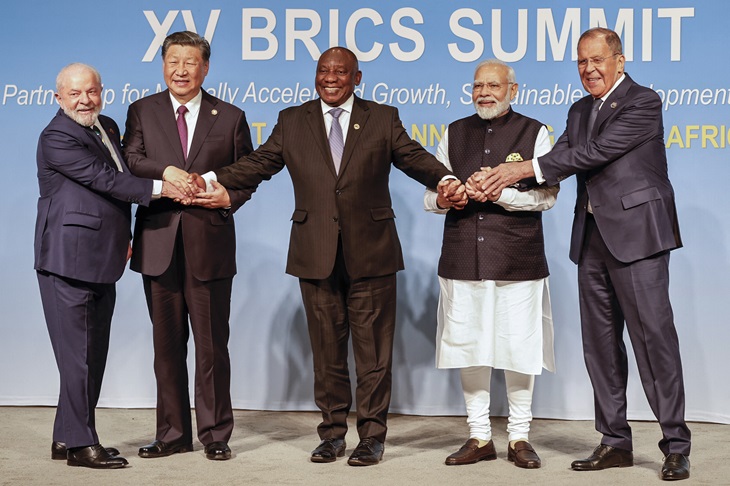
Despite joining the Quad alliance in 2022, (Australia, Japan, India, and the US), India continues to tread a difficult, non-aligned path. Its military and economic posture is limited by its reliance on imported Russian oil and arms supplies. It is also, along with Russia, economically entwined with the Brics (Brazil, Russia, China, and India). This economic group, originally founded by four countries in 2006, was joined by South Africa in 2009. Its latest gathering in 2024, now includes Iran, Egypt, the UAE, Ethiopia, and Saudi Arabia, a strange collection of ‘bedfellows’.
This is an unlikely economic powerhouse, with South Africa almost bankrupt from corruption and over 30 per cent unemployment, Brazil is a failed economy, Ethiopia is similarly in financial strife with its never-ending civil war, and Egypt is on the brink of economic collapse. Previously wealthy, but now bankrupt Argentina, seemingly had the right economic criteria to join, but has withdrawn. Russia is an international pariah and its next-door neighbour China is India’s biggest threat.
Headquartered in Beijing, China has plans to establish an alternative to the G7 group with its own trading block, and the New Development Bank, as an alternative to the US-dominated World Bank. Goldman Sachs economists predict this grouping could dominate the world’s economy by 2050, but economists are not renowned for their accurate predictions. Certainly, it contains some dud economies. It also brings more rivalries into contact with Egypt/Ethiopia, and Saudi/Iran, in addition to the potential China/India confrontations. Nevertheless, these nations could encompass 45 per cent of the world’s population and 30 per cent of the world’s economy (China making 20 per cent). Others contemplating the move include Indonesia, Thailand, and Vietnam with the hope of financial loans being a major incentive.
India is an ancient country. It was an advanced civilisation in its early history, credited with inventing mathematics around 3,000 BC until it succumbed to repeated invasions, initially from the East but in more recent centuries from the West. Perhaps, its time has come again. Like many other nations, it feels the threat of China next door and has already fought limited border wars. To the West, it has other potential threats such as terrorism from Afghanistan and the ever-present and more significant danger from its nuclear-armed neighbour, Pakistan.
At self-government in 1947, the previous Empire-enforced religious tolerance faded and India was partitioned, as demanded by the two rival religions. This resulted in a mass migration of 12 million people to and from predominantly Muslim East Pakistan (later Bangladesh) and West Pakistan. There are still around 200 million Muslims in both India and Pakistan with 160 million in Bangladesh. The religious rivalry persists with regular military confrontations. India’s massive population, now over 1.4 billion, has taken over from China as the world’s biggest, with a staunchly nationalist Hindu government.
The British bequeathed a country with a rail and road system, established health and education facilities, and an organised bureaucracy using English as the uniting language, (there are 37 major languages). With hindsight, it is remarkable that a country of hundreds of millions could be administered by as few as 100,000 British. 52 per cent of the country was under direct control, the rest indirectly via the local rulers. Since self-government, India’s economic progress has been slower than China’s, with corruption, religious disputes, and the caste system perhaps being limiting factors.
Like us, India has a healthy democratic system with multiple political parties – eight national parties, 54 state parties, and hundreds of minor parties. Some are religion based, some nationalist or socialist, there are also communist parties. Corruption remains a perpetual problem, with money siphoned from welfare schemes and blatant cash-for-votes bribery. The country is ranked 80 out of 150 in the worldwide corruption index. By comparison, Australia came in at 13 in 2020, with a corruption score of 75 (maximum 100) falling from a previous high of 85, the current world top score being 90 for Denmark.
Indian defence spending, because of its belligerent neighbours, has of necessity been high. In times of conflict it reaches over 4 per cent of GDP, diverting resources from infrastructure development. The country has a military of around 1.5 million, with a reserve of around 5 million. It has the third largest defence budget in the world, behind the US and China, which still only a quarter of China’s. It is the world’s second largest arms importer behind Saudi and has, belatedly, pushed its own private industry to diversify its weapons production. It hopes to have entirely home-grown production by 2025. Currently, arms still come primarily from Russia, although dependence has fallen from 85 per cent to 55 per cent in recent times.
Another important factor in its sluggish economy has been insufficient power generation, with slow electrification. Despite eight nuclear power plants and some hydro, electricity is still predominantly fossil fuel-based, with 65 per cent coming from coal. Cheap oil and coal imports from Russia have surged five-fold since the Ukraine War and are now the country’s biggest energy source. This has undermined the effect of Western sanctions. As fossil fuel requirement increases, (with increasing demand for coal and gas from Australia), its vast population will make it a world manufacturing power of the future.
India still has poverty but dramatic improvements have been made, with a decline from over 50 per cent in 1980, to now around 10 per cent. Life expectancy has improved from around 40 years in 1950, to 70. Child survival has improved, with better health care and immunisation programs. There is greater access to education and natural disasters are better managed. Greater access to education has led to new developments, the country has developed particular expertise in ship-building and technology.
Along with successful satellite launches, beginning in 1993, its first lunar probe was in 2008, an orbit of Mars took place in 2014. A recent moon landing has confirmed its capability, with human space flights planned for 2024. Of the over 2000 satellites in orbit, it has accounted for 422, for 34 different countries. Despite its technology successes, India surprisingly continues to receive aid from the West, $2.7 billion in 2022 – if that’s a developing country, what does it make Australia?
In the surge to become an international force it is belatedly developing its infrastructure, with investment of around $US2 trillion planned between 2019 and 2025. It has doubled its highway network in a decade and increased its electricity output by over 40 per cent in that period. Foreign investment has more than doubled, to around $US 50 billion in 2022.
As it advances, India is rapidly becoming a force to be reckoned with, a democratic force with problematic neighbours. We have a historical connection through the English language, justice system, and the Commonwealth while trade opportunities for food and minerals look good for Australia. Currently, China takes 32 per cent of our exports, Japan 16 per cent, South Korea 7 per cent, and India only 4 per cent. This means threats to our biggest export market remain.
As its economy expands – an over 8 per cent increase in 2021 – India is the world’s fastest growing economy, and is now surpassing UK and France, in fifth spot. Following China’s increasing belligerence, many manufacturing companies are moving production there. As well as an ally against a mutual enemy through the Quad agreement, India is our export future. The 2022 Australia/India Economic Cooperation and Free Trade Agreement (ECTA), should accelerate the process.
The Indian diaspora has spread throughout the world and reached the top in business, technology, and research. The recent British Prime Minister and Home Secretary were of Indian origin, as was the Scottish Prime Minister (although Muslim), the recent Irish Prime Minister, the US Vice President, and several Australian politicians. The same achievements apply in the private sphere, with numerous large companies in the US, UK, and Australia having Indian male and female CEOs. It is also surprising that in a sub-continent where women have historically had a lesser role, all four of the countries – India, Pakistan, Sri Lanka, and Bangladesh – have had a female Prime Ministers, with Sri Lanka being the world’s first.
Locally, the Australian/Indian population is increasing. Although making up only 3 per cent of the Australian population, this percentage is growing rapidly with immigration with the numbers more than doubled between 2011 and 2021. Recent statistics for the 20 years to 2020 reveal that India accounted for nearly 500,000 immigrants, more than the UK at 350,000, out of the total 3 million new arrivals. These are immigrants who can speak the language, work hard, and do not break the law. As these residents settle, we will also see their increased representation in politics and the media. This connection can only add to our economy, reinforce the importance of family, religion, and democracy. With the Quad in addition to Aukus, this will help deter aggression.
At present, India is caught in the short-term trap of dependence on Russia for arms supplies, cheap oil and coal, and China on trade. These connections have resulted in its abstention in any UN votes on Ukraine. As part of the Brics economic group, it may also have difficulty in fulfilling its full potential with the Quad alliance and our economy. Recent local issues and a focus on Aukus, with Japan perhaps joining, have reduced its priority. Despite these limitations, the future for India and the Australian/Indian economic connection has good prospects.