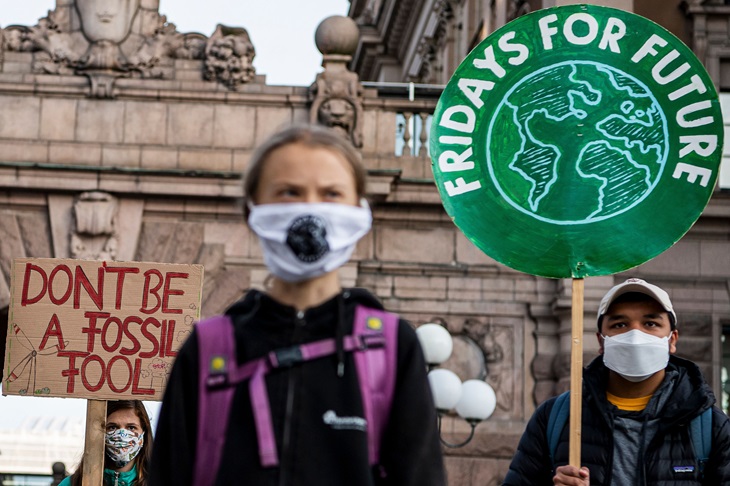
The Climate Emergency movement is an illustration of the ‘power of a narrative’.
The mass of people caught up in the belief that there is a climate emergency are not driven by any clear understanding of the complexities, much less the uncertainties, of climate science. They are driven by a basic narrative that goes something like this:
Human emissions of carbon dioxide (CO2) – mostly caused by burning fossil fuel – are a pollutant that is overheating the Earth and causing a climate emergency.
As a movement, it has gained success because its proponents take every opportunity to repeat this simple narrative and remind the public of the urgent need to reduce their carbon emissions.
Some highly credentialed scientists express the view that this narrative embodies the greatest scientific delusion in human history. If the central thesis of this narrative is a Goebel-size Big Lie, it has become widely believed on account of endless repetition.
One fact is certain: if a government is needed to control carbon emissions, it will have to be a centralised regime that controls almost every aspect of human existence – what we can eat, what we can drive, how much we can travel, and in the end, and what we can think or say on social platforms.
The only way to effectively counter this narrative is to propose a better one. A mass of scientific data and arguments will not change the public perception that CO2 is a dangerous pollutant. What is required in this battle for the collective mind is a clear and convincing positive narrative about the benefits of having more CO2 rather than less.
This counter-narrative is suggested by photosynthesis. Plants draw in CO2 from the atmosphere and breathe out the oxygen. In this process requiring sunlight, plants use CO2 as food to grow and flourish. In this way, plants use CO2 to green the Earth and provide food for all creatures, great and small.
Before CO2 was demonised as a pollutant, these scientific truths about photosynthesis were taught to children at school.
The process of photosynthesis suggests a counter-narrative along these lines:
CO2 is the food plants use to green the Earth and give us food to eat as well as oxygen to breathe. More CO2 means a greener Earth and more food for humans as well as beasts. CO2 is therefore vital for the health and well-being of the Earth.
Such a narrative was the substance of the 1998 Oregon Petition drawn up by the Oregon Institute of Science and Medicine and signed by 32,000 scientists to protest the 1997 Kyoto Protocol.
Unfortunately, the Oregon Petition was never seriously considered and instead buried by an avalanche of ad hominem attacks, misinformation, de-platforming, and threats to the reputation and academic careers of anyone who dared support it.
Not to be silenced, Freeman Dyson (1923 – 2020) was a Princeton physicist who never ceased to champion the narrative that more CO2 would far outweigh any possible harmful effects. Being a scientist of legendary stature, Dyson was impossible to silence. He lived to see a group of highly credentialled scientists form the CO2 Coalition to challenge the narrative which demonises CO2 as a dangerous pollutant.
As its name indicates, the CO2 Coalition publishes papers and articles to defend CO2 as a natural, non-toxic gas that is highly beneficial. Among other things, the CO2 Coalition has delved into the geological record of the Earth to show that in past ages, such as the Cambrian and Jurassic periods, atmospheric CO2 levels were many times higher than they are today, yet life proliferated and flourished.
Rather than the present CO2 levels being too high, the geological record indicates that CO2 levels are now at levels where plants are impoverished. This is being proven by horticulturists who raise the CO2 levels in their indoor greenhouses 2.5 times and raise plant productivity by 40 per cent. The CO2 Coalition reports on hundreds of other experiments that prove that raising CO2 levels raises the growth and productivity of plants. More CO2 also means that plants can survive with less water and endure harsher conditions. These are enormous environmental advantages.
The CO2 Coalition keeps its narrative about the benefits of more CO2 out front and central even when it reviews complex scientific data. Gregory Wrightstone’s book, Inconvenient Facts, deserves its ranking as an Amazon top seller in the climate debate. In all the detail of his 145-page book, this author succeeds in keeping the basic facts understandable and the narrative about the benefits of more CO2 central.
This good news narrative about the benefits of CO2 means that there is no need to reduce our standard of living, turn off our air conditioners, cease travelling by plane, stop eating meat, or putting up with a government controlling almost every aspect of our existence under the pretext of controlling carbon.
There has never been a time on Earth when so many people have lived longer, been better fed, housed, educated, entertained, or enjoyed the bounties of Earth as much as now. Are we ready to trade all this in for massive government meddling to reduce our CO2 emissions that don’t need reducing? If CO2 levels were reduced to pre-industrial levels of 280 ppm, that would decrease world food production by around 15 per cent – enough to starve a billion people.
As the great optimist Julian Simon put it when the dark clouds of climate alarmism were beginning to gather some 40 years ago:
‘We – humanity – should be throwing ourselves the party to outdo all the parties, a combination graduation-wedding-birthday-all rites-of passage party, to mark our emergence from a death-dominated world of raw-material scarcity. Sing, dance, be merry – and work. But instead, we see gloomy faces. They are spoilsports, and they have bad effects. The spoilsports accuse our generations of having a party – at the expense of generations to come. But it is those who use the government to their own advantage who are having a party at the expense of others – the bureaucrats, the grants-grabbers, the subsidy-looters. Don’t let them spoil our merry day.’ – The Ultimate Resource.
There are those who reject any climate emergency, but, unfortunately, they are not yet ready to embrace the liberating narrative about the benefits of more CO2. They still think that present CO2 levels are a problem that needs to be addressed, but in ways that will neither damage our standard of living nor hurt the environment. This finds them stuck between a rock and a hard place. They still have one foot firmly stuck in the camp which demonises the gas of life which enables plants to feed the world and green the Earth.
To say with the CO2 Coalition, ‘We need more CO2 rather than less…’ is a step too far them. This leaves them without a winning narrative.
It’s the narrative, Stupid!
Robert Brinsmead is an Australian horticulturist and freelance writer.