All the different aspects of a culture collide and interconnect. Melbourne is the undisputed capital of Australian rules football (which is the most cherished and energised of this country’s football codes) and it is also the home of the Australian Ballet. Last Saturday we saw the preliminary festivities of the AFL Grand Final kicked off by Delta Goodrem and Robbie Williams and when Geelong achieved their crushing victory over the Sydney Swans it was the old-timer Isaac Smith who at 31 came away with the Norm Smith medal for best on the ground. On the Friday, the night before, there was the opening of the Australian Ballet’s Instruments of Dance show and the ghosts of the Australian Ballet from Peggy van Praagh through Helpmann must have looked down on proceedings as surely as Bob Davis and the great Polly Farmer were barracking for the Cats from some heavenly vista.
The director of the Australian Ballet David Hallberg is very intent on showing whatever is bubbling in the world of dance, whatever variations are taking shape as that homage to the Nederlands Dance Theatre showed a couple of months ago. Hallberg is a Lord of the Dance before he is a ballet master and you constantly feel with him that he does not want the Australian Ballet to be in thrall to the artificialities of an outmoded form which can only be expressive in terms of conventions that are a hundred years old and only have a pretence to dance drama once arcane codes are mastered.
Obsidian Tear by Wayne McGregory transpires in a virtual wasteland full of portent and sinister suggestion with a wall of men creating a sense of claustrophobia which only the most bravura intervention can have any impact on. In the midst of this world of negativity, of a universe weighed down, there is Adam Bull’s extraordinary star turn with all the leaping and charisma and circular motion in the world. It is as if only the spirit of virtuosic classical ballet in its most breathtakingly spectacular form can possibly mitigate or transfigure a site where the dancers can only shuffle, can barely walk, let alone dance. It’s as if the spectre of the great dancer is the only hope and Adam Bull incarnates that hope and brings alive the memory that the Australian Ballet is a company with which Rudolf Nureyev once danced Hamlet.
It is therefore a relief after Obsidian Tear with a strong suggestion of a crawl towards death which only an archangel of ballet can relieve by a principle of annunciation. To turn to Everywhere We Go: it is animate with Justin Peck’s vast and ribald sense of the erotics of pure fun. This is laid back and sexually purring ballet with a brilliant engaging score by Sufjan Stevens where the lushness of the jazz is constantly being inflected with a curvaceous and sexually inviting chorus of sailor-suited girls who seem to be anticipating with their every thrusting movement the joys of a sex which has reduced the world (or expanded it) into a carnival of foreplay. The men are lords of the bodies they saunter with and the female sisterhood are their elated complement. The principal Benedicte Bernet is a pretty radiant prince of erotic grandeur for whom the ballet seems simply the metaphor for an act of love that has to have a command of the right moves and techniques.
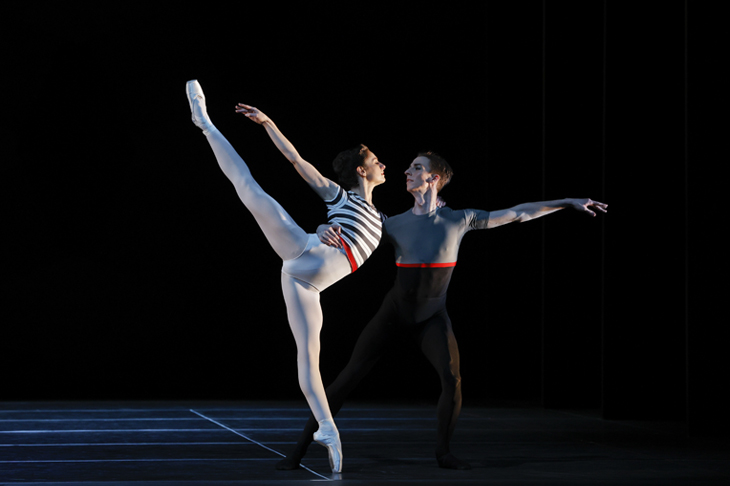
Despite this Instruments of Dance is not simply an alternation of deathly footshuffles followed by thrusting bottoms. Annealing choreographed by Alice Topp is a quizzical and not unsceptical examination of the traditional mythology of man and woman which the ballet may be construed as having encouraged and been sustained by. Topp is the resident choreographer and it’s as if she has taken the traditional bias of the ballet – this is, after all, the high performing art which stacks of women young and old go to with their girlfriends – as the ground from which traditional notions of sexuality and stereotype can be scrutinised.
The upshot is at once dynamic and hopeful. What is generically the whole shebang of the corps de ballet turns into a polymorphic frenzy of powers and dominions with limbs going everywhere in light and in shade as if the energies that feed our distinctions about male and female, human and superhuman, are all up for grabs and the spirit of the dance with its vast complexity of whirling shapes can still yield something that is deeply touching and erotically tender.
Certainly when Callum Linnane and Dimitry Azoury do their great number we feel light-years from the more artificial conventions of the pas de deux. We feel in the midst of an insistent erotic exchange that is all the more moving because it is deeply felt.
You could not be more aware with Hallberg’s Instruments of Dance how much the artistic director wants to rescue the ballet from its fealty to old-fashioned forms. There is, needless to say, a risk in his horror of allowing ballet to be a mausoleum of culture that the Australian Ballet will throw the baby out with the bathwater but Instruments of Dance does show at every point a strong awareness of how tradition and experimentation can feed into one another.
Then there was the Grand Final back where it belongs at the MCG with a roaring crowd of 100,000. It was a triumph for Geelong coach Chris Scott and for the captain Joel Selwood who took the Premiership Cup into the stands. He also gave his boots to the Auskick boy who had given him his medallion. There was an uncanniness, a weird sense of genuine heroism about the whole thing.
Of course Aussie rules is just a game. But was that great West Indian cricket writer C.L.R. James right when he said no game, not even cricket with its Bradmans, could equal a great actor in a great role? There was too much luck, too much randomness. Perhaps he was but you have to wonder. The Australian Ballet represents a very artful use of the body but then there’s the high and mighty poetry, the supreme glory of great football.
You don’t have to choose.
Got something to add? Join the discussion and comment below.
You might disagree with half of it, but you’ll enjoy reading all of it. Try your first month for free, then just $2 a week for the remainder of your first year.