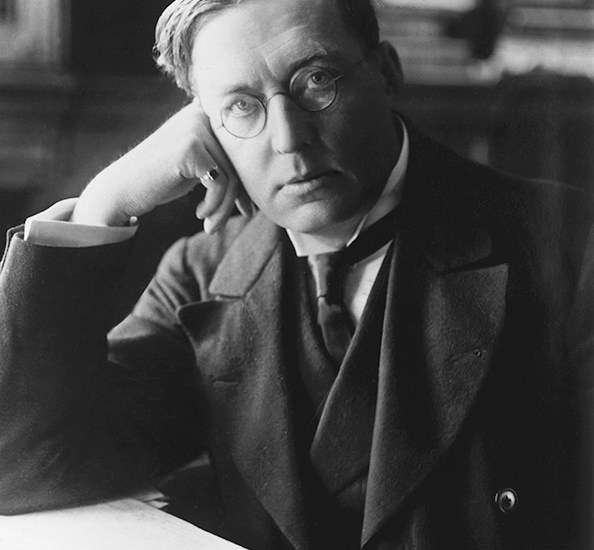
At the start of his Ghost Stories of an Antiquary (1905), M.R. James tells us that five of the stories ‘were read to friends at Christmas time at King’s College, Cambridge’. Darryl Jones’s biography of James describes how it went:
On Christmas Eve, MRJ and his friends would gather in the Chapel – always full and always dark – for the service, ‘a gravely cheerful’ occasion… After the Chapel and the dinner, the party would retire to the Combination Room for drinks and cards, and from there over to MRJ’s rooms, talking, laughing and smoking, drinking port or whisky and soda… MRJ would generally disappear into the bedroom to finish his story, ‘composed at fever heat’ and it was usually after 11 by the time he emerged, the ink still wet on the sheets of paper covered in his spidery, impossible handwriting. He would blow out all the candles but one, and begin to read (to perform) his latest ghost story, his clear, confident voice cutting through the dark and the December chill. After the story, a silence would fall on the party.
Given that the tales included such blood-curdlers as ‘Oh Whistle and I’ll Come to You My Lad’, no wonder there was silence. James was the great ghost story writer of Edwardian England and, ‘with his vast store of arcane knowledge and his natural gifts as an actor’, he was also one of the great ghost story tellers.
He had an unerring instinct for the elements necessary for a ghost story. One was what he called reticence. We never see clearly the full horror of the thing that creeps up on the unwary or the foolhardy – a shadow that scuttles sideways, a dancing shape that comes ever closer on the seashore, figures seen at a distance approaching the unsuspecting schoolboy who trespasses on the gallows hill.
This book is an account of a man who was wholly of his time and place and wholly of a piece. He was antiquary, don, Provost of the twin foundations of Eton and King’s College, Cambridge and, in Jones’s opinion, almost certainly a well-suppressed homosexual. Those Christmas Eve gatherings were male, and there was generally a certain amount of enjoyable horseplay among the friends. He had no lovers, but there was at least one man he loved.
James was, thinks Jones, a man almost entirely without an inner life (though it may be that he just didn’t express it). Perhaps that inner life found its way into the stories, disturbingly in the case of the later ones with their threatening depictions of hair and nails. His world, says Jones, was ‘one of forces that needed to be kept at bay’. James was profoundly conservative, unabashedly misogynist and robustly against reform in all its threatening manifestations, chiefly the possibility of women becoming members of the university, a threat he did his best to see off. He was also cheerfully anti-intellectual. When talk in his rooms turned to dangerous abstractions, he would cry: ‘No thinking, gentlemen, please!’
His father was a clergyman and his family, a generation back, were slave-owners. (Two ladies who stayed in the family home had horrific dreams about ‘happenings pertaining to the slave trade’.) James himself was subject to vivid childhood nightmares – ‘processions or dances of hideous larvae’. He was preternaturally bookish. At his first children’s party he burst into tears, but was easily comforted by being taken to the library and left there. When he was six, suffering from bronchitis, he asked to see a particular 17th-century Dutch bible and sat up in bed, happily poring over it. By 12, he was an accomplished codicologist with pronounced antiquarian interests.
But swot as he was, he survived the horrors of his prep school, Temple Grove, where sadism and starvation were the norm – Jones describes with relish the torments of Victorian schooling – before progressing to Eton and King’s. He flourished as a brilliant classicist and eventually as a don.
That closed and enchanted world was his natural habitat. He was also director of the Fitzwilliam Museum but never really enjoyed responsibility other than, at the end of his career, as Provost of Eton. He was above all a medievalist, as can be seen in his manuscript catalogues. Some of the demons in those manuscripts found their way into the stories. So, too, did places he visited on the astonishingly long bicycle trips he undertook with friends. All these influences are painstakingly recorded by Jones.
For the Dead Remember is not the first biography of James – Richard Pfaff’s life was excellent too – but it is the most comprehensive, and unlikely to be displaced. Yet for all its thoroughness, it’s hard not to feel that the man has eluded his biographer. Fitting, really.
Got something to add? Join the discussion and comment below.
You might disagree with half of it, but you’ll enjoy reading all of it. Try your first month for free, then just $2 a week for the remainder of your first year.