No belief binds the nation’s pub bores together more strongly than the idea that we need to do away with ‘career politicians’ and replace them all with businessmen. This banausic bleat seems to be the animating spirit behind some recent posts which have gone viral on X comparing the private and public sector experiences of the Cabinet and Shadow Cabinet.
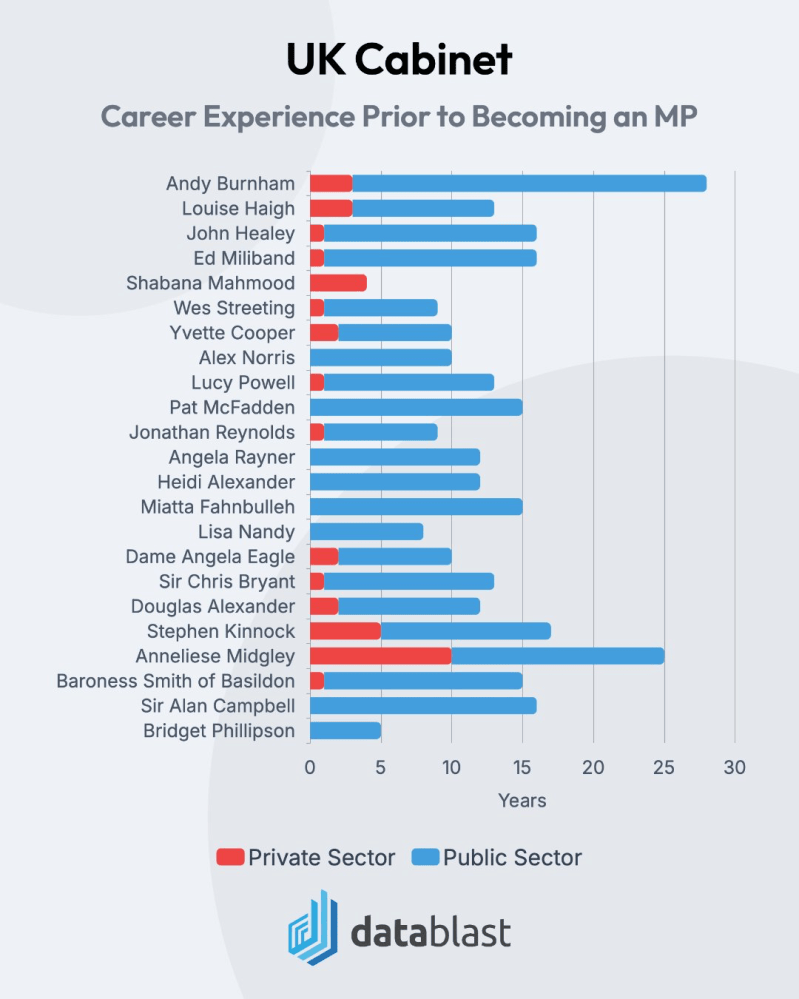
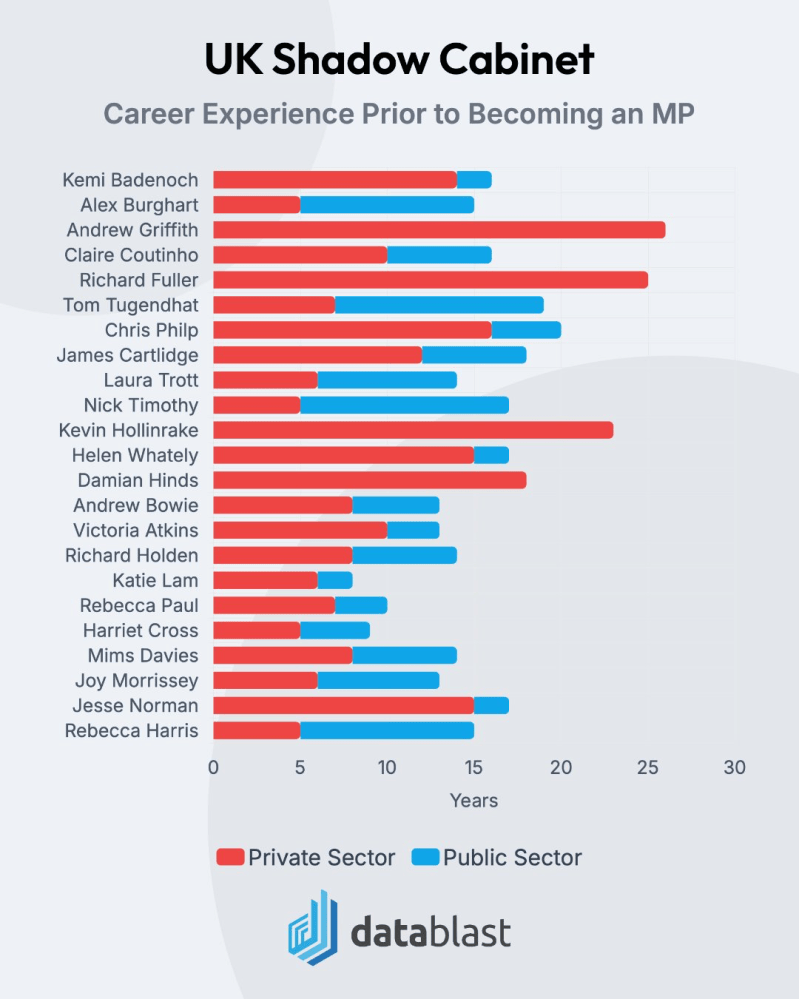
Underneath his tweet the CEO of Datablast, Sebastian David Lees, said he ‘would love a law that says 10 years private sector experience before eligible to run as an MP. You can be a cleaner for all I care, as long as it’s not public sector’ and ran a poll asking if MPs without ten years in the ‘real world’ or the private sector should be banned from running. Some 71 per cent of those who voted agreed with him.
First let’s address the inconsistencies in the graph as presented. Andy Burnham is listed as having 25-plus years of experience across the public and private sectors before becoming an MP, which he impressively managed to fit into the ten years which elapsed between graduating from Cambridge in 1991 and being elected to represent Leigh in 2001. The chart also defines working in a charity as ‘public sector’. For example the chart states that Miatta Fahnbulleh has no experience working in the private sector before becoming an MP. But a quick browse of her Wikipedia will tell you that she spent six years as the Chief Executive of a think tank, the New Economics Foundation (NEF).
‘Andy Burnham is perhaps the best case in favour of the careerists.’
You may disagree with the NEF’s political outlook (which strikes left), you may disagree with the very idea of a think tank – but the NEF is not a public sector organisation. Think tanks, even charities like NEF, are not exclusively funded by the government and their directors have all the same concerns that private sector companies have, including compliance with tax and managing wage bills. Nandy, who worked in several charities after graduation, has similarly had her experience rendered as public sector only.
There are other strange inconsistencies in the totting up. Kemi Badenoch has been awarded almost fifteen years in the private sector. She graduated in 2003 and became a London Assembly member in 2015 (leaving her job at The Spectator the following year). She first stood to be an MP in the 2010 election, and so would have fallen foul of Sebastian’s ten year rule (unless her part-time working for McDonalds and New Look could have served in mitigation). In a similar vein the Shadow Chancellor Andrew Griffith has rightly been rewarded with over 25 years of experience in the private sector. Griffith did not enter Parliament until his late forties in 2019, his ‘about Andrew’ page warmly reminds readers that he had an unusual route into politics and wouldn’t consider himself a ‘career politician’. True enough, but not for want of trying – Andrew first stood for Parliament in 2001, less than a decade after he entered the world of work at PwC in 1992.
Datablast did not respond to our approach for comment, so let us move on to the substance of the argument it presents. Sebastian’s belief that our representatives do not have enough ‘real world’ experience is not just his own – politicians have called for more business people to stand as MPs for decades now. Margaret Thatcher tried to draft in ideas from the world of business to improve public sector delivery (such as New Public Management Theory in the 1980s) and even commissioned industry experts, like Sir Roy Griffiths, to do it. Reform has repeatedly floated the idea of bringing in figures from business to staff their Cabinet by way of peerages in the House of Lords, instead of drawing on their prospective talent pool in the House of Commons. Rupert Lowe of Restore frequently boasts that he is not a career politician. For quite some time the Conservative Party selection process has strongly favoured people with business backgrounds (hence the smorgasbord of regional wheeler dealers with expansive Company House records who now populate the Tory backbenches).
Leave aside that the neat division of public sector and private sector would imply teachers, doctors and nurses do not have ‘real world’ experience – the historical record of businessmen trying to enter politics in the belief that they will do it much better than ‘careerists’ is mostly one of failure.
John Davies spent years in the oil industry then left the CBI to join the Conservative Party and serve in Ted Heath’s government in industry-related roles. His time in office saw the unions further wreck the British economy and he was eventually relegated to the backbenches in opposition by Thatcher. In 1970, Enoch Powell compared Davies to Caligula’s horse in the pages of The Spectator, while criticising Heath for putting a businessman straight into Cabinet:
‘What is peculiar and almost unique about government in Britain is that it is truly parliamentary: not in the literal and untenable sense that Parliament governs, but in the sense that men come to govern by way of Parliament, by way of the political arts which bring them to Parliament and keep them there, and by way of the parliamentary arts which enable them to survive in that assembly and, in one style or another, to predominate in it. These are arts which are not communicable. Like other arts, a man may have more or less endowment to learn them, and the survival of the fittest will tend to winnow out those who have less; but learnt they must be, and time and the hard school of experience are the only tutors.’
Archie Norman of Asda only managed eight years in Parliament before scuttling back to the boardroom. Much was also made of Nadhim Zahawi’s business background as founder of YouGov, which came with tax compliance baggage that would eventually drag him out of Cabinet. Ernest Marples was brought in from a construction firm with heavy interests in the building of motorways, to be transport minister, where he would (funnily enough) enthusiastically pursue the Beeching cuts, later fleeing to Monaco.
Take the three transformative Prime Ministers of the 20th century – Churchill, Thatcher and Blair. Churchill, a political nepo-baby (his father had been Chancellor) believed it was his destiny to be Prime Minister as a child, and only briefly pursued a career in the army such that he would enjoy record of bravery before entering public life (much of it spent as a correspondent, creating the fortune which would let him enter politics). Margaret Roberts half-heartedly pursued a career in chemistry before meeting the successful businessman Denis Thatcher, who helped pay for her to train as a barrister, which she would qualify for but ultimately not pursue. Tony Blair tried his hand at music and standup comedy before a stint as a barrister. All three of them stood to become MPs in their 20s (Churchill at 25, Thatcher at 25 and Blair at 29). Would a ‘shelf-stacker with ten years of experience’, to borrow again from Sebastian, have done a better job of confronting Hitler than Churchill?
Compare these leaders, who defined their political eras, against recent leaders who had a longer time outside of politics. Rishi Sunak spent over a decade in financial services, Theresa May served a long stint in the Bank of England and Apacs. Liz Truss, a chartered accountant, spent years working for Shell. Apropos of their political convictions, what all of these politicians with longer careers in business shared was that they were just not very good at politics. Exceptions make it through. Heseltine managed, eventually, to bring down Thatcher. James Goldsmith furthered the Eurosceptic cause greatly with the Referendum Party, Donald Trump has managed to win two Presidential elections against Hilary Clinton and Kamala Harris – both lawyers turned politicians in the Democrat careerist style. But the pattern over all does not suggest that the skills of business transfers neatly over to success in politics.
Andy Burnham is perhaps the best case in favour of the careerists. Beginning in politics by working Tessa Jowell as a 24-year-old, he went on to work in and around Westminster as both special advisor and as an MP and Minister for decades. He replaced Keir Starmer who pursued a career in law into his fifties. People find it difficult to explain why Burnham is doing so much better than Keir – the policy direction has barely changed – he just seems to be better at the job. He’s somehow more relatable despite having the Oxbridge to Westminster background that Keir did not have.
The answer is quite simple. He’s better at politics because he spent decades honing his skills in it.