Whatever happens in the American mid-terms today, there are only two-and a-bit years remaining of Donald Trump as a politician. Will we miss him when he’s gone?
Millions of words have been written about Trump, but for all that verbiage, are we any closer to getting a grip on him? Whatever your personal feelings, you must in honesty agree that he is an exceptional person, in the sense of being exceptionally peculiar. While we are all individual like snowflakes, Trump is surely the oddest of all the oddballs. One of the mistakes made by his many detractors has been to try to categorise him as a familiar type – a dictator, a crook, a nutcase, a bully. But he is just too strange to fit into any recognisable category.
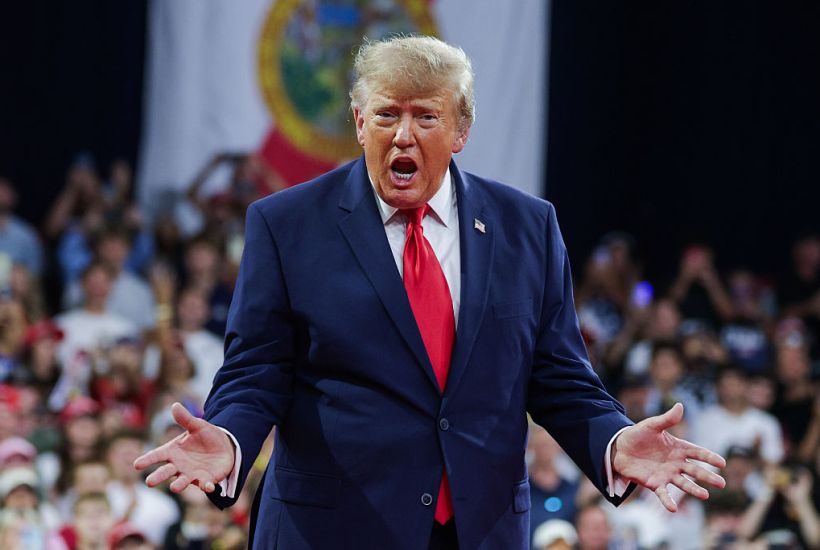
You just can’t put an easy label on the man – he is, by random turns, funny and frightening, reassuring and ridiculous
It has been fun to watch these attempts flounder. You just can’t put an easy label on the man – he is, by random turns, funny and frightening, reassuring and ridiculous. The fascination of Trump is that he is so flagrantly odd. Back in the day when he was just a loudmouth TV celeb, he seemed to be just another strange American thing that we Brits couldn’t quite
understand, like driving on the wrong side of the road, or taking Depeche Mode seriously. But his political career has been startling, and reduced his opponents to spluttering incoherence and delusion. He kept doing extraordinary and unprecedented things, not least returning stronger than ever after losing the 2020 election. Things like that are just not supposed to happen.
He is that very rarest of all things in a human being – unpredictable. Writing this right now, I feel qualms about making any kind of prediction about him and the mid-terms. I wouldn’t be surprised if our current assumptions look totally different in 24 hours. In fact, I suspect he is one of those figures that it will only be possible to fully comprehend decades after their exit.
Who can compete with Trump? Our own political ‘characters’ can’t hold a candle to him. The idea that Boris Johnson was ‘our Trump’ was a very shaky one – Boris was far too trivial and silly for that. He also frequently looked caught-out or guilty, things that Trump never, ever is. Similarly, Farage – for all his sunny demeanour – can’t help but transmit disappointment or disquiet when things go wrong for him. Even Mrs Thatcher could look flustered now and again.
A human being, like Trump, without the quality of shame – somebody who is unembarrassable – is very hard for other humans to deal with. The capacity for shame is one of the key traits that we use in all our social interactions; when somebody lacks it, they are much harder to deal with. The modern British politician who most resembles Trump in this regard is, perhaps surprisingly, Andy Burnham. Like Trump, he waffles and rambles speciously, and has a knack for making strange and contradictory pronouncements seemingly at random. Gaffes that would flatten a normal politician appear to just bounce off him after a day or two. Like Trump, he frequently appeals to a folksy myth of a lost land. And like Trump, this makes him disorienting.
Alastair Campbell is our only other candidate. If you or I had done half of what Campbell has done, we would hide in our bedrooms curled up in a foetal ball rocking ourselves back and forth and muttering incoherently. But Campbell is right out there on the front line, co-host of the country’s most popular podcast, and is now the author of a self-help guide – one of those books I suspect needs not a reviewer but an exorcist.
Shameless people often make a big play of their shamelessness, but with Campbell as with Trump, shame just doesn’t even seem to occur. It is simply not a colour on their palette. And it’s for that reason – for all the talk of a lame duck second half of this second Trump term – that I wouldn’t be surprised if something very surprising happens to confound us all.