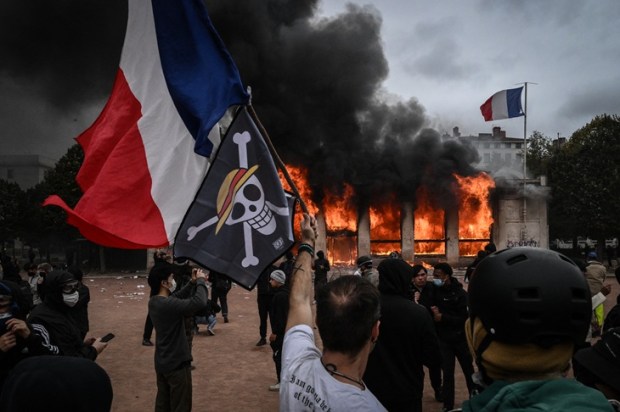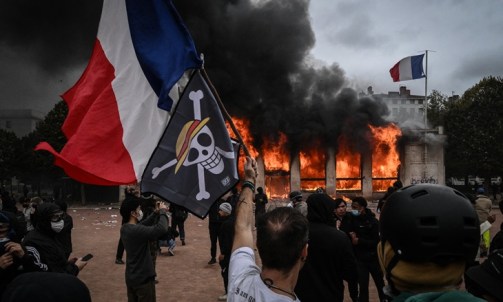
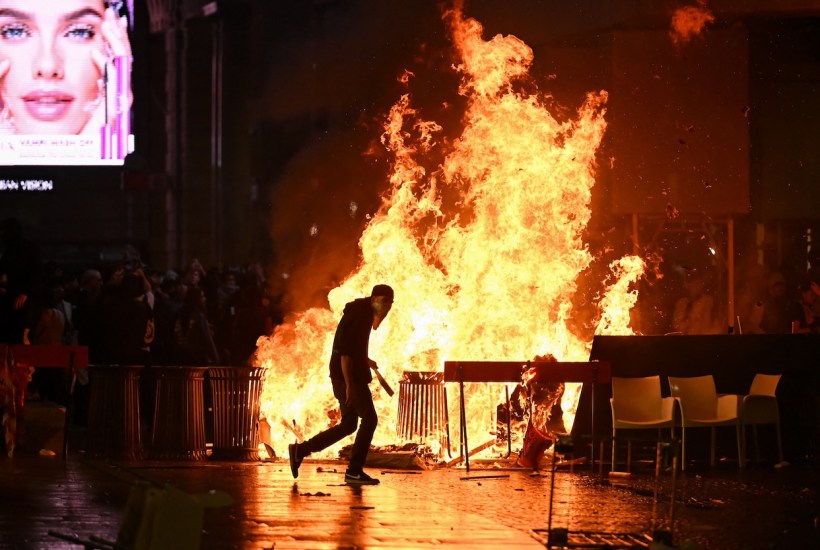
‘Facciamo come in Francia!’ shouted the masked and hooded rioters on Sunday in Milan and other major Italian cities, notably Turin and Bologna. ‘Let’s do like in France!’ By far the worst violence was in Milan around the Duomo where about 3,000 rioters fought running battles with police and sacked and looted countless high-end shops.
Most of the 200 rioters arrested in Milan on Sunday, plus the 70 odd on Saturday during similar though less destructive scenes, were Italian citizens who are the children of immigrants, according to media reports. They are known in Italian as ‘di seconda generazione’. Around 60 of those arrested were foreign nationals. Eighty per cent were teenagers under the age of 18, some as young as 12. Far-left white activists were a small minority.
Though on a far smaller scale than the riots in France where at the weekend there were 2,700 arrests and where a far higher proportion of the rioters appear to have been far-left white activists, the riots in Italy are deeply disturbing nonetheless.
They are a symptom of a sick society – a symptom evident to a lesser or greater degree across Europe – of a society seemingly incapable anymore of producing economic growth, or children, while government spending, especially on welfare, pensions and health, continues to grow and grow. This is a most depressing prospect for anyone young, of whatever colour, however industrious. For them there is it seems, or so they say, no future. It is also a depressing prospect for the rest of us.
I am not trying to justify the rioters, merely to describe the zeitgeist.
The rioters had apparently decided to descend on Milan and devastate the city centre after the call went out on social media platforms such as TikTok and Whatsapp. The dynamics of why so many should heed such a call to cause mayhem remain unknown. Once there, many communicated with each other in Arabic. Many shouted ‘Allah u Akbah’. Some brandished Palestinian flags. But there were no banners of any kind. There was no political party or movement involved. Their only creed, it seems, is the thrill they get from attacking the police, setting rubbish bins and cars on fire, and destroying and looting luxury goods shops.
One masked rioter, asked by a television reporter why he was there, replied: ‘Revolt!’ ‘Against what?’ asked the reporter. ‘The state, politics!’
‘Quite simply they hate the country that has welcomed them, the last thing they think about is integration […] they attack and assault shops that have nothing to do with basic necessities. They don’t look for food but designer shoes and clothes’, wrote Alessandro Sallusti, the editor of the Milan daily Libero on Monday when most high end shops in the centre such as Gucci, Chanel, Dior and Hermes remained closed with their shop fronts devoid of merchandise. Then:
They don’t protest against low wages because they’re not interested in work, they couldn’t care less about the problems in schools. Most of them have never even seen one. In other words they are common criminals and they are even proud of it.
In Milan we have seen what Italy might become if we do not change direction, above all what Italy might become if the left take control.
For the far-left white activists among the rioters, on the other hand, such riots serve a clear political purpose: the destabilisation of the capitalist state.
The violence overshadowed – as it does with relentless regularity wherever and whenever it occurs – the point of a demonstration in Milan on Saturday – as it did similar demos in other Italian cities – against the cost of living crisis caused above all by the huge rise in the price of petrol since the war in Iran began.
The demonstrators were young people marching as ‘students’, most of whom were not. Part and parcel of such protests has been the demand to stop spending money on arms. As one of their slogans proclaimed: ‘They have taken money from schools to spend on weapons.’ Needless to say the demonstrators were also fanatical supporters of the Palestinians and haters of the Israelis. They were angry but on the whole not violent.
In the deep south of Italy, meanwhile, lorry drivers and farmers continued road blocks begun last week in protest at the price of diesel which has reached €2,30 a litre (£1.93). As a result, many supermarket shelves in the regions of the south are half empty and petrol stations without petrol and diesel.
Elly Schlein, leader of the main opposition left-wing party – the post-communist Partito Democratico – said:
The Italians on the streets are the poorest and the most angry and they must be heard, not criminalised. It’s unacceptable if the violent ones are used to stifle the voices of thousands of people.
Top far-left TV talking head Professor Tomaso Montanari, the rector of the University for Foreigners in Sienna where the world’s rich go to live the Tuscan Experience, said:
The protests? They are la miglior gioventù [the best youth] in Europe. Thank goodness that there are these young boys and girls who are turning themselves into our teachers.
Many on the left, supposedly hostile to police repression, even blamed the Meloni government for the devastation, saying that it had not deployed enough police officers!
One left-wing Euro MP went so far as to blame the riots on sexual frustration caused by the failure of the Meloni government to provide proper sex education in schools!
As ever, the Italian left is big on criticism, but has precious few viable solutions.
On Tuesday, Italy’s right-wing prime minister, Giorgia Meloni, announced the deployment of 500 soldiers in the centre of Milan to help police deal with repeat performances which are expected as soon as Saturday if the chat on social media is to be believed. Her cabinet also issued a decree law with immediate effect which among other things creates a new crime of violent participation in a demonstration punishable by up to five years in prison and €20,000 (£16,790) fine payable in the case of minors by parents, extends the preventative detention in custody of those suspected of being about to commit a crime during a demonstration from adults to minors, and the banning of a demonstration deemed a threat to public order.
Announcing the new security measures, Meloni said on social media:
Let me be clear, there is no political idea, there is no social disadvantage, there is no political opposition to a government that can justify the devastation of a shop to take away its goods […] Devastating and stealing is not revolutionary, it’s criminal and the reaction of the state must be firm.
Just as in France commentators are saying that the riots there increase the probability that so-called ‘far-right’ Marine Le Pen will win the French presidential election in April 2027, the same is true in Italy about Meloni where a general election must be held by December 2027 but is thought will be called in April.
This past month, Meloni’s party – Fratelli d’Italia – has increased its lead in the polls by three percentage points. It had fallen to 26 per cent in September which was its share of the vote when it topped the ballot at the head of a right-wing coalition to win the 2022 general election after reaching a high of 31 per cent in the polls a year ago.
It is now polling just under 30 per cent, according to a poll published on Monday for the major left-wing Italian TV channel La 7, well ahead of all other parties.
It is almost unheard of for a party in power in a western democracy to increase support in the opinion polls which is what Fratelli d’Italia has done.
Meanwhile more demonstrations are planned, which include the call by the largest trade union, the CGIL, for a general strike on 20 November.
But let us remember May 1968 when France appeared to be on the verge of revolution. The demonstrations had begun with students in Nanterre complaining about their inability to sleep with each other at night on campus. But it swiftly morphed into a desire to destroy the capitalist state and the trade unions and the workers soon got involved as well.
The revolutionary tide seemed unstoppable and President Charles De Gaulle, hero of the Free French, disappeared from Paris for an unknown destination. In fact, he had gone to speak to the commander of the French troops stationed in Baden-Baden in West Germany to seek his allegiance.
‘You have the faces of spoilt brats’, Pasolini wrote
On the morning of 30 May a huge demonstration in the Champs Elysées celebrated his imminent fall chanting ‘Adieu, De Gaulle!’
But that afternoon De Gaulle broke his silence to speak on the radio and announce a snap parliamentary election. The short speech caused the anti-revolutionary silent majority to descend in even larger numbers than the insurrectional minority had done on the same Champs Elysées in support of the general.
The Gaullist UDR won 354 seats in the National Assembly, compared to 91 for the combined left and 42 for other centre-right candidates. De Gaulle and the Fifth Republic were saved.
Meanwhile in Italy where there was – as today – a watered-down version of the same insurrectional sentiment, film director and author Pier Paolo Pasolini published a poem in June 1968, subtitled ‘I Hate You, Dear Students’, that became a defining sentiment. Italy had the largest communist party in Europe outside the Soviet Bloc. Pasolini was a communist but had been expelled from the party in 1949 for being gay.
His poem takes as its focus the bloody battle between students and police in March 1968 in which the students stormed and occupied the architecture faculty at Rome’s Sapienza University which left hundreds of students and police officers injured.
Pasolini writes:
Today the journalists of all the world (the television ones included) lick (as they still say in boisterous slang) your asses. / Not me, dear ones / You have the faces of spoilt brats. / I hate you as I hate your fathers.
When yesterday in Valle Giulia you began your fight / with the police / I sympathised with the police / Because the police are the sons of the poor / They come from squalid, run-down places whether in the countryside or the city.
It is not so very different in Italy today – apart from the presence of Italians of the ‘seconda generazione’.