A man picked up by police on suspicion of robbing a petrol station is entitled to say nothing. Not a word. Police must caution him to that effect, and a jury is generally barred from holding his silence against him. It is one of the oldest protections in the common law and for good reason. The state should not be able to force a citizen to open his mouth and hand it the rope.
Now try the same thing at a polling booth.
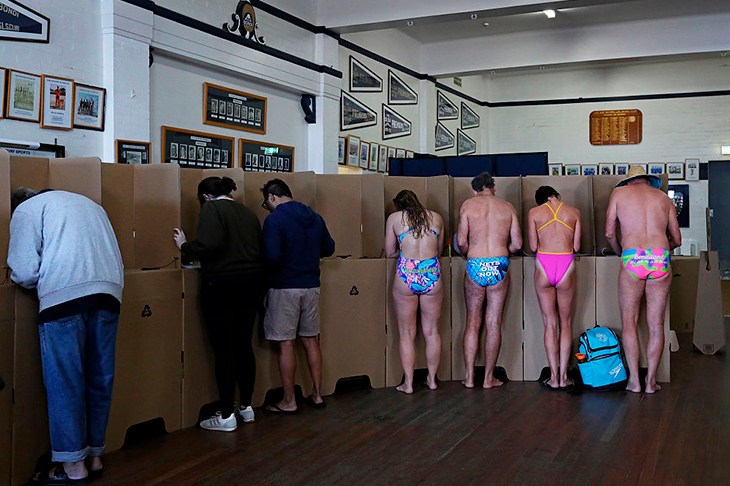
Every three years or so, the Commonwealth orders more than eighteen million enrolled Australians into school halls to pick up a ballot paper and say something. Not whatever they like but precisely what parliament tells them to say.
On the green House of Representatives paper, that means a number in every box, ranking every candidate from favourite to least favourite. Cranks, crooks and loons included. Stay home and a penalty notice follows. Leave boxes blank and the vote is, in most cases, thrown out as informal.
A suspected armed robber has the right to stay quiet. A law-abiding pensioner does not.
Australians tend to treat compulsory voting and compulsory preferences as dull administration, on a par with the democracy sausage. In truth, it is the government forcing citizens to make a political statement.
Defenders of the system have a standard reply. Compulsion, they say, drags politics to the centre. The evidence for this? Who needs evidence? The social science is apparently settled, never mind that plenty of countries with neither form of compulsion have elected centrist governments for generations.
Then there is the High Court. In 1992, the justices discovered something in the Constitution that nobody had noticed in the preceding ninety-one years. Somewhere between the lines lay an implied freedom of political communication. It was a curious find, given the framers had deliberately declined to give the country a bill of rights.
The High Court’s logic was that, because sections 7 and 24 of the Constitution require members of parliament to be ‘directly chosen by the people’, the people must be free to discuss politics, or the choice would be a sham.
Very well. But if political speech is protected because elections depend on it, then the most important political speech of all is the vote itself. And any freedom of speech worth having includes the freedom to not speak.
The Americans worked this out a long time ago. In 1943, the US Supreme Court ruled that schoolchildren could not be forced to salute the flag. In 1977, it held that New Hampshire could not punish a motorist for covering the state motto ‘Live Free or Die’ on his licence plate. Australia has no bill of rights, but if the High Court can find an implied a freedom to speak, then surely there must also be an implied freedom to stay silent.
Of the two electoral compulsions, compulsory preferencing is the more egregious, because the government is not merely making citizens speak but dictating what they can say.
Suppose a voter wants to back one candidate in a lower house seat and nobody else. Bad luck. The whole list must be ranked and if the chosen candidate is knocked out, the ballot is passed along as an endorsement of someone the voter cannot stand.
Consider, for example, a conservative voter who would rather saw off their hand with a butter knife than vote for the Greens or some other Trotskyist outfit but is told to preference one anyway. The law refuses to accept that some voters see no difference worth recording.
It is no mystery who benefits. A system that forces every ballot to run its full course favours the major parties, and Labor in particular, which reliably picks up the bulk of Greens preferences. Even Labor figures concede the federal compulsory preferential-voting system will help carry the party to a third term.
And as for consistency, the High Court mislaid it within four years.
In 1996, Albert Langer urged voters to number some boxes and then repeat the final number so that their preferences stopped before reaching candidates they loathed. Such ballots were counted under the savings provisions of the Electoral Act at the time. But urging people to cast them was itself an offence. Langer refused to stop, defied an injunction and was sentenced to ten weeks in prison. Amnesty International declared him a prisoner of conscience and the High Court upheld the law.
Four years after discovering a constitutional freedom of political communication, the High Court decided that freedom did not cover a man telling fellow citizens how to cast a vote the system would count.
Parliament repealed the offence in 1998 and closed the loophole so such ballots no longer count. Meanwhile, the reasoning of the High Court still stands.
Silence says something. If only more politicians appreciated it. For those voters who would prefer to decide whether and what they say at election time, the Australian system ensures nobody hears it.
Where voting is voluntary, a slump in turnout is a verdict. Exhausted preferences send the same message. Australia muffles both. Parties never learn that a large slice of the public wants none of them.
Compulsion also changes how campaigns are fought.
Only around two dozen countries make voting compulsory, and only a minority of those enforce it. In Australia, millions who have given the choice barely five minutes of thought are marched to the booth, and these are the people who often decide the result. So the parties chase them with scare campaigns and cash splashes. Lollies over vegetables. A voluntary electorate is harder to frighten and harder to buy. Parties must persuade rather than bribe.
But before anyone clutches their pearls, the sky does not fall without compulsion. New South Wales has used optional preferential voting at state elections since 1981, and the state is hardly governed by Attila the Hun. Britain, Canada, New Zealand and the United States all manage with voluntary voting.
Since the 2016 reforms, even Senate voters need only number a handful of boxes rather than every one. If partial preferences are good enough for the Senate, it is hard to argue the lower house needs the full numbered list.
The grand claim for compulsion is legitimacy. Every government, the argument goes, is chosen by the whole people. But a mandate extracted under threat of a fine is not consent. If political speech deserves protection because democracy depends on it, the High Court should protect the most basic choice of all. The choice to say nothing, to pick no one, or to pick one and stop there.
A democracy confident in itself would let people stay quiet and then listen to what the silence is saying.
Got something to add? Join the discussion and comment below.
You might disagree with half of it, but you’ll enjoy reading all of it. Try your first month for free, then just $2 a week for the remainder of your first year.