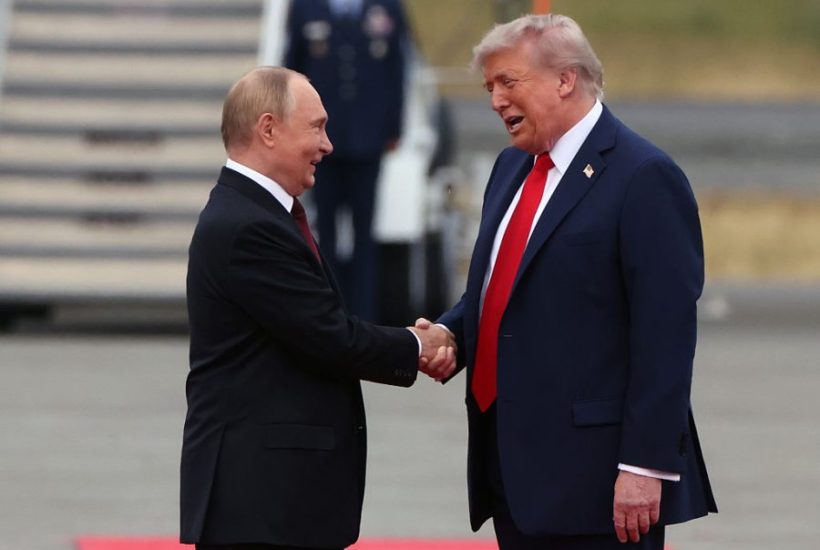
Donald Trump’s telephone call with Vladimir Putin last Friday was supposed to be about a suspected outbreak of plague in Russia, but it ended, as their conversations tend to, with a deal. Russia, the American president announced, would supply America with more than 300,000 tonnes of diesel immediately, 500,000 tonnes in November, a million tonnes ‘immediately thereafter’ and another three million ‘within a short period of time’. The Treasury obligingly issued a licence exempting Russian diesel from American sanctions until April.
In the same breath, Trump proclaimed another energy ceasefire between Moscow and Kyiv, the second in a month, and took another swipe at Volodymyr Zelensky, whom he would plainly like to see replaced at the ballot box. Russia marked the truce, a few hours later, by striking a power station in the Kharkiv region.
The diesel arithmetic is unflattering to everyone involved. The first tranche of 300,000 tonnes amounts to about 2.2 million barrels – or roughly half a day of American distillate consumption, which runs at around four million barrels a day. Even if all 4.8 million tonnes materialise – and Ukraine, which has been targeting Russian refineries for months, will have something to say about that – they would cover barely nine days of demand spread over six months.
The barrels Trump is ‘getting’ are barrels Russia would have sold anyway
True, diesel demand is notoriously inelastic, since lorries and combine harvesters cannot simply stay at home when the price displeases their owners, so even modest changes in supply can move the market. Nevertheless, volumes of this size will pass through it largely unnoticed.
Nor does America have any need for Russian diesel, being a net exporter of the stuff. What Trump wants is more diesel sloshing around the world market in the hope that pump prices ease before the midterms on 3 November. This is understandable as politics but rather less convincing as economics.
Trump insists that the world’s diesel shortage is mostly the fault of the war in Ukraine rather than his own war with Iran. Ukraine’s drones have certainly done real damage: Russia, which used to export some 600,000 barrels of diesel a day, now ships almost none. This is a loss roughly comparable to what has gone missing from the Gulf, where diesel exports through Hormuz fell from about 800,000 barrels a day before the war to 165,000 in July. But the order of events matters. By mid-July, when Moscow banned diesel exports, American diesel was already a third dearer than it had been before the first bombs fell on Iran. Kyiv’s drones landed on a market that Tehran had already squeezed dry.
Russia, moreover, did not stop exporting because it had run out of diesel. It has always produced far more than it consumes, with the surplus originally built to supply Europe. Its ban on producers’ exports was a precaution – taken after Ukrainian drones had knocked out refineries – against the prospect of queues at the pumps during the harvest. The government’s own decree candidly admits this. With the end of the harvest season, permission to export some diesel was expected to be granted, otherwise, storage would fill up and refineries would be forced to cut their runs.
The barrels Trump is ‘getting’ are therefore barrels Russia would have sold anyway, to Turkey, Brazil or West Africa, as its harvest demand fades and the Ukrainian strikes become less frequent. Redirecting these sales to America changes the address on the bill of lading rather than the amount of diesel in the world.
Moscow’s gains are correspondingly modest. The waiver should erase the discount on Russian diesel, which was not large to begin with, and cheapen freight and insurance as the risk of sanctions recedes, all of which is welcome news for the oil companies’ margins. The state, however, collects only a quarter of the extra profit in tax, and only a third of that reaches the federal budget. The rest goes to the regions. Over six months the Kremlin can expect tens of millions of dollars, or at best millions of dollars in the low hundreds, which for a budget that finances a war of this scale is small change.
The energy truce Trump claims to have brokered has even poorer prospects, because the Kremlin believes it is winning the infrastructure war. Ukraine’s strikes on refineries are denting Russian margins, prices and exports, whereas Russia’s strikes on the Ukrainian grid are threatening to leave Kharkiv and Kyiv barely habitable by January. Putin, therefore, is unlikely to give up his most effective winter weapon just as the frost arrives. The September ‘ceasefire’ lasted roughly a day before Russia hit petrol stations in Kyiv and Ukraine hit another refinery. This time Kyiv learnt of the truce from Trump’s post, while Moscow has maintained the kind of silence it reserves for agreements it has no intention of honouring.
What matters more than the barrels of diesel is the signal this agreement gives. If the American waiver was meant as a carrot to coax Putin towards serious negotiations over Ukraine, it is far too small to tempt a man who regards patience as a strategy. The more likely lesson he will draw is that Western unity can be bought for a few tankers of gasoil.
Kyiv, meanwhile, is left contemplating the stick. Washington may threaten to cut off intelligence, which provides vital early warning of ballistic missile launches, and to halt sales of American weapons bought by European governments for Ukraine. Ukraine could survive both, since Europe now supplies far more intelligence and hardware than it did when Trump last turned off the tap in March last year. Ukraine also builds more of its own arsenal, and refineries are fixed targets that do not require American satellites to find. It would nonetheless be painful, because without early warning, more Ukrainians will die under ballistic strikes.
The hope of a remedy has also faded: Kyiv wants Starlink coverage over Russian territory to hunt down mobile missile launchers, the best defence available when interceptors are scarce. Elon Musk’s enthusiastic backing of Trump’s call for new Ukrainian leadership, however, makes that vanishingly unlikely.
There is some consolation for Zelensky: few things unite Ukrainians as effectively as an American president demanding that they hold elections in the middle of a war. Bruised by corruption scandals, the Ukrainian leader may yet emerge stronger at home and more persuasive in European capitals.
The real damage lies elsewhere. Sanctions were designed to raise the cost of Putin’s war. Once they are waived to shave a few cents off the pump price before an election, they become a transactional instrument, available to whoever offers the most convenient deal. Every trader, insurer and buyer of Russian barrels has now learnt that American sanctions are negotiable, a lesson worth far more to the Kremlin than anything it will earn on diesel.