The Bee Gees were a popular trio of singers in the 1960s and 1970s, so named because their lives were filled with folk whose name included the letters ‘B’ and ‘G’, such as Barry Gibb and Bill Gates. They were the Brothers Gibb. The Vee Gees are lesser known, but these initials ‘V’ and ‘G’ have long been used by geologists to record their experiences with ‘visible gold’. Finding and recording ‘visible gold’ or ‘vg’ was always a pinnacle of geological exploration life, but generally a rare one, since gold is not a common element, like copper or lead or zinc. This relative rarity is reflected in both historic and current metal prices, where gold, symbol Au, is currently (2026) priced at US$133 million/tonne, compared with copper (Cu) priced at US$14,000/tonne.
These value comparisons only serve to show that gold is a desirable metal to own and pursue, whereas copper is less so by a considerable margin. It is why there is a historic mystique and desirability about this most sought-after of our native metals, and why the pursuit of gold is often accompanied by both the best and worst of human behaviour and corruption. Despite our relative value comparisons above, it must be noted that the traditional language of gold value and production has always been in ounces per ton or tonne, or in grams per tonne if we are discussing modern mineral exploration programmes and results.
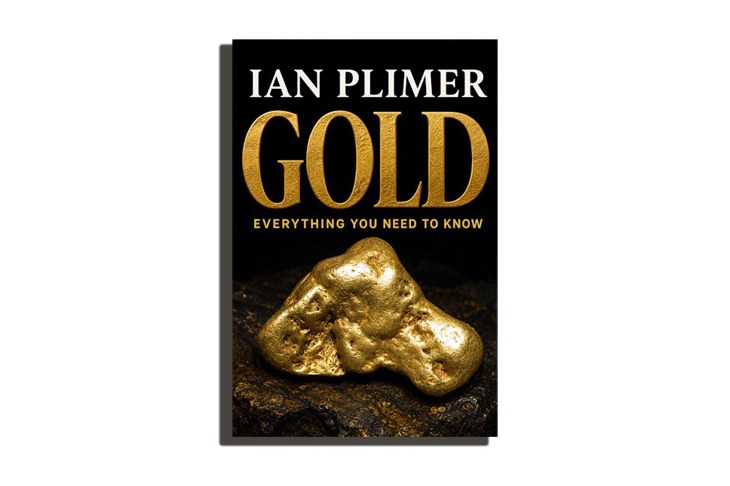
Professor Plimer’s new book, GOLD, sets out to inform both the lay and scientific reader about ‘everything you need to know’. It is in every respect a ‘page-turner’, written superbly in prose that gallops along for 287 pages, informing the reader with a stunning and extensive array of facts and observations broken down into six major chapters and an index.
In his introduction, Plimer familiarises the reader with basic concepts such as a ‘troy ounce’, now the standard unit of measurement when dealing with and trading gold – the name comes from the French town of Troyes, an ancient trading hub in the Champagne region of France. In subsequent chapters, we learn about the history of gold, including the legends or otherwise of King Solomon, the Persians and ancient Greeks and Romans, and the Egyptian empires of the Old, Middle and New Kingdoms dating from 2650 BC to 1070 BC, in which the tombs of the Pharaoh kings were blessed with a myriad of gold artefacts, many of which have now been plundered.
What the reader gets from Plimer is veracity, insofar as he himself has been there and done that – he has been many times to the precious metal mines of Georgia, Turkey and Greece, the latter including the Lavrion mines at Attica, where there has been mining since the late-Neolithic (around 3000 BC) through to the abandonment of the mines in about 100 BC. Colchis in Georgia is perhaps the oldest known gold mine in world history, dating back 6,000 years, and the Bolnisi mine is still operating today.
Plimer also explains gold deposits, taking the reader gently through the finer points of economic geology, which is a specialised branch of earth sciences dedicated to metal discovery used to create all of our civilisations. Gold can be recovered from both primary ‘hardrock’ sources (e.g. the massive open pits at the Cadia porphyry Cu deposits near Orange, NSW), and from alluvial sources, where gold is recycled and concentrated many times in streams because of its very high specific gravity (i.e. ‘weight’) of 19 (common quartz has a specific gravity of 2.65) and exceptional chemical durability.
Professor Plimer is always an engaging writer, but he raises the readability level to new heights by taking us through the magnificent journey of gold here in Australia.
We learn how early gold discoveries in the 1850s shaped the path of this nation, and how gold helped rescue the new colony from depression and famine. From Bathurst in New South Wales, we meet Edward Hargraves, described not as a hero but ‘cad, bounder and mountebank’. Soon after in 1850-1851 the fabulous alluvials of the ‘Golden Triangle’ near Bendigo and Ballarat began production from thousands of small miners in scenes of social chaos but enormous riches. Some of the largest nuggets ever found included the Welcome Stranger in 1869 – 72kg of solid gold about the size of a cocker spaniel. In 1854, the goldfields violently erupted in Victoria as disgruntled miners fought government policemen over onerous taxation at the famous Eureka Stockade.
With the degrading of the Victorian goldfields, vast numbers of prospectors migrated to the emerging goldfields of Western Australia in 1892-93, mainly around Coolgardie and Kalgoorlie. Paddy Hannan had found gold that ultimately led to the famous ‘Golden Mile’ around Kalgoorlie, where today sits one of the largest open pits in the world at the ‘Super Pit’, whose edges literally flank a few of the old houses in Kalgoorlie. Professor Plimer is happy to use the mantra ‘Go west, young man’, as Western Australia has emerged as a repository of world-class gold deposits and prospectivity.
Plimer also summarises the complexities of gold markets and the like. ‘Golden Gems’ is arguably the most fascinating story of all, exploring the human frailties induced by gold – the theft, the heists, the frauds, the bushrangers, the forensic tricks and of course, the salting of gold deposits by crooks and shysters.
One of my personal favourite stories (not in this book) is the one about the old prospector with a panning dish trying to sell his lease to a big city suit; he is smoking his old roll-your-own durrie (cigarette) as he pans away. He triumphantly rises and shows the suit some excellent colours in the pan. What the poor suit doesn’t know is that the prospector filled his cigarette with gold dust, and let the ash fall into his pan as he played out the scam.
What more can be said? Professor Plimer’s book is a wonderful page-turner, educational, exciting, creative and without a dull moment – add it to your bookshelves as soon as possible.
Got something to add? Join the discussion and comment below.
You might disagree with half of it, but you’ll enjoy reading all of it. Try your first month for free, then just $2 a week for the remainder of your first year.