In my line of work, I read a lot of self-serving twaddle. Arguably, most of what I read is self-serving twaddle, including the budget papers and the voluminous reports put out by government agencies.
But the extent of this deliberately slanted guff has been on full display recently as One Nation released a perfectly sensible proposal that superannuation policyholders might care to use some of their own money now rather than when they retire in several decades’ time.
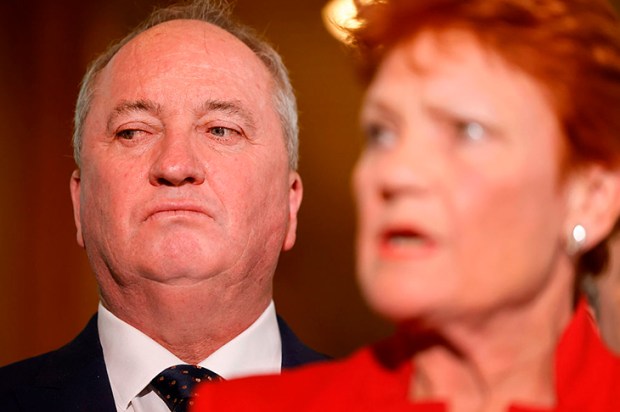
Barnaby’s idea is that, for a period of three years, policyholders who are renters or mortgage holders should be able to extract up to three percentage points of the superannuation contributions made on their behalf. (The principle is fine, but I personally wouldn’t do it that way. I would opt for withdrawal at the payroll point of the chain and allow all individuals access.)
Unsurprisingly, the superannuation funds went into meltdown. According to Super Members Council chief executive Misha Schubert, who represents some of the country’s largest funds, ‘turning super into an ATM is a reckless idea that would make battling Australians poorer’.
She then hit the airways sounding like an hysterical teenager. Didn’t we realise that those silly people withdrawing money now would have a lower lump sum when they retire? Didn’t we understand that all policyholders could be worse off because the funds would have to manage their liquidity and may have to alter their investment strategies? (Oh please, spare us the amateur analysis, Misha.)
But, hang on, it wasn’t that long ago that the superannuation contribution charge was 9 per cent – not the current 12 per cent – and the sky didn’t fall in at that point. And wasn’t it that koala-loving progressive economist, Ken Henry, and the good folk down at the Grattan Institute – they have never seen a new tax they don’t like – who forcibly argued that 9 per cent was the right figure? There was no justification for the hike to 12 per cent.
I had to laugh because at the same time there was a money column in the Sydney Morning Herald outlining the ‘retirement sweet spot’. It turns out that if you have too much retirement savings, you may end up going backwards.
The author compared a single person with around $340,000 in super assets with another with super assets of $670,000. Apparently, the one with the lower super balance does better in terms of annual income. ‘Once you get above the base assets test threshold, every additional $1000 dollars of assessable assets can reduce your Age Pension by $78 a year.’
The point here is that by forcing people to forgo high rates of current income through compulsory superannuation to provide for their retirement, the effect for many retirees is simply to knock off their full entitlement to the Age Pension and the various concessions attached to it. And let’s not forget here that one of the advantages of the Age Pension is that it deals with longevity risk in a way that a private pot of money doesn’t.
I suggest that Misha takes note. But her role in life is to ensure that the guaranteed flow of funds to the pampered super funds is not interrupted by rogue political parties making suggestions about early withdrawal. I doubt she gives a toss about the welfare of the members.
But when it comes to self-interested nonsense, it is possible that Mark Scott, the Vice-Chancellor of the University of Sydney, should be awarded the gold medal. Here’s what he said about the (false) claim that the Albanese government might clamp down on the number of international student visas.
‘All migration is not the same – international students attend the University of Sydney for a defined period, make a vital contribution across the economy and overwhelmingly return home. It is important to remember that Australian students are among the greatest beneficiaries; international student fees support teaching, infrastructure and research and help lift our global standing.’
Give me a break. This is a university that has close to half of its enrolments made up of international students. In some courses, the percentage is even higher. The local students don’t mix with the international students save for some forced group assignments where the locals do all the work and the international students get the same mark.
Sure, Chinese students are more likely to go home than students from other countries. But many of them hang around for a long time, some permanently.
The idea that, ‘Australian students are among the greatest beneficiaries’ is just piffle, stated to make a very weak case for continuing the excessive flow of international students. But what this flow does ensure is that senior university managers are paid outrageously high salaries – much higher than overseas – and that often pointless research is funded.
The fact is that there are now parts of Sydney and Melbourne around centrally located universities where you can feel as though you are in another country. This doesn’t worry Scott because he doesn’t have to deal with the issues; but he loves counting the money. Universities have effectively snaffled the gains from international student enrolments while imposing the external costs, including pressure on housing and other resources, on everyone else.
Postscript: I am now officially a Victim of Crime. The policeman conferred this title on me – I’m not keen on the victim bit – because my car registration plates were stolen. It may have happened outside our house, but it could also have happened at a Bunnings car park. (Don’t ask me why I was there, you don’t want to know.) I didn’t notice immediately.
Believe me, it’s a complete hassle dealing with these sorts of events. A call to the police unanswered, an online complaint lodged, a trip to the faraway Vic Roads customer service centre. I love that description, given that there was a pre-queue line of around 100 people followed by another wait after being issued with a ticket.
The politicians obviously failed to plan for the fact that Melbourne’s population is now around 5 million and has grown by nearly one-third this century.
I got my new plates – but no screws – and was charged $42. There was no concession for the fact that they were stolen. I was told to go to the nearest police station to have them attached. Amazingly, the police station was open, but the grumpy constable had no intention of helping and simply handed over a pamphlet about attaching the plates.
Another trip to Bunnings and Total Tools – I’m not making that up – and 24 hours later, I had my new plates attached to the car. Some further admin informing the insurance company and the toll road operator was also required.
Two pointless calls from the police, one where I was informed of my victimhood, and I now await being accused of providing the getaway car for some bank robbery or firebombing of a tobacco shop.
The joys of living in Victoria.
Got something to add? Join the discussion and comment below.
You might disagree with half of it, but you’ll enjoy reading all of it. Try your first month for free, then just $2 a week for the remainder of your first year.