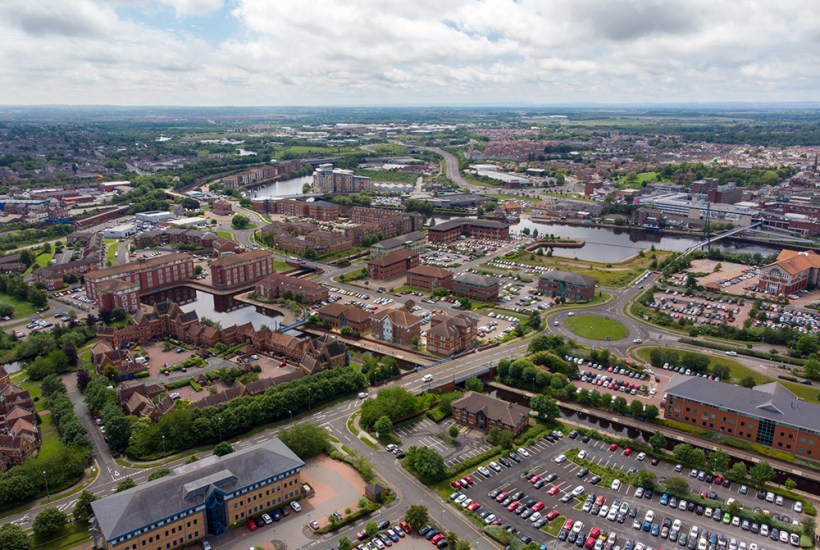
When I wrote here 30 years ago that ‘Middlesbrough, once renowned for building bridges for Sydney Harbour and the White Nile, is now better known as the north-east capital of motorised crime’, I earned a rebuke from the town’s evening paper under the headline ‘Slur in toffs’ magazine’. But I wasn’t wrong – there was an outbreak of ‘ram-raiding’ at the time – and it was Rod Liddle, writing about his teenage years there in the 1970s, who compared the place with Mogadishu. My point is that the current lawlessness in Middlesbrough is nothing new. It’s endemic, it goes back decades, and it gives rise to two potent questions.
The first is whether, as some commentators claim, the disorder can be blamed on the destruction of job prospects in Teesside’s traditional industries, in turn the fault of ‘Thatcherism’. Fifty years ago, the major local employers were steelworks (including those of the historic bridge-builder Dorman Long), shipyards and the chemical works of ICI. Only fragments remain, under different company names. Realism in the face of global trends has driven decline more forcibly than the distant legacy of Margaret Thatcher, who did her best to attract new foreign investment to the north-east – including, in 1986, the Nissan factory at Sunderland.
But let’s not debate whether the erosion of skilled work has been a greater catalyst for social breakdown than the rise of the drug trade and the disintegration of family structures. What’s plain is that no would-be investor, looking to find a site for an auto-parts plant or an e-commerce warehouse, is likely to choose Middlesbrough today. So here’s my second question: how can that be reversed?
The elected Labour mayor, Chris Cooke, thinks youth clubs might be the answer. But Andy Burnham can surely do better: make Middlesbrough a test case for the ‘place-based’ policymaking, public-private cooperation and turbo-devolution he claims to have perfected (even if on the shoulders of others) in Manchester. Send a minister to emulate Michael Heseltine’s Merseyside triumph after the Toxteth riots in 1981. Appoint an ‘enterprise tsar’, my top tip being the haulage tycoon, Middlesbrough FC owner and former Labour councillor Steve Gibson.
And remember that Liverpool, Glasgow, Derry and Bradford, among other troubled places, were nudged towards regeneration by sometimes tenuous cultural awards. Why not shamelessly fix it for shortlisted Middlesbrough to be UK City of Culture 2029?
School of Murdoch
I have nothing against Sir Mel Stride, who has been a steady middle-order batsman for the Tories through a decade of sticky wickets. But I never felt the need to salute him in his role as Kemi Badenoch’s first shadow chancellor and I have higher hopes for his successor, Andrew Griffith.
The youngest finance director in the FTSE 100 when he was promoted (at 37) to that role for BSkyB in 2008, he’s a product of the Rupert Murdoch school of calculated risk – having also been a player, alongside Murdoch’s son James, in Sky’s 2006 dawn raid to buy 18 per cent of ITV, which sent shock waves through the broadcasting sector.
Unlike Labour’s John Healey, Griffith speaks the language of tax-burdened business; he knows the City too, having started his career at Rothschild. But it’s (probably) still a long time to the next election: I hope he hasn’t peaked too early.
Trop de frites
As my summer idyll comes to an end, I leave beautiful France with a flatlining economy, a 21 per cent youth unemployment rate and a looming public debt crisis. The obvious remedies are much the same as for any western nation: fiscal rigour, welfare restraint, entrepreneurial spirit, less red tape.
But no such common sense can be expected from next year’s presidential frontrunners, Marine Le Pen on the populist right and Jean-Luc Mélenchon on the Marxist left. And the best I can add by way of parting advice is this: ease back on the chips. Not the microchips, that is: reports say France needs plenty more of those if it is to rival Germany, the Netherlands and even the UK in AI development and adoption. There are Paris-based challengers such as Chaps-Vision, hyped as Europe’s Palantir, and Mistral AI, now worth £10 billion. But they are minnows compared with the £500 billion Dutch champion ASML (which makes world-leading lithography machines for semiconductor manufacture) or any US giant.
No, I’m talking about the mound of chips that accompany everymagret,confit or bistrot burger; rarely a dauphinoise or recognisable vegetable. Carry on like that, mes amis, and you’ll soon catch up with that other Anglo-Saxon trend du jour: our obsession with weight-loss jabs. Reports on this one say French users of GLP-1 drugs still number in the tens of thousands, despite health-service subsidies, compared with upwards of two million in the UK.
Will Mounjaro sales soar as cost-hit French cuisine gets stodgier? Or will rising restaurant prices suppress appetites more naturally? There’s still value to be found if you search, but even a guinguette in the woods whose name I’ll omit took my party for €57 a head this summer. So here’s another piece of advice, perhaps even a universal metaphor: rapport qualité-prix wins repeat customers, not overpriced, supersized French fries.
Bad taste
Here’s a food oddity to end with: a reader sends a photo of the wrapper of a Snickers bar bought in Acton, west London, on which the language is Russian. The manufacturer is Mars, the US giant which maintains factories in Russia, supposedly for the domestic market only, despite a pledge to scale back after the invasion of Ukraine. Mars says it can’t control third-country resale of its products. Russia’s Tass news agency thinks they may be entering the UK via Turkish distributors; others say India or Pakistan. Safe to eat? One thing’s for sure, don’t touch any sweet treat branded ‘Novi-choc’.
Got something to add? Join the discussion and comment below.
You might disagree with half of it, but you’ll enjoy reading all of it. Try your first month for free, then just $2 a week for the remainder of your first year.