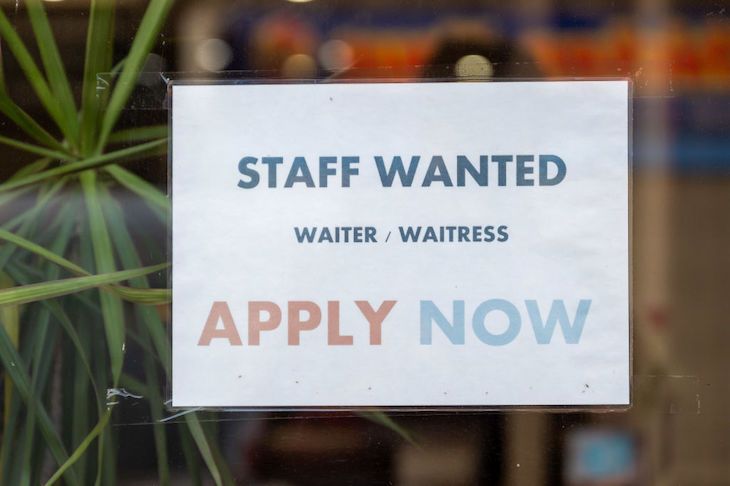
Most waiters and waitresses don’t dream of doing the job forever. Being a ‘plate juggler’ or garçon is hard work and can be thankless. Difficult customers, unsociable hours and staying on your feet all day, or night, takes a heavy toll. But there is a reason why people choose to do the job: the flexibility of waiting tables makes the job work for many people.
Labour’s Employment Rights Act will give workers on zero-hours and low-hours contracts the right to guaranteed hours and compensation when shifts are changed at short notice
In my twenty years working in, and eventually owning, restaurants, I’ve met – and employed – actors who need to attend an audition at the drop of a hat; parents juggling childcare; and, rarer still, someone on the cusp of retirement who doesn’t quite have enough of a pension and wants to wait tables to make up the shortfall. Put simply, these people work when they want to and don’t work when they don’t want to.
The benefits of this flexibility works both ways: restaurants often need an extra pair of hands at Christmas, or holiday cover in August. Like a game of Tetris, each person’s needs is made to fit the rota: Ant wants less this week, so Bea picks up Tuesday lunch. We discuss it, the rota is done and, barring sickness or storms, it holds.
But it seems that this system of people communicating with each other is not sufficiently rigid for Whitehall. Labour’s Employment Rights Act 2025 will, from next year, give workers on zero-hours and low-hours contracts the right to guaranteed hours, ‘reasonable notice’ of shifts and compensation when shifts are changed at short notice. Naturally, Parliament defined much of this too loosely, passed the law and the buck. A consultation on what ‘ending one-sided flexibility’ should mean closed this week. Hopefully the powers that be will see common sense before it is too late, but I doubt it.
The truth is that restaurants are not like factories that plan to ramp up or down their doobry, widget or gizmo production over prolonged periods of demand fluctuation. When I opened restaurants for a chain, the places were always overstaffed, partly for training and partly because nobody knew what would happen. When I opened my own restaurants, I had no idea whether Friday lunch was a clever idea, but took a risk on it. It can take two years, two ‘Veganuarys’ and multiple menu changes to work out what days and months are busy.
Employers don’t chop and change because they want to annoy employees. Often, the truth is simpler: customer demand changes. Government research found that over half of cancelled shifts were for this reason: 29 per cent followed lower-than-expected demand and another 27 per cent followed a customer cancelling. Sometimes customers don’t come because it rains, England is getting thrashed at football, or a Great British Railway driver hasn’t turned up to work, again. Sometimes it’s a national bad mood that puts people off going out for dinner. When Keir Starmer and Rachel Reeves came into power and started talking about fiscal ‘black holes’ before their first Budget, customers told me they were tightening their belts in response; in my restaurant, I cancelled a handful of shifts as trade weakened.
This is what life – and business – looks like: it can be messy. Hospitality has always been one of the most uncertain industries, rather like agriculture, which relies more on God’s whim for a decent harvest. The Labour government’s big idea is to take more of this uncertainty and force the employer to pay for it. Yet the irony is that 72 per cent of insecure workers surveyed said their arrangement suited their lifestyle.
Labour’s new rules are already having unforeseen consequences. One restaurant chain boss I knew had a policy of hiring fifty people and deliberately take a risk on about ten or so people. Her logic was that half the risky ones wouldn’t work out, but the other half might be stars and outperform everyone else. She understood that you cannot identify every good employee from a CV, and that it can be worth taking a punt. But nowadays, giving someone a chance has become too much of a gamble. Most restaurants will simply hire the experienced waiter, and the sixteen-to-twenty-four-year-old NEET (not in education, employment or training) misses out again.
The Labour government’s big idea is to take more of this uncertainty and force the employer to pay for it
In good times, making life harder for the hospitality industry might be merely expensive silliness that most restaurants could suck up. But that isn’t the situation we are in. The Low Pay Commission describes a ‘low hire, low fire’ labour market as particularly bad for the young. They’re right. And the government is walking into yet another trap of its own making. The crackdown on zero hours contracts could cost employers between £350 million and £2.9 billion, according to one estimate. This is the real cost of preventing restaurants from offering staff less flexibility.
I can see what the future holds. Restaurants will employ fewer people and replace them with buffets, self-service, QR codes Sellotaped to tables, robots and quick-service terminals. Managers will resort to using more freelance staff,. Or businesses will just give up and close. Labour may succeed in making insecure jobs rarer. Unfortunately, they will make all jobs rarer.