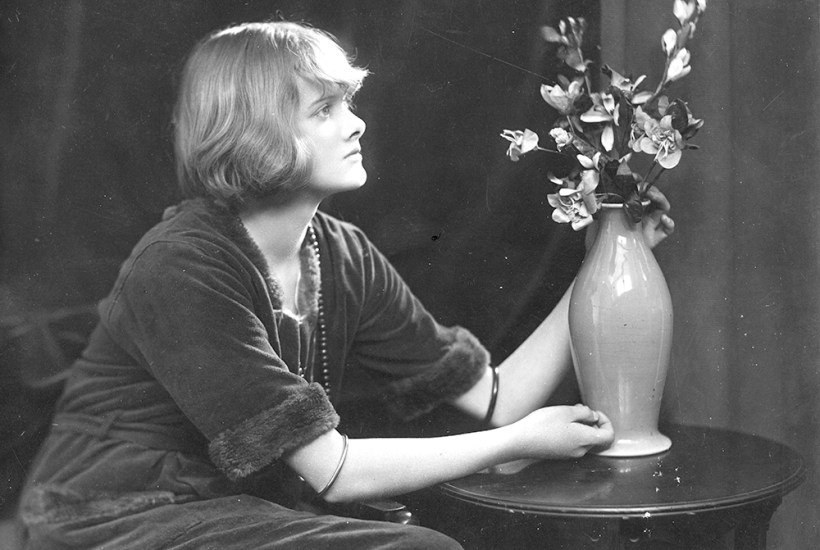
‘We can never go back again,’ wrote Daphne du Maurier in her bestselling novel Rebecca (1938). ‘The past is still too close to us.’ Yet back she went, in book after book, to the past of her remarkable family. In 1934, six months after the death of her father, the matinée idol Gerald du Maurier, Daphne wrote his biography, portraying him as a spoilt man-baby with a ‘stable’ of mistresses. Gerald’s own father, George du Maurier, was the celebrated book illustrator and Punch cartoonist whose creation of characters such as Mrs Ponsonby de Tomkyns and Lady Gatheremall skewered the Victorian nouveaux riches. A friend of Henry James, he also wrote Trilby, the bestselling novel of the 1890s, in which Svengali, the demonic manipulator, transforms a tone-deaf young laundress into a world-class diva.
It was George, said Daphne, who ‘started it all, the family’s creative and dark imagination’, but the spirit can be seen in his grandmother, Mary Anne Clarke, Regency courtesan to the Duke of York, who ran a lucrative side hustle selling commissions to the army. Mary Anne, wrote Daphne in her family biography, was
a woman without morals, without honour, without virtue, a woman who had known exactly what she wanted at 15 years of age and, gutter-born and gutter-bred, treading on sensibility and courtesy with her exquisite feet, had achieved it all laughing – her thumb to her nose.
Mary Anne’s daughter Ellen married Louis-Mathurin Busson du Maurier, a failed inventor, and it was his father, Robert Busson, who might actually be said to have started it all. A glass-blower and convicted fraudster, he added ‘du Maurier’ to the family name and allowed his descendants to believe they had the blood of the ancien régime coursing through their veins. When George mocked middle-class aspirations, he knew, deep down, that his own lineage was a fiction.
The du Maurier line is now ended, which is one reason why Paul de Zulueta, Daphne’s eldest grandson, was inspired to write this poignant ‘farewell’ to his forebears. But Last Night I Dreamt is more than another family biography. It is de Zulueta’s attempt to understand the du Maurier character, a medley of mischief and melancholy, with a preternatural capacity for tapping into the collective unconscious. George, Gerald and Daphne, he writes, ‘were like surfers in the steepest part of an unbroken wave. They knew where the energy lay and had an uncanny feel for what the public wanted.’ Success came instantly to all three, before they had time to prepare themselves, and they each found it difficult to adjust to the limelight.
The response to George’s bestsellerwas known as ‘Trilby-mania’: there were Trilby parties, Trilby sausages, Trilby ice cream sundaes and, of course, the Trilby hat. Daphne reflected:
When a novel can affect the human heart in such a way, it seems to me to mean one thing only: not that the tale is exceptional in itself, but that the writer has so projected his personality on to the printed page that the reader either identifies with that personality or becomes fascinated by it, and in a sense near hypnotised.
It is a striking image, given that the subject of Trilby is itself hypnosis, while mind control of the kind Mrs Danvers practises on the young Mrs de Winter is a repeated theme in Daphne’s own writing. The mesmeric appeal of Rebecca, a novel which similarly embedded itself in the popular imagination, begins with its rhythmic opening line, an example, as de Zulueta points out, of the iambic hexameter: ‘Last night I dreamt I went to Manderley again.’
Daphne, a bisexual Jungian with a deep interest in doubles, described having a divided self. There was Self One, full of courtesy and humour, and Self Two, who wanted to ‘bash everyone’s face in’. De Zulueta moves between both selves as he unravels her complexities, while also suggesting that she did not consider herself an individual at all but a channel for the family ghosts: ‘She was only too aware that she possessed feelings, emotions and a mind and a body passed on to her by people long dead.’
It was not only their genetic code that was transmitted. The du Mauriers communicated in a linguistic code impossible for anyone else to understand. Begun by George, embellished by Gerald and enriched by Daphne, it was so much a part of their history that de Zulueta has included a code-breaker at the start of the book. ‘Cairo’ was sexual intercourse, ‘Venetian’ was lesbian, to ‘have your feet up the chimney’ referred to homosexuality, a ‘menace’ was an attractive person, and to be ‘menaced’ was to be sexually attracted; ‘see-me’ meant being vain or self-absorbed, and a ‘tell-him’ was a boring story about oneself. Princess Margaret, said Daphne, was a major see-me. Even now, de Zulueta admits: ‘I catch myself if I find myself meandering on about something which others might look upon as a tell-him.’
There is nothing tell-him or see-me about de Zulueta in these pages, as he gets to know his remote and forbidding grandmother, who dressed ‘like a woman operative in the French Resistance’ and died when he was in his thirties. What is most striking about his style is its honesty, modesty and lack of pretension. He did not read Rebecca, he reveals, until he was in his forties, and it was only in preparation for this book that he discovered the bulk of his grandmother’s short stories, which include ‘The Birds’ and ‘Don’t Look Now’. The freshness of his reaction to Daphne’s writing can be felt on every page.
Daphne, a bisexual Jungian with a deep interest in doubles, described having a divided self
The see-me of the family was Gerald, whose need for attention was such that he could not even keep his affairs a secret. He wrote to his wife: ‘My sweet, my love, beside loving you terribly – I have fallen desperately in love with a girl I met down at Portsmouth on Sunday. – I’m ashamed to say we stayed at a hotel.’ Aside from his infidelities, Gerald’s love for Daphne was so possessive that de Zulueta ‘harboured the idea that their relationship was even incestuous’. While nothing in his research dislodges this suggestion, he is unexpectedly moved by what he learns of his great-grandfather. ‘Before I wrote this book,’ he says, ‘I was ambivalent about Gerald, as many in the family are today, but the more I looked into his life and career, the more I grew in admiration and sympathy.’ At times, as de Zulueta goes through the family letters, he finds himself in tears, particularly when he discovers the depth of the postwar trauma suffered by his grandfather, Lieutenant-General Sir Frederick ‘Boy’ Browning (also known as ‘Tommy’), who married Daphne in 1932.
In 1948, Browning became treasurer in the office of the Duke of Edinburgh, a man Daphne described as ‘an absolute dear’, and in 1952 the Brownings were invited to the Coronation. Daphne complained to her close friend Ellen Doubleday:
The Coronation is bitching up everybody’s summer. I have to be in Westminster Abbey at 5 a.m., what about if I have ‘Robert’ and where does one ‘nim’ or ‘pal’ for that matter. Tommy in cocked hat and plumes and I have to wear an ankle-length frock and veil like a hospital nurse. Let’s fly east together and meet me in Budapest.
A quick look at the code-breaker explains that ‘Robert’ means menstruation, ‘nim’ and ‘pal’ refer to the call of nature, and Budapest is ‘fantasising’.
Last Night I Dreamt is packed to the rafters with delicious details like this, but the book’s finest chapter, for me, is the one in which de Zulueta goes back to his own past. It was Easter 1968, he was 12, and his parents were getting divorced. Daphne, aged 60, suggested that she and the unhappy schoolboy take a walk together after lunch; this would be the first and last time that they were ever alone. Their shy silences were broken by sudden bursts in which Daphne talked about her new book, The House on the Strand, her recently deceased husband and an oil spill that had damaged the local bird life. The divorce itself was not mentioned. ‘I am sure she would have preferred to have been by herself with her own thoughts,’ de Zulueta reflects. ‘It was her way of saying she cared.’
Got something to add? Join the discussion and comment below.
You might disagree with half of it, but you’ll enjoy reading all of it. Try your first month for free, then just $2 a week for the remainder of your first year.