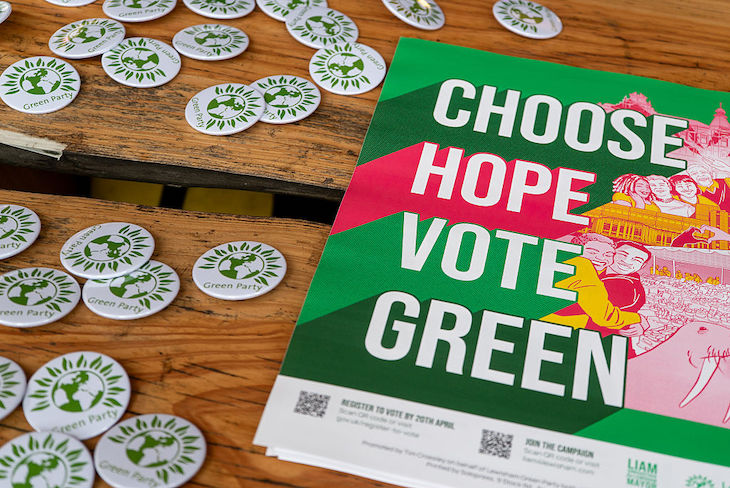
The Green Party came to prominence earlier this year by forever promising ‘hope not hate’. Indeed, that dreamy yearning played a key part in securing an unprecedented mandate in the May local elections, when a callow cohort of progressive twenty-somethings, wooed by these nice-sounding words, helped to put the Greens into power in many inner-city councils. This is the same demographic who are also receptive to similar utopian platitudes about abolishing borders, housing immigrants, and free bus travel, free university education and free childcare. Free everything, if possible, courtesy of ‘the billionaires’, who in the Green Party’s ethereal vision will obligingly pay for it all.
Such bellicose sentiment is wholly consistent with the worldview of the idealistic, progressive left
Yet such charmingly naïve sentiments seems to jar with Green Party rhetoric in regard to Israel and the Jews. When it comes to this matter, their members are rather lacking in compassion, somewhat short on soppy inanities. On this subject, they are hate-mongers of the first order.
Some Green Party activists now speak of British Jews being a ‘weapon’ of Israel, describe hostility towards Jews as ‘understandable’, and talk of ‘violent resistance’ and ‘armed struggle’ by Palestinians. Messages in a private WhatsApp group used by Green members also referred to ‘killing Zionists’. One participant in the group chat described the majority of Israeli Jews as ‘genociders’, another referred to Iran’s Islamic Revolutionary Guard Corps as ‘part of a national liberation movement’, while one Green Party parish councillor on the Isle of Wight, asked if their comment ‘Zionism has to go’ meant that they would like Israel ‘wiped off the map, in essence?,’ replied: ‘Yes, I would like that.’
For a party that likes to preach pacifism, this is fighting talk indeed. Yet far from representing a contradiction or an aberration, such bellicose sentiment is wholly consistent with the worldview of the idealistic, progressive left.
From the Jacobins to the Bolsheviks to the Khmer Rouge, those who have combined idealistic utopianism, unassailable righteousness, the pursuit of absolute egalitarianism, and a quasi-religious sense of mission have always spoken with belligerence – and usually acted upon it. The inevitable catastrophic and bloody fate of utopian movements partly stems from the necessary payoff between liberty and equality – you can have more of one only at the expense of having less of the other, so the pursuit of complete equality must entail the complete elimination of liberty – but it’s also the consequence of people being beholden to unshakeable convictions.
To paraphrase Yeats, those possessed with convictions and passionate intensity are the worst types. Those who present themselves as unquestionably caring and good and on the ‘right side of history’ always feel at licence to behave as they please, because they see their opponents as being on the side of evil.
This is why many will also recognise another related, longer-standing and similarly ostensible contradiction in politics: the propensity of those who profess to ‘Be Kind’ to act abhorrently online. They feel at liberty to be as vile and personal in their insults because all is forgiven if you have right on your side. In the minds of the elect, those who hold opposite opinions are already dehumanised.
What makes the self-righteous fury of the hard-left today all the more toxic is that it has been enabled by a culture that valorises victimhood and equates it with moral superiority. Those who present themselves as victims of political oppression, or ally themselves to others in that position (in this case, the Palestinians) are even more likely to have recourse to bellicose language. The wrath of ideologues with good on their side is even harder to gainsay when they add to their argument that they are victims, and that the pain they feel is your fault – as a straight white man, or as someone who is ‘right wing’, or as a Jew.
This noxious admixture of ideological certitude, victimhood and infantile sentimentality helps to explain the recent rise of ultra-left violence. The return to the headlines last week of Luigi Mangione is a reminder of how this combination works. It was not merely Mangione’s actions that are telling – he shot and killed the CEO of a private healthcare provider in December 2024 – but the manner in which he was subsequently feted by those who think some people deserve to die for being capitalists, for not being caring.
Mangione’s actions can be seen in context with the murder of Charlie Kirk, or in this country, the emergence of the militant transgender rights group Bash Back, and indeed Palestine Action, an outfit which also has no qualms about using violence if it’s for a ‘good cause’.
One can therefore be shocked, but not confused, at what we are hearing today from the mouths of some Greens. The boastfully compassionate, those brimming with convictions, are often those who are also full of hate.