With the Jason Arday episode set to become one of the most important and symbolic stories of the year, and his death one of its foremost tragedies, it is appropriate and timely that there should be an investigation into the whole sorry affair. As Cambridge University announced on Friday, it will launch a two-part investigation into whether it could have done more to support the professor, who was found dead at an address in south London on 14 August, a week after he resigned as professor of sociology of education at the university.
The real issue was how Cambridge University elevated Arday in the first place to a position well beyond his merit
Cambridge has said that it will be an ‘independent review’ that will examine its ‘decision-making, policies and organisational processes’ in order to identify ‘lessons and opportunities for improvement’. The first part of the review will consider the university’s support of Arday, while the second promises to be a broader review of the institutional process and practices related to his appointment and time at the university.
This all sounds noble and dutiful, and one would hope that shows good faith on Cambridge’s behalf. It is welcome to hear, in addition, that a former prosecutor who took on the Rochdale child grooming gangs has been appointed to lead the first part of the independent review, which will look at the support, interventions and protections available to Arday during the period before his death. Nazir Afzal, chancellor of Manchester University, said that he intended to ask the university ‘difficult questions’ about ‘whether more could and should have been done’ on behalf of Cambridge to support its former professor.
Questions may well be asked of the university’s conduct this year, the year not only when Arday’s academic integrity increasingly came under scrutiny, with serious allegations of plagiarism, but the year when his fabulist narratives and implausible life story began to unravel in full public glare. Questions will be asked whether such a delicate soul and fantasist should have been left exposed to the public spotlight this summer.
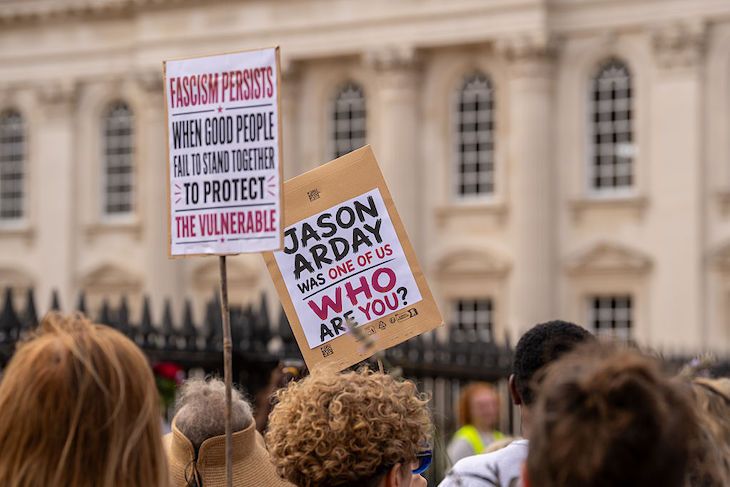
Those who have since sought to martyrise him believe that all of this relentless examination was part of a racist witch-hunt. And to be fair, there was so much in his concocted life narrative that was tabloid gold-dust, from the multiple claims of marathon-running to the assertion that he raised £5 million for charities over a 20-year period. But such storytelling only proves the point made by many of Cambridge’s detractors in the first place: that he wasn’t suitably qualified or personally suitable for the position to which he had ascended.
In truth, there is little Cambridge could have done about the media storm that erupted, beyond predictably tarnish those of making legitimate queries as ‘racist’. That indeed was the baseless reaction of even Cambridge’s University’s chancellor Chris Smith, who at Arday’s vigil at Trafalgar Square on 17 August, criticised the ‘racist feeding frenzy’ of this summer – even if this so-called ‘feeding frenzy’ had included the Guardian and the Times Higher Education Supplement, two publications hardly renowned for their attack-dog racist views.
While the Guardian was able to demonstrate that Arday’s claim that his parents received a severed pig’s head at their door was, in truth, never investigated by the police, Arday defensively responded to legitimate inquires by a Times Higher Education Supplement journalist by contacting the Metropolitan Police. They in turn launched an investigation into the journalist and instructed him not to contact Arday again.
Ever since he became Cambridge University’s youngest black professor in 2023, questions were raised about Jason Arday’s extraordinary claims – in hushed tones to begin with – not only because they seemed too good to be true, but because he seemed too convenient a mascot in these post-George Floyd times. He was an anti-racist poster-boy – with autism to boot – for an institution desperately seeking to flaunt its anti-racist credentials and seek to prove that it had cast off all vestiges of stale, white elitism.
This is one aspect the new investigation is unlikely to delve into or find Cambridge at fault. It was not so much how the university safeguarded Arday after his life story began to unravel that was ever the issue. The real issue was how Cambridge University elevated him in the first place to a position well beyond his merit, and how it continued to exalt and parade him for their own arguably selfish ends.
Not for the first time, and not for the last, a body consisting mainly of white liberals desperate to exhibit their anti-racist credentials went to all lengths in order to do so. And when people are beholden to brutal utilitarian policy such as DEI, which places skin colour above the human individual, it will always be actual people who will be the casualty.
The only meaningful lesson can ever be: never treat people as a means to an end.