‘The story of Graceland’s origins,’ writes Ashley Kahn in his deep dive into Paul Simon’s multi-million-selling album, ‘is the story of a cassette: a bootleg tape.’ Entitled Accordion Jive Hits, Volume II, and containing a collection of decade-old Mbaqanga songs from the townships of black South Africa, it had been lent to Simon in 1984 by the Norwegian multi-instrumentalist Heidi Berg. She had come to know the musician through his friend and neighbour, Lorne Michaels, the creator of Saturday Night Live, and Simon had offered to produce her. She explained she needed the tape back, as it belonged to someone else, but that this was essentially what she had in mind for her next record – though there were many obstacles to working with musicians in apartheid-era South Africa.
Just four years earlier, the United Nations General Assembly had passed Resolution 35/206, requesting ‘all states to prevent all cultural, academic, sporting and other exchanges with South Africa’, and urging ‘writers, artists, musicians and other personalities’ to boycott the country. This boycott had the backing of the outlawed opposition party, the African National Congress, whose leader, Nelson Mandela, languished in prison on Robben Island. Many prominent western musicians, including Bruce Springsteen and Bono, made their support public, rallying together under the banner ‘Artists Against Apartheid’ and releasing the charity single, Sun City. It was a kind of musical rebuke to Queen and Rod Stewart for playing that majority-white holiday resort in the neighbouring ‘homeland’ of Bophuthatswana.
In the event, Berg would never get the tape back. Simon clung on to it for dear life, listening to it incessantly on the three-hour drives he was making between his apartment in New York City and a beach house under construction at Montauk, Long Island. That property had been intended as a dream home for himself and his new bride, Carrie Fisher, but after less than a year their marriage was already disintegrating. Simon’s album Hearts and Bones had been a commercial flop, ending an almost unbroken run of hits since the mid-1960s when his and Art Garfunkel’s folk-rock duo had first topped the charts with ‘The Sound of Silence’. Now, with MTV, Madonna, Michael Jackson, Van Halen and Prince (and Walkmans and mix-tapes) in their pomp, Simon, aged 43, was at a loss about where to go next.
Kahn wryly observes that Berg would be far from the last person in the whole saga of Graceland to cry ‘Stop thief!’ when, in addition to half-inching the tape itself, Simon promptly went off and made a record in South Africa. Accusations of appropriation of one kind or another dogged the album from the day of its release in late August 1986. Even its title song came in for criticism in referencing the Memphis mansion of Elvis Presley, the white singer whose debt to African-American music was never settled to everyone’s satisfaction. Given that the record’s cover image, a 15th-century Ethiopian Coptic Christian representation of St George, was sourced from a museum in Salem, Massachusetts, perhaps a witch hunt was to be expected.
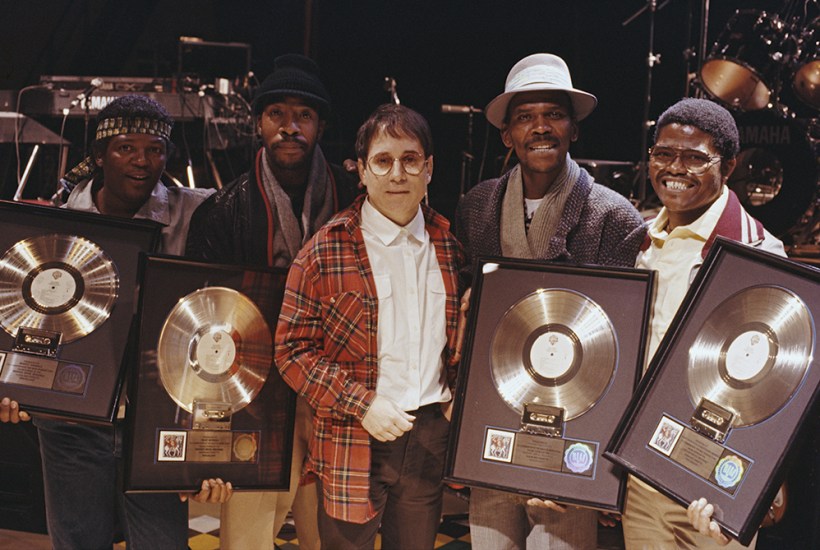
Kahn mounts an impassioned defence, earnestly charting the album’s collaborative, open-hearted composition and highlighting the positive after-effect it and the follow-up ensemble live shows had, for example, on the career of Ladysmith Black Mambazo. Kahn witnessed firsthand the subsequent global success of this Zulu a cappella group when he acted as their tour manager on dates in the US, Europe and Japan in 1988. He quotes the trumpeter Hugh Masekela, living in exile in London at that time, whom Simon consulted before travelling to Johannesburg. Instead of discouraging the singer, he applauded him for putting ‘the music into the ears of people who would otherwise never bother about South Africa’.
Illustrating just how thorny the issue was, Masekela’s sister, Barbara, in her role as head of the ANC’s Department of Arts and Crafts, working in Lusaka, Zambia, would find herself having to draft an official statement rebuking Simon, and by implication her own brother, for the ‘inadequacy’ of his anti-apartheid messaging. It was a charge levelled by some reviewers at the record itself, which, if spawning the chart smashes ‘The Boy in the Bubble’ and ‘You Can Call Me Al’, lacked anything as finger-pointing as the near contemporary ‘Biko’ by Peter Gabriel or ‘Free Nelson Mandela’ by the Special AKA.
Accusations of appropriation of one kind or another dogged the album from the moment of its release
Still, Kahn notes, Malcolm McLaren suffered nothing like the same level of opprobrium when, just three years earlier, the former Sex Pistols’ Svengali-turned-solo artist put out Duck Rock. That album was, like Simon’s, partially recorded in South Africa and made liberal use of Mbaqanga musicians without crediting them. When the matter was raised in the British music press, McLaren fronted it out, wearing the theft as a badge of artistic provocation, stating that England was ‘the land of piracy’.
By contrast, Simon, Kahn maintains, went out of his way to ensure everyone received their due and more, paying the South African musicians triple the local rates for recording sessions. Kahn argues that Simon, having published his first song as a teenager, knew only too well the value of writing credits. Nevertheless, the Mexican-American band Los Lobos, who played on the album’s closer, ‘Around the World or the Myth of Fingerprints’, continue to insist that Simon robbed them blind. Kahn cites Simon’s method of piecing together songs from mere fragments of different recordings and manipulating in digital post-production as the mitigating factor here. There was no song until he and the engineer Roy Halee put it all together, goes the reasoning. The seemingly unflappable Halee emerges as nothing less than the hero of the piece. He helped steer the whole rapidly sprawling project, as recording roamed across three continents and guest turns came in from everyone from Phil Everly, Adrian Belew and Linda Ronstadt to Youssou N’Dour and Rockin’ Dopsie.
The 1980s were nothing if not about excess; and the effort and vast sums of money spent on recording and then promoting the album were suitably period. There is also something almost quaint about reading 40-year-old arguments about musical thievery when OpenAI, a company with a certain white South African among its original founders, has more recently ransacked the whole of recorded history without a second thought.
Got something to add? Join the discussion and comment below.
You might disagree with half of it, but you’ll enjoy reading all of it. Try your first month for free, then just $2 a week for the remainder of your first year.