This book begins with rueful comments on the absence of philosophy from terrorism literature. The phenomenon is frequently analysed through psychological, religious, political, economic, sociological and military perspectives, but rarely from the philosophical. Yet questions such as how and why terrorists opt for violence, how they justify it to themselves and others, how they regulate it and why they stop, all have philosophical ramifications. As do questions about counter-terrorism, particularly with reference to retributive terror, running agents in terrorist organisations, interrogation and torture.
Quassim Cassam and Richard English, philosopher and historian respectively, avoid the easy route of exploring such questions via abstract thought experiments. The best known of these frequently features in discussions of possible justifications of torture: if your prisoner had concealed a nuclear device in London timed to explode later this afternoon and was refusing to say where, would you be justified in torturing him? Instead of agonising over such hypothetical scenarios, the authors focus on actual examples of what they call lived experience, showing that in real life such issues are surrounded by the messy complexities of timing, truth, error, falsehood, motive and efficacy.
They also resist the temptation to reach for some ultimate definition of terrorism applicable in all circumstances at all times. As we know, one man’s terrorist may be another man’s freedom fighter. Overly precise definitions can lead to arguing that Ukrainian resistance to Russian occupation is terrorism (as the Russians would claim, of course), or that the destruction of Pan Am flight 103 over Lockerbie in 1988 was a justified response to American military action. Instead, the authors opt for a descriptive and interpretive approach, outlining what characterises terrorism and stressing the importance of context, motive and intention. Their emphasis is on what works, and they conclude that the legal definition offered in the Terrorism Act of 2000 will ‘suffice for most practical purposes’.
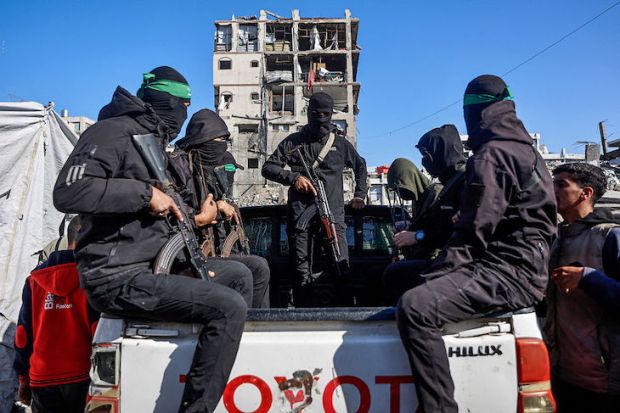
Nearly all modern discussions of terrorism assume and focus on non-state terrorism as conducted by terrorist groups, some of which may be state-sponsored. However, there is also state terrorism, as openly advocated in the Terror following the French Revolution. This is terror ‘systematically embedded in the state’s structures and identities’, such as in the Soviet Union or Nazi Germany – or, arguably, in today’s China. The book’s summary of the differences between Hamas and Israel in this respect is succinct and persuasive.
It is non-state terrorism, however, that the authors find ‘emblematic of terrorism as a whole’. In discussing its various aspects, particularly methods, motives and purposes, they encouragingly cite the groundbreaking research by the US academic Audrey Cronin, who concluded that terrorism nearly always fails. She examined 450 campaigns and found that only 4.4 per cent achieved their strategic aims, that 6.4 per cent had some limited success and that 87.1 per cent were complete failures.
This is relevant to any philosophical assessment of a terrorist group’s justification of its actions: if your aims are in practice unachievable – the universal adoption of Islamic Sharia law, for example, or the extinction of the human race, or the expulsion of Northern Ireland from the UK against the democratically expressed wishes of its majority – this must surely torpedo any attempted justification for murdering people in order to (not) achieve it.
Such considerations, along with evaluation of means and ends, are the meat and drink of philosophical analysis and should be deployed in any attempt to persuade terrorists of the wrongfulness and futility of their ways. Much has been written about preventing people becoming terrorists, usually emphasising something called the radicalisation process. Cassam and English argue that this is an assumption by policy-makers who need generalisations in order to secure predictability.
Particularists, on the other hand, claim there is no single path to radicalisation and that it is pointless to strive for generalities when human beings are all specificity. Cassam and English favour a hybrid approach, while inclining towards the particular; profiling terrorists, they reckon, is about as useful as profiling farmers. But ‘the Devil alone knoweth the heart of man’ pronounced a medieval judge, and they concede that, ‘with the best will in the world, we might still be unable to make sense of the excesses of an Emwazi [the sadistic IS executioner, Jihadi John] or a Breivik [the Norwegian mass murderer]’. Assessment as to whether terrorists are mad or sane, and whether terrorism is rational or irrational, leads to the conclusion that most terrorists are fanatical rather than mad, and that although terrorism can be rational it is inherently neither one nor the other. This illustrates why philosophy should be part of terrorism studies: how we see terrorists affects how we treat them, and how we treat them can affect whether or why they do it. There are no complete answers, but this approach, like the book that endorses it, is a worthwhile endeavour.
Got something to add? Join the discussion and comment below.
You might disagree with half of it, but you’ll enjoy reading all of it. Try your first month for free, then just $2 a week for the remainder of your first year.