The Society of Radiographers have said racism is rising in the NHS.
They give the example of a patient refusing a chest X-ray from a black radiographer, saying ‘black people frighten me.’ Other anecdotes cite patients calling healthcare staff ‘dirty foreigners’ or ‘monkeys’. The Society of Radiographers says the problems have got worse in the past 18 months. They blame ‘increasingly hostile public attitudes’, and single out ‘nationalist movements such as Operation Raise the Colours’. They offer no evidence for that.
Their published findings are neither large enough nor systematic enough to establish a trend, but at first glance they chime with a recent survey that is: the NHS Staff Survey, sent annually to 1.5 million NHS staff. Among respondents, it finds the proportion who report experiencing discrimination over the past year from patients and relatives to be 9.26 per cent. We’re told that’s a five-year high.
What does it mean that almost 10 per cent of NHS staff report discrimination each year? The all-you-can-eat buffet of victimhood and grievance tempts too many, but genuine bigotry is foul. Knowing the difference is essential.
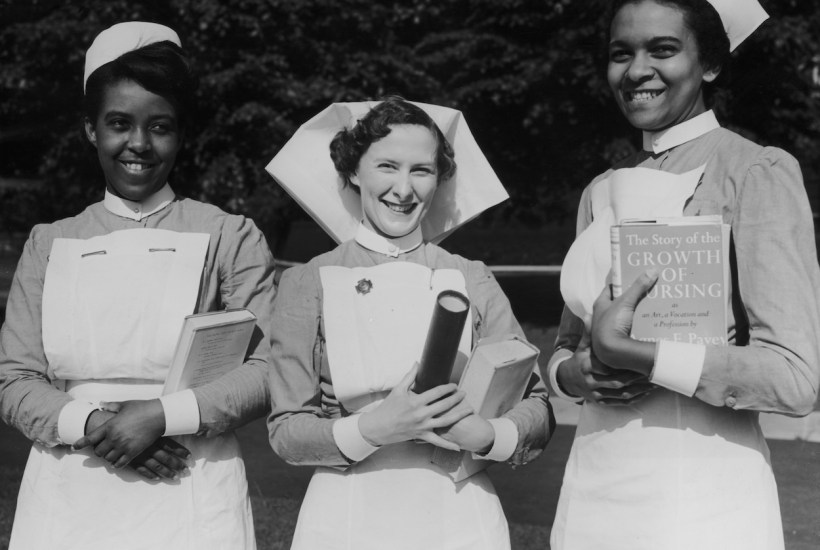
We are often told that the NHS is structurally racist, or that its poor outcomes derive from ethnic prejudice. Any simple description of the NHS as a racist institution ought, however, to reckon with what the institution actually looks like. Our diversity neither disproves nor precludes racism, but to ignore how thoroughly mixed our daily working life has become is to miss something important.
I had a day the other month when everyone on my firm, including every junior and every medical student, was white and English. I noticed it because I don’t remember it happening at any other point over the past quarter-century.
Normal service has returned. Today my team consists of an Omani who trained in Ireland, and speaks with a Dublin lilt, a woman who describes herself as half German and half Chinese, a Greek, a Pakistani, and – I’m afraid – a Welsh.
As a good contrarian, I should be able to rank the different nationalities in the NHS in order of my preference. Disappointing to report, I can’t. There are a few countries for whose doctors I have a robustly positive prejudice. I have now met a Sri Lankan doctor who was merely average: an actual relief after a run of excellence so dazzling as to shake my patriotism. Singaporeans and those from Hong Kong have also been conspicuously above average. If you forced me to generalise – you don’t have to, since I’m fond of generalisations – I’d say their excellent cuisine is no coincidence, and keen intelligence in the kitchen is a good sign. I realise I’m not flattering the English when I say this, and am being ruder still about the Scots.
If we concentrated our international recruitment on countries with the best food, I would be happy. Cultures differ, in cuisine and in much else. Insisting that they don’t simply makes your view of the world less truthful and less interesting.
The number of staff reporting discriminatory behaviour from colleagues is lower than that reporting it from patients: 8.77 per cent rather than 9.26 per cent. That 8.77 per cent is a five-year low. Neither figure tells us how much of that discrimination was racial. Even so, staff report less of it from colleagues than from the patients and relatives we serve. That hardly suggests an institution distinctively poisoned by bigotry. Might it be that discrimination and racism are not the NHS’s defining problems and that, perhaps partly because we really are extraordinarily diverse, we are doing reasonably well? Britain seems to me one of the least racist countries in the world – an assertion that sounds outrageous until you try listing those that are better.
Officially the NHS has a zero-tolerance approach to racism. Unofficially it has nothing of the kind. In reality we tolerate it often, because toleration is a key part of our job. We don’t decide whether someone’s life is worth living before judging what treatment they need. And when people are old and frail and frightened, when they are delirious or demented, they are often not at their best, and forgiveness is part of our job.
Officially the NHS has a zero-tolerance approach to racism. Unofficially it has nothing of the kind
Football clubs improved the atmosphere on the terraces when they discovered racists could be given life bans. The NHS can’t do that. We care for patients even if they are foul and obnoxious – even when they’re racists – which is not the same as pretending their behaviour is acceptable. Sent in to deal with a patient who had been racially abusive to the rest of my team, I remember him looking almost disappointed to find I was white. ‘What do you want, you four-eyed cunt?’ he asked.
That same staff survey finds that only 58 per cent of staff would recommend their organisation as a place to work, only 63 per cent are happy with the standard of care it provides, only 72 per cent say that looking after patients is their organisation’s top priority.
Racism exists in the NHS, as it does everywhere, and it deserves attention. But the NHS’s chief problem is not that we are racist – it’s that we aren’t very good.