When the 50th anniversary ALP national conference kicks off in Adelaide this week, Labor’s ties to the trade union movement will have never been closer. It underscores a cosy, self-serving, Tammany Hall relationship where, for political and financial favours, union leaders enlist their 1.6-million-strong membership and industry superannuation clout to campaign for ALP causes.
Industry super funds are particularly strategic. They influence the appointment of partisan company directors, the signing of union sweetheart deals and the adoption of woke workplace practices. Woe betide businesses in which they invest, who resist their agenda. No wonder union-negotiated collective agreements delivered average annual wage increases of 4.2 per cent, compared to 3.0 per cent under agreements where no unions were involved.
With the industrial relations system purposely designed to favour so-called not-for-profit, superannuation funds, a handful of union funds, with little capital backing, have been able to grow to around 36 per cent of Australia’s more than four trillion dollars in retirement assets, yielding them an estimated $10 billion a year in fees.
This scale has provided industry funds with some $30 million to spend on advertising and other inducements to attract new members; easily out-competing smaller, retail funds.
This Labor/union cartel was a blessing during the 2025 federal election campaign with unions donating an estimated $15.9 million to Labor. The opposition claims unions spent a further $22 million on direct and indirect political campaigning. Members of the Media, Entertainment and Arts Alliance were dependable cheerleaders, particularly on the ABC.
Predictably, familiarity has led to a convenient blurring of lines, abuses of power, personal indulgences and cover-ups.
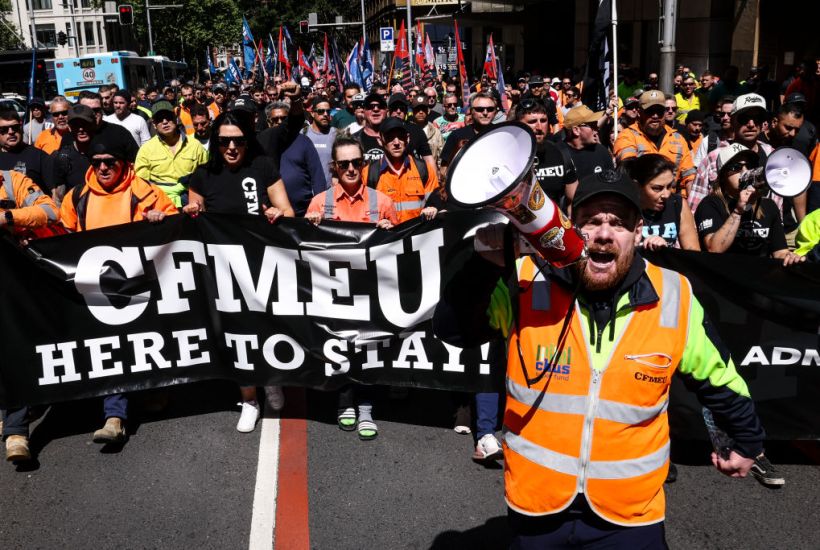
Nowhere has this been more apparent than with the Construction, Forestry and Maritime, Employees Union (CFMEU). It is alleged to have been involved in systemic corruption, standover tactics, and underworld infiltration on major Australian infrastructure projects, particularly across Victoria’s $100 billion ‘Big Build’ undertakings, where it is believed to have cost taxpayers a massive $15 billion.
So rampant were the allegations that federal Employment Minister, Murray Watt, was forced to place the union into administration. Still, it’s one thing to expose corruption and another for consequences to follow.
So when the Labor-appointed CFMEU administrator redacted two chapters in his report demonstrating the Victorian government ‘knew and had a duty to know’ that corrupt union and underworld figures had infiltrated the state’s ‘Big Build’ projects, it understandably led to allegations of an ‘industrial scale’ cover-up and accusations that CFMEU muscle had cowed the Victorian government into submission. These claims were given credence when Labor rejected a royal commission into trade union corruption until after the November state election.
Conclusion? Tammany Hall prevailed.
Meanwhile, and despite calls for greater transparency and competition, the latest Workplace Relations Legislation Amendment Bill has given construction unions even more power by allowing the government to preference those contractors and subcontractors with union enterprise agreements. Moreover a single Commonwealth project can impose union conditions on every business in its supply chain. What Labor describes as ‘moderate tweaks’ further entrench the cartel by giving the Commonwealth immunity from coercion and unlawful discrimination laws.
Despite advocating transparency, Labor eschews it. It established the secretive Capacity Investment Scheme to underwrite renewable energy investment. Unions are expected to play a crucial role in community engagement, raising concerns around the potential for corruption in the tendering process.
The pretentiously named $15-billion National Reconstruction Fund is yet another example of familiarity breeding contempt. It emphasises the employment of unionised workers and has already being charged with ‘jobs for the boys’ following a union member’s board appointment, bypassing proper process.
Then there are Labor’s appointments of ‘union mates’ to the Fair Work Commission which further tip the scales toward employee-favourable outcomes. This could play a handy role given the adoption at the NSW Labor party conference of a raft of union priorities. These bind the government to a more heavy-handed approach to AI as just announced by the Prime Minister and will have application in the workplace for union and non-union workers alike. They will have particular application for the 2.6 million public servants whose workplace tenure can be expected to limit potential productivity gains.
Clearly, in the four years since Anthony Albanese became Prime Minister, organised labour has increased its influence within the Labor party and in the workplace. Its impact on the economy, and society generally, should not be underestimated.
By adopting some of the most sweeping industrial relations changes in more than a decade, Labor has taken a deliberate and systematic shift away from the enterprise model. It prioritises centralising control, increased regulation and union intervention. This not only impacts big business. Lifting the unfair dismissal threshold and requiring all employees to be paid their super at the same time as their wages hits small businesses hardest.
But then multiple small businesses complicate Labor’s grand plan which Treasurer Jim Chalmers describes as ‘humanising capital’. In his words, this means ‘the transformation of the welfare state into a managerial utopia with the government, in collaboration with (industry) superannuation funds, acting as benevolent resource allocators through which autocratic technocratic elites will manage all aspects of society’.
Labor believes that by effectively determining the terms under which all labour is employed it will command one critical factor of production. It then aims to control capital directly via state ownership, and, indirectly, through union-run superannuation funds and via subsidies and tax incentives for favoured sectors.
Indeed, despite pretensions of equality, in reality, Labor’s utopia unashamedly calls for a system run by elites for elites. As Victoria demonstrates, that arrangement may work well for corporate grifters, bureaucrats and the CFMEU, but not for small businesses and working-class families. They become disenfranchised collateral damage. That’s not rhetoric. Victorians are experiencing the fastest decline in living standards of any Australian state.
As German economist, Kristian Niemietz warned, ‘Socialism is always democratic and emancipatory in its aspirations, but oppressive and authoritarian in its actual practice.’
Got something to add? Join the discussion and comment below.
You might disagree with half of it, but you’ll enjoy reading all of it. Try your first month for free, then just $2 a week for the remainder of your first year.