Earlier this month, America marked the 250th birthday of its Declaration of Independence. This anniversary should also matter to Australians. The story that began in Philadelphia in 1776 runs, by a longer and quieter road, directly to this country.
It is a story worth telling around the dinner table, because it is increasingly clear that Australian schools will not tell it. The most recent National Assessment Program results for civics and citizenship found that only 43 per cent of Year 6 students and a dismal 28 per cent of Year 10 students met the proficient standard, the worst results since testing began in 2004. Earlier NAP testing found that nearly a quarter of Year 10 students believed governments determine the outcome of referendums. In the most successful referendum democracy on earth, Australian teenagers do not know that the people decide.
What little civics children do receive too often arrives marinated in the fashionable conviction that Australia is a nation conceived in sin, and its history is chiefly a ledger of shame. The failings of the past are real and should be taught honestly, but a curriculum that teaches only failings produces citizens who can recite grievances but cannot explain why their country works. So here, offered as a family supplement to the syllabus, are the civics lessons worth passing on.
The first lesson is that ideals are not institutions. The US Declaration announced as self-evident truths that all men are created equal, that governments derive their just powers from the consent of the governed, and that a government destructive of these ends may be altered or abolished by the people. Stirring stuff, but a statement of aspiration is not a plan of government.
Implementing these ideals fell to the Constitution, drafted in Philadelphia eleven years later, which took the poetry of 1776 and turned it into machinery: elections, courts, legislatures and checks engineered to survive contact with human nature.
Any movement can proclaim ideals. The Soviets guaranteed freedom of speech, the press and assembly even as the Great Terror filled the gulag. The North Koreans promise the same to the subjects of a hereditary dictatorship whose elections offer one candidate. Words on parchment are cheap. The rare thing is to build institutions that keep working when the idealists have left the room.
The second lesson is to assume men are not angels. Two men stand at the centre of the American drafting. James Madison, a bookish Virginian, arrived at the 1787 convention having performed an autopsy on every failed confederacy in history, and left as the Father of the Constitution. Alexander Hamilton, the immigrant who became the first Treasury secretary, was its great salesman. Together with John Jay they authored the Federalist Papers, still the most sophisticated defence of constitutional government ever produced, and in which Madison supplied a most famous sentence: ‘If men were angels, no government would be necessary.’
Madison’s answer to human imperfection was structural: ambition must be made to counteract ambition, so that liberty survives not because rulers are virtuous but because the architecture assumes they are not.
The third lesson is that the Australian constitutional framers read their Madison. When they gathered through the 1890s, men such as Andrew Inglis Clark, Samuel Griffith and Edmund Barton drew deliberately on the American model. Inglis Clark, the Tasmanian attorney-general, produced a draft constitution borrowing heavily from the Philadelphia text. Griffith refined it and Barton, the first prime minister, was the political architect of Federation.
The borrowings were substantial: federalism; a Senate with equal representation for each state, reassuring the smaller colonies; a written constitution as supreme law, policed by a High Court modelled on the Supreme Court. Chapter and section, the Australian Constitution is recognisably Madisonian.
The fourth lesson is that the Australian framers were adapters, not copyists. The Americans had fought a revolutionary war to sever the imperial nexus; Australia was building a federal nation under the Crown, not against it. From Westminster the framers preserved responsible government, the principle that the executive survives only while it commands the confidence of the lower house.
The result is the hybrid that scholars call the ‘Washminster’ system: American in its federal structure and written constitutional limits, British in its executive accountability to parliament. The Senate slows and scrutinises, as Madison intended, while responsible government keeps the executive answerable in a way the American presidency is not.
The fifth lesson is an important point of departure, and the finest Australian improvement. The Americans gave the mechanism for changing their Constitution to the elected class. Amendments are proposed by two-thirds of both houses of Congress and ratified by three-quarters of the state legislatures. At no point does an ordinary citizen cast a direct vote on the text. Politicians propose, and politicians dispose.
The Australians gave that power to the people. No alteration takes effect unless approved at a referendum, and not by a bare national majority alone. Consistent with the principles of federalism, an amendment must win a majority of votes nationwide and a majority in a majority of states. The double majority ensures the smaller states cannot be overridden and that change requires genuine consensus across the federation, not a passing enthusiasm in the capital.
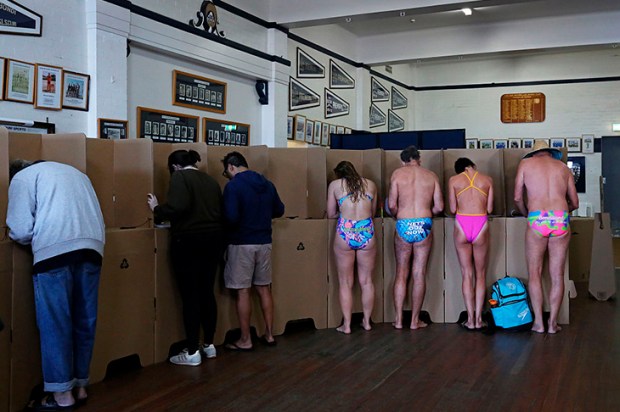
The mechanism has done what it was built to do. Of the forty-five proposals put to the people since 1901, only eight have succeeded, and radical projects beloved of the political class have foundered on the good sense of the electorate: longer parliamentary terms in 1988, the republic in 1999 and the Voice in 2023 among them. Elsewhere, elites amend constitutions over dinner. In Australia, they must first persuade the people.
The final lesson follows naturally: Australians voted themselves into existence. America purchased its Constitution with a war. Australia secured its own with pamphlets, conventions and referendums, a nation that talked, argued, and then voted itself into being.
The ideals of 1776 crossed an ocean and a century and were ratified here not by muskets but by ballots.
That is a birth certificate any people might envy, and it belongs to the same country in which children are taught to regard chiefly with embarrassment. Good constitutions, the lesson runs, are built, not proclaimed, and the boldest political argument ever made was won here with words alone.
If Australian schools will not teach that, it must be taught at the dinner table.
Got something to add? Join the discussion and comment below.
Dimitri Burshtein is at Eminence Advisory. Peter Swan AO is at the UNSW-Sydney Business School.
You might disagree with half of it, but you’ll enjoy reading all of it. Try your first month for free, then just $2 a week for the remainder of your first year.