The right kind of devolution
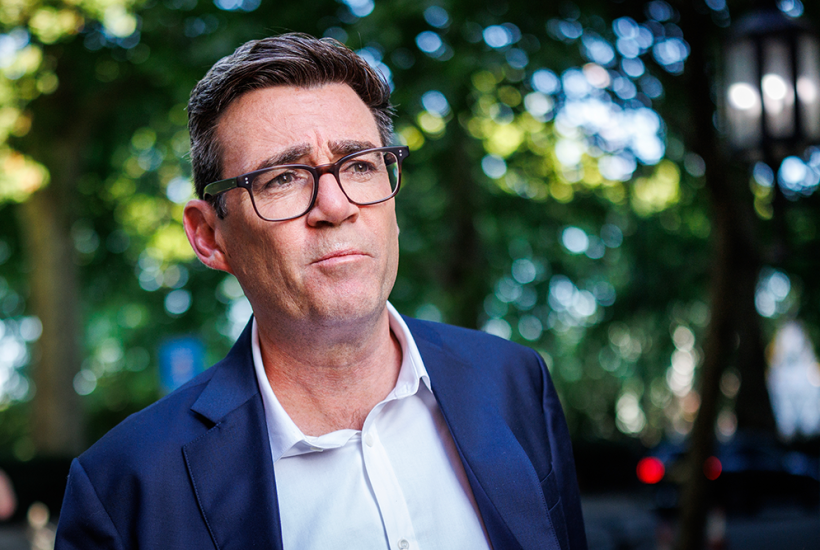
Sir: Your leading article ‘The Burnham Question’ (11 July) suggests that the putative prime minister’s enthusiasm for devolution might be a good thing, provided that it is the right kind of devolution. Although Andy Burnham would never admit it, devolution of the Manchester and Teesside type succeeds because, in both cases, business is given the chance to thrive. By contrast, devolution to the Scottish parliament and Senedd has stifled economic growth, while providing a platform for nationalist politicians to bash the UK. A true believer in effective devolution would scrap these national institutions and transfer power to business-friendly bodies in cities and regions across the UK. Sadly, I doubt that Burnham has either the courage or conviction to take such a radical step.
Jeff Green
Bath
Royal omission
Sir: Dot Wordsworth (Mind your language, 4 July) discusses the sobriquet ‘King of the North’, now bestowed upon Andy Burnham. But she overlooks the significant history of the Percy family, Earls of Northumberland from when William de Percy stepped ashore with William the Conqueror.
The story is depicted in Kings in the North by Alexander Rose, published in 2003. This fine history encompasses the period pretty much up until the Battle of Bosworth in 1485 and describes the role over many years of one of the most influential dynastic families in England, in residence to this day in Alnwick Castle.
They are also remembered through their ownership of Petworth House in Sussex, now in the hands of the National Trust.
Michael Brown
Walton on the Hill, Surrey
I agree with Nigel
Sir: Dominic Cummings’s remarks (‘There’s going to be a big push to rejoin the EU’, 11 July) have opened my eyes to what is happening to Nigel Farage. I think he should have been more transparent about the gifts he received, and I am not impressed by his friendship with Donald Trump. I am suspicious of conspiracy theories but when the attacks on the Reform leader include publication in the Times of a picture of his daughter’s home and when there is agreement between all the other parties not to contest the by-election, my hackles rise. I hope they will rise in Essex, too. Massive support for Farage from the voters of Clacton would assert the power of democracy against the machinations of the Europhile establishment.
John Hicks
Manchester
Two’s company
Sir: May I make another suggestion for smaller weddings (‘Marry in haste’, 4 July)? Forget Gretna; instead choose one of the elopement venues dotted round the country and escape your own wedding. We opted for a mill in Devon and had a cream tea for our wedding breakfast. No guests and no arguments.
Nicola Jones
Shropshire
Farce and the Force
Sir: Mary Wakefield’s article ‘British policing has descended into farce’ (11 July) is illustrated in the following situation. In the past few days a collection of large motorhomes has arrived at a popular beauty spot near my home. They removed the height bar across the entrance and took down a low fence so they could set up camp on the grassy area by the car park. When I was walking there yesterday, the public path was partially blocked by a stove and barbecue grill. I phoned the East Lothian Council Office on Friday and was put through to the roads department, who were not answering the phone. I left my name and number and was told someone would phone me back. Needless to say, no one did.
Today the vehicles are still there. The main item on BBC Scottish News reports that at Edinburgh airport the police confiscated the electronic devices of one Craig Houston, said to be a ‘right-wing blogger’, even though he has not been charged or arrested. Please would someone explain to me why the police are taking action over someone’s opinions while no action is taken against people who break the law and vandalise property?
Alison Carter
Musselburgh, Scotland
Mass pleasure
Sir: I am relieved to learn from Damian Thompson that Pope Leo’s excommunication of the Society of St Pius X does not apply to those who continue occasionally to attend its services (‘All at See’, 11 July). My visits to Paris would be bleak without the wonders of the packed Sunday High Mass at Saint-Nicolas-du-Chardonnet. There, amid the Latin chant, the sumptuous vestments and the clouds of incense, one can still catch that glimpse of Heaven which used to be available in every Catholic church until the post-Vatican II reforms. The excommunication will almost certainly be counter-productive, the Vatican having thrown petrol on the smouldering embers of the Lefebvrist schism. I can hardly wait for my next visit.
Francis Bown
London E3
Stifling hot debate
Sir: There is another aspect that Toby Young could have added to his theories of why the left is refusing to debate the climate issue (No Sacred Cows, 11 July). Climate science relies heavily on computer modelling and statistical probabilities. While mainstream climate scientists often understate these inherent uncertainties, sceptical scientists frequently place them at the centre of their argument. In the late 20th and early 21st centuries, public debate between these two sides were commonplace. However, these events routinely concluded with a measurable audience shift toward scepticism or uncertainty – a result that shocked climate campaigners.
In response, advocates began arguing that adversarial debate created a ‘false balance’ by signalling an even split within the scientific community. Yet by adopting this stance, campaigners overlooked the reality that scientific controversies are an integral part of the scientific process and are rarely evenly divided. Driven by these early debate outcomes, most scientific institutions and news organisations altered their approach, effectively abandoning open debates regarding the causes and impacts of climate change. As a direct consequence of this strategy of effective censorship, public trust in both news and scientific institutions has steadily eroded across most western countries.
Benny Peiser
Liverpool
Lost in translation
Sir: Charlie Methven (‘What’s the point of Eton?’, 11 July) comments that Eton is not ‘primarily an academic school’. Winston Churchill once used a Latin phrase in the House of Commons. Greeted by shouts of ‘Translate!’ he responded: ‘Certainly I will translate, for the benefit of any Old Etonians who may be present.’ Churchill was, of course, an Old Harrovian.
John Graham-Leigh
Westbury, Wiltshire
Got something to add? Join the discussion and comment below.
You might disagree with half of it, but you’ll enjoy reading all of it. Try your first month for free, then just $2 a week for the remainder of your first year.