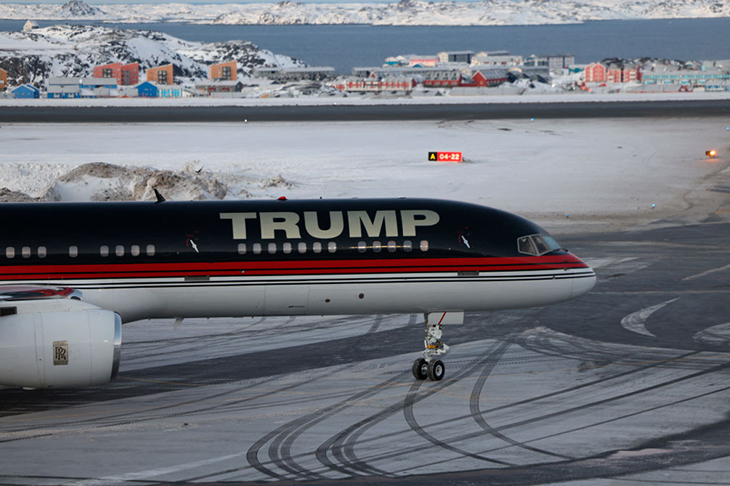
The reason why Donald Trump wants Greenland is obvious. He wants to show the world by using Greenland’s history that human-induced global warming is the biggest scientific fraud in the history of time.
Greenland was covered with lush forests and all sorts of animal life. The Greenland ice sheet first appeared 2.8 million years ago, a result of ocean circulation changing after South America joined North America. Much of the ice sheet disappeared 400,000 years ago, reappeared and partially disappeared again 7,000 years ago. No humans were burning fossil fuels then.
About 4,500 years ago in the warmest time in our current interglacial, the Saqqaq, an Inuit group, arrived in Greenland from Alaska. The temperature was about 5ºC warmer than now, sea level was two metres higher, and the seas were calmer thereby making travel easier.
Another Inuit group from Alaska followed at about 500 BC and the Inuit Thule people spread in waves from Alaska about 800 AD across Arctic Canada and travelled to Greenland in kayaks and large skin boats made using walrus hide and supporting bone ribs. The Thule harpooned marine life, made dogsleds by using driftwood or bone runners for land and sea ice travel and wintered in coastal houses constructed from whale bones, driftwood, peat sods and rocks.
Some 88 per cent of the current Greenland population of 56,400 derive from the indigenous people of Alaska. The capital contains 35 per cent of the population. Why shouldn’t POTUS make a claim on Greenland? After all, the US has owned Alaska since 30th March 1867 and 88 per cent of Greenlanders are paleo-Alaskans.
Maybe Mr Trump is interested in the minerals of Greenland? There is an industrial mineral mine on the west coast and a rich gold mine in southern Greenland. For 120 years of operation, the now-closed Ivittuut cryolite mine in the southwest provided flux for aluminium smelting. The Black Angel mine 500 km north of the Arctic Circle in western Greenland is now closed and produced zinc and lead for 17 years in one of the most remote parts on the planet. There are three undeveloped rare earth element projects and a zinc-lead project. The President would have been informed that there are far better places in the world for mining rare earth elements.
The Greenland ice sheet rests in a basin, moves uphill because of the overlying weight of ice and then travels downhill in glaciers. Calving of glaciers is unrelated to air temperature. The radioactive rocks underneath the ice generate heat which melts ice. Maybe much of what we are told about climate change and melting ice is nonsense.
The only claim that the Danes have on Greenland results from Viking visits and settlements from Norway. After being banished from Iceland for manslaughter, the Viking Eric the Red went to Greenland with 30 ships and populated the southern and western coast in 982 AD. He renamed Kalaallit Nunaat, the Inuit name for the island, as Greenland. This was a marketing technique aimed at attracting immigrants to the Norse colony on the isolated icy island. The name Greenland probably was used because of abundant summer grass in southern Greenland, summer green algal blooms in the fjords and the green cliffs at Skaergaard in eastern Greenland. The arrival of the Vikings in Greenland was during the Medieval Warming after the bitterly cold Dark Ages and before the Little Ice Age.
For nearly 500 years during the Medieval Warming, the Norse in Greenland built villages with churches; grazed cattle, sheep and goats; could dig graves because of the lack of permafrost; grew grain in protected valleys; cleared birch woodlands for pastures; used seaweed for stock feed and fuel and, unlike the Inuit, wore European clothes. With the onset of the Little Ice Age, the Viking diet steadily shifted to seafood because European grazing and farming collapsed.
The Vikings died out in Greenland with the onset of the bitterly cold Little Ice Age. The Black Death in Europe had cut supply lines, economic stresses arose because cheaper African and Russian ivory replaced Greenland walrus ivory and the Vikings couldn’t adapt European farming and grazing to an Arctic climate. During the zenith of the Little Ice Age at about 1400 AD, all contact was lost with the Vikings on Greenland. The Inuit survived, the Vikings didn’t. Today there is limited farming in southern sub-arctic Greenland with sheep and cattle and hardy cold-climate vegetables in glasshouses.
In 1397 AD, Norway, Sweden and Denmark formed a union under a single monarch, Sweden splintered from the union and Norway and Denmark remained unified under the Danish crown during which time Denmark controlled Norwegian territories such as Greenland.
The Danes sent missionaries in 1721 AD to convert the remnant Viking settlers to Protestantism but only Inuit were found. Climate change had wiped out the Vikings. During the Napoleonic Wars, Denmark and Norway allied with France and lost. As punishment, the King of Denmark was forced to give Norway to Sweden, despite Sweden changing sides twice during the war, and the colonies of Greenland, Iceland and the Faroes were retained by Denmark.
Sovereignty over Greenland was challenged by Norway a century later concurrent with a deal in 1916 whereby the US recognised Danish rights over Greenland and purchased the Danish West Indies (now the US Virgin Islands). In the Permanent Court of International Justice in 1933, Norway lost its claim to eastern Greenland and permanent sovereignty was granted to Denmark.
After Denmark fell in the second world war to the Nazis in 1941, the US took responsibility for Greenland’s defence to prevent it from changing hands. Six Lockheed P-38 Lightning fighters and two Boeing B-17 Flying Fortresses made emergency landings on a glacier in July 1942 and have since been swallowed by moving ice.
In 1946 with the rise of the Soviet Union, President Truman offered Denmark $US 100 million in gold to buy Greenland for national security reasons. Denmark declined. In the Cold War times of 1951, the US struck a defence agreement with Denmark under the Nato framework and several military stations such as Camp Century were established (and since decommissioned). In 1953, Greenland became an autonomous country, but Denmark still handles its foreign policy, currency and defence. This means that Greenlanders could do a deal with the US.
In 1968, a cabin fire in a US Boeing B-52 Stratofortress forced crew ejection and the plane crashed on the ice floes of North Star Bay near the Thule Air Base. It broke up, conventional explosives detonated, four nuclear weapons went to Davy Lones’ Locker, ruptured and dispersed radioactive material. One nuclear bomb was never found.
The US presence now is mainly limited to the Pituffik Space Base (formerly Thule Air Base), 750 km north of the Arctic Circle. This is a ballistic missile warning system and is used for space surveillance. Other isolated stations are also used for Arctic scientific research and weather monitoring.
In today’s world with increasing belligerence and threats from Russia and China, maybe Mr Trump is eminently sensible in wanting a super-strategic 51st state bristling with the most up-to-date early warning and ballistic defence systems.
Got something to add? Join the discussion and comment below.
You might disagree with half of it, but you’ll enjoy reading all of it. Try your first month for free, then just $2 a week for the remainder of your first year.