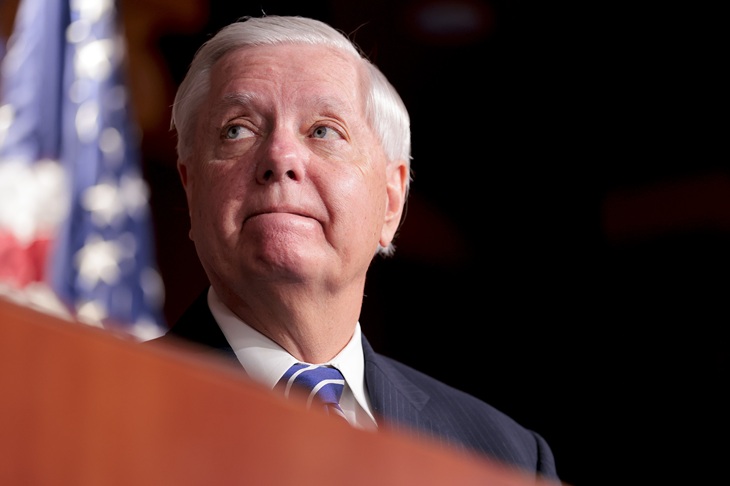
America was shocked by the sudden death of Senator Lindsey Graham who, it has been reported, died after a short and sudden illness on July 11 at the age of 71.
Medical examiners say the Senator died of an ‘aortic dissection due to arteriosclerotic cardiovascular disease’.
His official X account release confirmed the news almost immediately to ward off conspiracy and speculation.
It has already failed. Social media is awash with speculation given the Senator was the target of repeated recent threats of assassination from within Iran and Russia. While there is no current suggestion of his death being anything other than a natural event, FBI Director Kash Patel has confirmed the FBI is ‘assisting local authorities and has made every necessary resource available’.
This article is not to discuss the often divisive nature of Senator Graham’s position within the Maga movement, or the increasingly vicious divide on the conservative Right that led some individuals to celebrate his death in the way the Left cheered at the murder of Charlie Kirk.
Rather, Senator Graham was working on a particular piece of legislation at the time of his death that could have a significant impact on Australia’s economy and fuel supply.
You probably haven’t heard about it because neither Labor nor the Coalition have mentioned the Sanctioning Russia Act or drawn the natural conclusion that with the closing of third-party loopholes on-selling Russian petroleum products, Australia could face a second crunch.
No doubt the reason for this conspiracy of silence relates to fuel security being a touchy subject for the Australian government and a problem created, equally, by both sides of the political fence.
The loss of Senator Graham is a personal blow for President Donald Trump, who posted almost immediately on Truth Social:
‘Senator Lindsey Graham, one of the greatest people and Senators I have ever known, is dead! He was always working, and was a true American Patriot. Lindsey will be greatly missed!!! DETAILS AND ARRANGEMENTS TO FOLLOW. So sad!’
The two were considered close political allies and Senator Graham was rare among Trump’s circle of trust when it came to delicate matters of geopolitics, namely, Russia and Iran.
Immediately before his death, he was heavily involved in assisting the US navigate the Russia-Ukraine war and travelled extensively, carrying the President’s wishes. It was only a few days ago that video of the Senator shaking hands in Ukraine with President Volodymyr Zelenskyy emerged.
It was his 10th trip made as the war between Russia and Ukraine exceeded the duration of the first world war in June. Not an enviable milestone. There is an exhaustion from the US, which remains generally unhappy about the burden it continues to carry for a European war. To that end, Trump has been shifting his position. Whether it’s been forcing the Europeans to take responsibility for their own defence, or making overt gestures that cannot be lost in translation, there can be no mistaking the change.
Lindsey Graham was briefing Zelenskyy on a bill being worked on by Congress since 2025 aimed at forcing Russia to run out of strength by attacking its primary source of income: petroleum. Its raft of sanctions had reached bipartisan support with US lawmakers several days ago after lengthy delays.
Its purpose is to further pressure Russia and its economic allies to strain the war economy by closing convenient export loopholes that allowed countries, such as Australia, to play dumb when it comes to on-sold Russian oil.
The US believe this strategy is viable because these sales, mostly to India and Asia, are keeping the war economy alive. Oil money from these sources is funding Russia’s military activities, via billions of dollars in energy exports, largely to third-world nations. Asia, they note, is one of its primary customers.
In his own words, Senator Graham said:
‘I’ve never been more optimistic than I am today. We have the formula to end this war. Help Ukraine be more lethal. Let those supporting Russia know it’s going to be a price to be paid if you keep doing it. And try to find an off-ramp, not to humiliate Putin, but to end this war so that Ukraine will thrive and survive.’
Ukraine has specifically called out China and India, which helped Russia earn $58 billion in the past six months.
Australia has imported significant volumes of Russian oil products third-hand via India. The Labor government know about the loophole but have chosen to leave Australia dependent on these Asian supply lines instead of re-negotiating with America and South America, or doing what Queensland Premier Crisafulli is doing and aggressively pushing domestic options.
Senator Graham’s bill is specifically designed to target this loophole.
While not aimed directly at Australia, we will suffer almost immediately from the knock-on effect.
There are two likely results. Either India and China will stop buying Russian oil and reduce their exports to Australia and other customers to protect their domestic requirements. Or, they might pass on the price hikes. It comes as the discounts on fuel excise approach their expiration date.
Either way, Trump will be eying off Albanese to see what he does. If Australia complains about the repercussions of the bill when it becomes law, we will have essentially admitted that we were happy to fuel the Russian war machine while supporting Ukraine publicly. It is political hypocrisy created by a domestic political failure over guaranteeing essential Australian fuel supply lines.
What does the Labor government think about this?
What is their plan?
Who knows. They do not appear to have made a public comment.
Senator Graham told the press after finishing negotiations with Ukraine: ‘We’ve reached an agreement with the White House on a version of the Russia sanctions bill that they will support. It means it’s going to become law.’
The Sanctioning Russia Act is likely to pass.
The group of Senators involved in pushing the bill forward announced recently:
‘As Russia intensifies its slaughter of civilians, it is imperative that the legislative and executive branches work together to create tools to exact a heavy price on those who buy Russian oil and natural gas, fueling the Putin war machine.’
You will notice the bill was drafted in 2025 … and it is now 2026. Despite being generally popular, it was stalled to leave Donald Trump additional time to negotiate peace between Russia and Ukraine. Something that has not manifested.
Cracks have appeared in Russia’s military campaign and some of these are creating domestic troubles. The most damaging has been the loss of young men, first from remote areas and now creeping through towns and cities toward Moscow. These deaths cannot be hidden beneath propaganda and Putin’s rivals may take advantage of a restless population. Hence the US insisting on speeding the process up.
As for Trump and Zelenskyy, they have come a long way since the incident at the White House. They were pictured together at the Nato summit, leading to Trump’s comments: ‘We’ve actually developed a good relationship. It’s hard to believe, right? From the Oval Office to know, I think we’ve developed a very good relationship.’
My question is this … who in the Australian government is watching these strategic legislative moves and preparing for their impact on Australia?
Are we making plans with the Americans to ensure our fuel supplies can cope with the fallout of the Sanctioning Russia Act – or are we, as a nation, dawdling along bickering with ourselves as the world falls to bits?
If there are any real politicians, now would be the time to start paying attention.
Alexandra Marshall is an independent writer. If you would like to support her work, shout her a coffee over at donor-box.