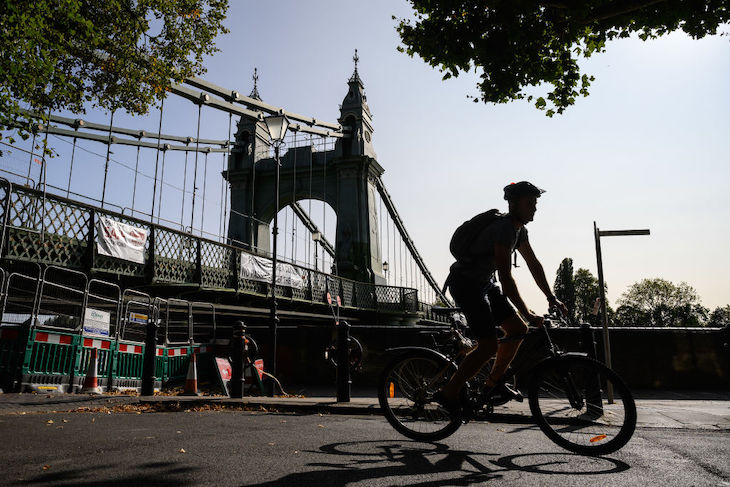
One could be forgiven for thinking that the extensive coverage given to the fiasco surrounding Hammersmith Bridge is typical of a capital-centric press blowing a local issue out of all proportion – it was disclosed this week that the west London structure, which has been closed to motor traffic since April 2019 after cracks were discovered in its pedestals, might never reopen to vehicles. But the reason the debacle has garnered so much attention, and attracted so much interest on social media, is that it is held by many to be symptomatic of this country’s troubled predicament and seemingly intractable problems.
It’s typical of a Britain which is broke and in which nothing seems to work anymore
The fact that Hammersmith & Fulham Council can’t muster the funds to repair this impressive and graceful Grade II Victorian building is seen as typical of a Britain which is broke and in which nothing seems to work anymore, and everything seems to be in a state of collapse or disrepair. Further downstream, Albert Bridge has been affected by similar periodic closures. In February, it too was indefinitely shut to motor vehicles. Continuing east along the Thames, the Houses of Parliament are in an even more critical state of decay.
Set these issues against the backdrop of a country in which our railways are in a constant state of repair, making journeys on Sunday a perpetual headache, and an HS2 scheme whose planned extent seems to shrink by the year, with its costs growing in inverse proportion, its estimated completion date continuing to be pushed further into the future and the planned maximum speed for its trains continuing to be reduced.
The magnitude of that particular folly – in March, Transport Secretary Heidi Alexander announced that HS2 could now cost up to £102 billion – has been repeated on a lesser scale here in west London. Although the bridge was reopened to pedestrians and cyclists last year, Hammersmith & Fulham council said on Wednesday that it was no longer pursuing the resumption of motorised traffic to the structure. Mark Raisbeck, director of the public realm at the council, said there was ‘no financial option available’ to cover the £300 million needed for a full restoration which would allow cars to return to the crossing.
That news will be a sore disappointment to residents, businesses, commuters and school children on the north side of the bridge that serves as an artery to Kensington and Chiswick, and on the south side at Barnes and leading to Putney, where the closure has caused bus diversions and chronic gridlock. It will also seem to confirm another longstanding and entrenched problem in this country: the general ineptitude and financial profligacy of devolved and local government, especially among councils run by the Labour Party. Hammersmith & Fulham, which is Labour-run, has spent £3 million laying down a cycle path on this landmark crossing.
Yet there are some ecological types who rejoice in the bridge now being permanently allocated to walkers and cyclists, seeing it as heralding the sunny foretaste of things to come, when all motor vehicles will be banished from our urban spaces. It’s that same ecological utopianism, epitomised in Net Zero ideology, that terrifies so many people in its potential cost – both at a financial and social level. For millions, Net Zero represents the ideology that will turn the clock back and make mobility and everyday life even more expensive and difficult. For many, the sprawling blockages and costly chaos created by Hammersmith Bridge’s incapacitation represents our Net Zero future to come.
Sure, its present compromised state isn’t wholly a bad thing. I was back in Hammersmith last week, where I lived from 1997 to 2007, and revellers at the charming and historic pubs on the north side of the river leading to Chiswick – the Blue Anchor has longstanding links to the annual Oxford and Cambridge Boat Race, and appeared in the 1998 film Sliding Doors, while The Dove featured in the closing credits of the 1980s comedy drama Minder, as did the bridge itself – seem to appreciate the tranquillity. Punters at the Old City Arms (where I spent much of my misspent youth) directly next to the bridge’s northern entrance have also taken advantage of the absence of cars, spilling out on to the road to enjoy their beers in the sunshine. The barman tells me that the years of the bridge’s complete closure from 2019 to 2025 were ‘really bad’ for business, with locals from Barnes unable to make their way to the place. Since the partial reopening, he adds, matters have much improved.
Yet the lamentable fortunes of this edifice nonetheless represents unwelcome change, in a country in which the accelerated rate of unwanted change has increasingly become a source of alarm and discontent. In a time of unnerving, rapid change and tumult, old and elegant buildings signify a reassuring continuity with the past and connection with more settled times. ‘We want our country back’ is a cry you hear more often these days. The current sorry state of Hammersmith Bridge represents one more reason why it will continue to be heard with urgency and vehemence.