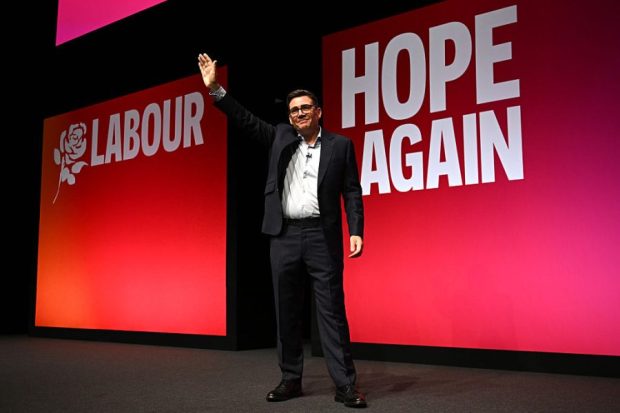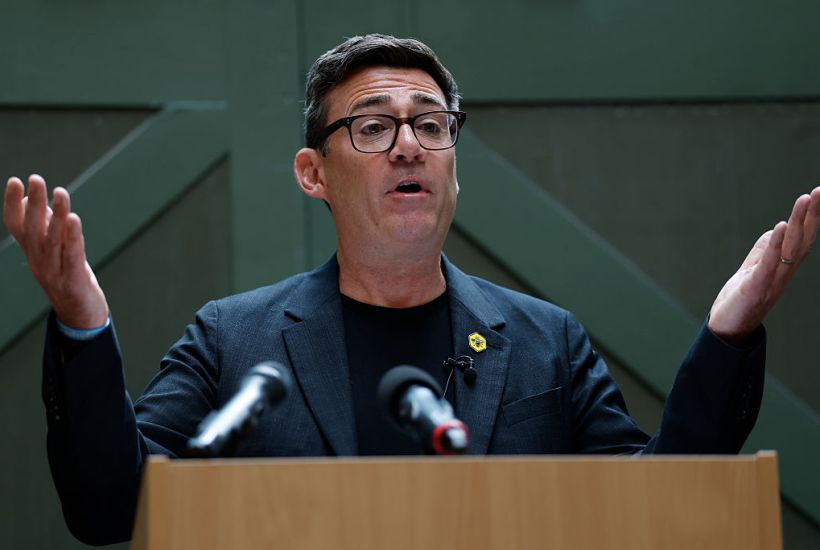
Every generation of politicians seems to believe that they are the first to discover the North. In Andy Burnham’s speech today he said that Britain was ‘over-centralised’ and that the ‘broken’ Westminster government was not working for the north-west of England. He promised ‘the biggest rebalancing of power our country has ever seen’, with decent infrastructure in all parts of Britain and ever more devolution.
Burnham rails against the London-centric approach of our politics and economy. But has such a centralised system actually been in place in our recent history?
It can’t have been during Keir Starmer’s government, which came to power on a pledge to ‘spread control out of Westminster’ and began an overhaul of council tax to fund the north at the expense of the South. It can’t have been during Rishi Sunak’s government – Rishi himself was the driving force behind the Darlington Economic Campus, which is part of a programme to move 22,000 civil service jobs out of London.
Urban regeneration has made a big difference in cities like Manchester and Liverpool
It can’t have been Rishi’s old boss Boris Johnson, who championed levelling up and freed up billions of pounds for investment in local infrastructure across the country. It can’t have been Theresa May, who kept up the Northern Powerhouse project, which she inherited from David Cameron. That initiative was spearheaded by the arch-neoliberal George Osborne. And the Northern Powerhouse was a repackaging of ‘The Northern Way’, another central government expenditure programme initiated by Tony Blair and kept on by Gordon Brown.
In the dark old days of John Major there were serious attempts to regenerate northern city centres such as Liverpool’s and Manchester’s, including the Single Regeneration Budget. The first British experiments in urban regeneration were entrusted to Michael Heseltine during the Thatcher government following the 1981 Toxteth riots.
Ted Heath had the Industry Act of 1972, designed to create industrial growth in regions outside the South East. When Harold Wilson returned to office in 1974, he revived his programme of regional economic planning, building on the pledge in Labour’s 1966 manifesto to ‘stop the drift of work and population to the West Midlands and the South East’. Jim Callaghan largely continued those policies after succeeding Wilson in 1976. Harold Macmillan said in 1962 that he wanted to ‘prevent two nations developing geographically, a poor north and a rich and overcrowded south’ and set up regional boards to that end.
As part of ‘Butskellism’, the Conservative governments of Winston Churchill and Anthony Eden continued to implement the redevelopment policies of Clement Attlee. Amongst other things, Attlee’s government introduced the Distribution of Industry Act of 1945 which created development areas in the North East, West Cumberland, South Lancashire, South Wales and Scotland. As a contemporary 1949 report, ‘The Distribution of Industry in Great Britain and its relation to Manpower Problems’, notes, this was building on the inter-war creation of ‘special areas’ from the Special Areas Act of 1934. These were areas which had suffered from industrial decline between the wars as British ship-building, steel and heavy engineering cratered, mostly because of weaker export demand caused by the international fashion for tariffs.
Spreading decision-making outside of Westminster and rebalancing the economy away from London and the South East has been tried in different forms and flavours by virtually every government we have had since 1945, and even before 1945.
It is not fair to say that the task is entirely Sisyphean. Urban regeneration has made a big difference in cities like Manchester and Liverpool. Burnham’s own political career has benefitted from this, as the afterglow of national regeneration schemes and investment into Manchester, the city he became mayor of, has helped to create his reputation for effective local government.
But the prize of diminishing London as the political, cultural and financial capital of the country and rebalancing the economy elsewhere has eluded governments of both parties. The agglomeration effects of over 9 million people living in the largest city in Western Europe, within an hour of the country’s best universities and with private financial infrastructure like the London Clearing House and Lloyd’s of London, are simply too powerful to overcome.
There’s another problem. Using state power in this kind of uphill struggle against market forces is by its nature inefficient. Regeneration is understandable in the context of strong economic growth, as in the 1990s, but Andy Burnham does not have those winds against his back. He should be focusing on finding growth wherever he can, not dreaming up ways to redistribute it.