It’s possible, though not popular, to feel a bat-squeak of sympathy for Sir Keir Starmer on a human level these days. It can’t be much fun being him.
It’s also possible, though not popular, to hold in your head at the same time the ideas that a) he’s been a pretty useless Prime Minister and b) he isn’t an actual monster. He has, where he has made any decisions, made terrible decisions. He has led from the back, thrown his colleagues merrily under a whole succession of Number 37s when things have gone wrong, switched tack at the first whiff of cordite, been serially economical with the truth and stubborn in his refusal to recognise reality. None of this redounds to his credit.
Is this loathing, we should ask, strictly proportionate? Is it, y’know, sane?
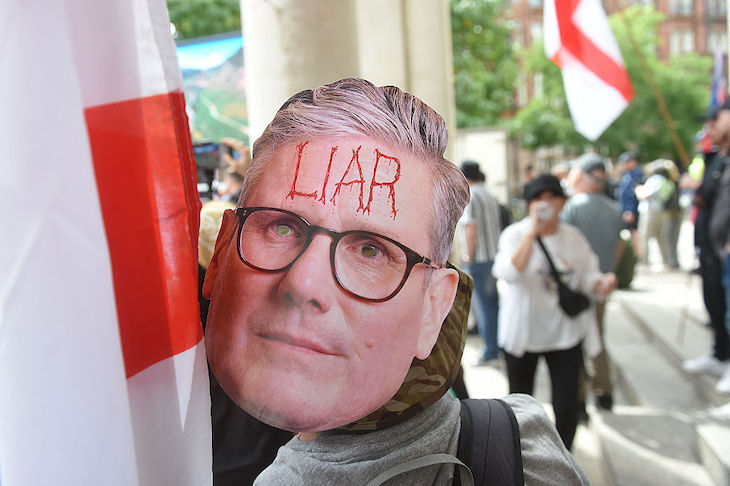
But he isn’t just disliked or disapproved of. He is actively, fiercely, loathed. Even what you’d think would be an unobjectionable social media post yesterday, calling a violent anti-Muslim attack on the streets of Edinburgh “absolutely appalling” and making the surely uncontroversial assertion that “no one should face violence on our streets” was swarmed with spite.
“F**k off you racist anti white Muslim loving c**t,” was one of the top responses on X. (Good with four-letter words; bad with hyphens. See teacher.) Most others took the line that he was a despicable hypocrite for objecting to random Muslims being attacked on the streets because, apparently, he had been indifferent to or actively in favour of Muslim men carrying out a programme of mass child-rape.
Is this loathing, we should ask, strictly proportionate? Is it, y’know, sane? And, sure, this is just social media and a particularly toxic section of it. But toxic social media has profoundly transformed the media, and therefore the political, landscape of the country. Everything has to be the worst, the most outrageous, the most hateful. Disappointment with an incumbent Prime Minister has been a feature of the cycle since long before any of us were thought of, but this is steroidal, metastatic, dangerous – and not so much dangerous to the fleeting objects of this loathing as to the body politic itself.
Loathing is now the great engine of our politics. Keir Starmer came to power because everyone loathed the Tories and many within his party loathed Jeremy Corbyn. Andy Burnham has returned to Parliament, mostly, because the voters of Makerfield loathe Keir Starmer, but also in part because Rupert Lowe loathes Nigel Farage. The Green Party and Reform are doing well, where they are doing well, because their voters loathe someone else: “Zionists”, rich people and conventional politicians in one case; immigrants, liberals and conventional politicians in the other.
Most voting is now about getting rid of someone you loathe, or voting for someone you loathe a bit less to prevent someone you loathe a lot more from taking power. Boris Johnson, popular at first, came to be loathed. Andy Burnham, popular now, will come to be loathed. Kemi Badenoch was quoted recently as exclaiming with something approaching jubilation: “I’m the least hated party leader!” Just you wait, ducky. In the unlikely event you get into power, you’ll find that changes.
Loathing is a very attractive emotion. It feels good. It doesn’t require the tedious work of empathy or compromise or doing the sums to understand why we can’t have all the nice things we want all at the same time. Plus it plays very well, and in some cases even profitably, on social media. But it’s no way to drive or choose governments. As Johnny Rotten pointed out, anger is an energy. But it’s an energy that can only destroy (or, as the Pistols would have it, de…stro-o-o-o-y) – not build.
Rik from The Young Ones, readers of a certain age will remember, was filled with loathing for Mrs Thatcher, aka “Thatch”. He had constructed an entire political identity out of this one-dimensional hatred. But he was also an undergraduate poseur of extremely callow understanding. Even the relatively left-leaning writers of the show – Ben Elton and Alexei Sayle weren’t exactly Young Conservatives – intended viewers to find him ridiculous, and we did. But now we’re expected to take seriously an entire social media ecosystem, an entire nation of vox-pop pundits and below-the-line philosophers, composed of Rik from The Young Ones. They’ve got “legitimate concerns”, yeah?
For various reasons, many of them structural (there’s not enough money; the machinery of government is falling apart) and some of them cultural (we live in an age of algo-driven rage, babyish consumer entitlement and ferocious short-termism) running the country is a next to impossible job. It’s no longer about being a leader: it’s about being a sin-eater.
To get elected, every politician either has to promise all the nice things all at once (mainstream parties) or promise all the nice things all at once while mobilising hatred of their opponents (insurgent parties). And in due course, when it turns out there are hard, boring reasons that we can’t have all the nice things all the time, we turn on our politicians in the manner of Goya’s “Saturn Devouring His Son”. Good luck to Andy Burnham, then. By God he’s going to need it.