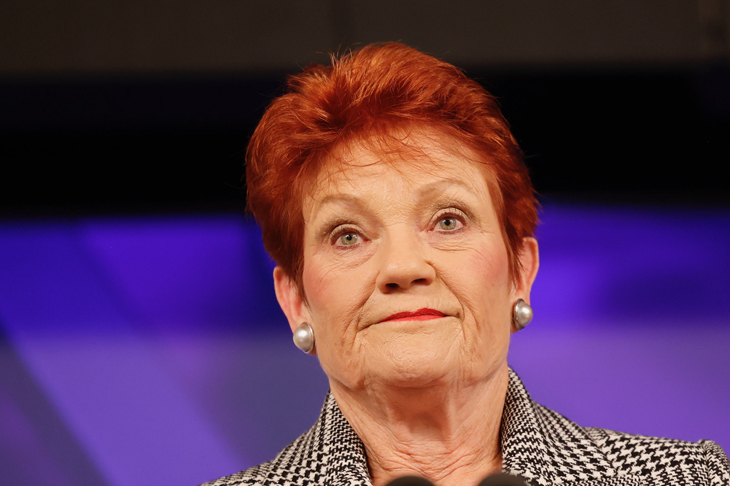
In her address to the National Press Club this week, Senator Pauline Hanson took aim at the financial disaster that is Snowy Hydro 2.0, saying One Nation would axe it. Hard to argue with that. Malcolm Turnbull’s nation-building vision has degenerated into a cautionary tale about political vanity, bureaucratic incompetence and the infinite capacity for taxpayer-funded projects to explode in cost.
But since One Nation is committed to slashing wasteful government spending, why does Hanson want to repeat the experiment in the gas industry? Last month, Hanson unveiled One Nation’s gas policy. The centrepiece is a proposal to establish a government-owned investment vehicle — the Australian Natural Wealth Investment Corporation — that would acquire up to 30 per cent equity stakes in gas projects, supported by taxpayer-funded exploration rebates. Profits would be channelled into a sovereign wealth fund.
The policy is sold as a bold alternative to Labor’s left-wing economic interventionism. In reality, it looks more like right-wing economic interventionism. Hanson is right to condemn Snowy Hydro as an example of government failure, but why does she think the government would be any better at investing billions of dollars in gas projects, allocating capital wisely and managing a sovereign wealth fund?
At least One Nation is not proposing that public servants operate gas fields. The policy explicitly recognises that expertise resides with private industry. The government would be a non-operating partner, sharing costs and profits while leaving technical management to industry. But that merely changes the question. Why should taxpayers become investors at all?
The justification appears to be Norway. Hanson and her supporters have repeatedly pointed to its enormous sovereign wealth fund and argued that Australians deserve a larger share of the benefits flowing from their natural resources. The difficulty is that Norway’s success rests on far more than government ownership.
Norway combines state participation with one of the world’s most comprehensive petroleum tax regimes. Oil and gas companies pay ordinary company tax plus a special petroleum tax that together impose a marginal tax rate of around 78 per cent on petroleum profits. The Norwegian state captures a large share of resource rents through taxation before it even begins to discuss equity ownership.
One Nation wants the sovereign wealth fund and government ownership associated with the Norwegian model, but it rejects the taxation framework that generates much of Norway’s resource revenue.
If Australians are not receiving a sufficient return from their gas resources, why not just reform the tax system? Why create a new government investment corporation? Why expose taxpayers to exploration risk? Why ask politicians to allocate capital? Why not simply ensure that profitable projects pay an appropriate return to the public that owns the resource?
One Nation’s gas policy is not an isolated proposal. It forms part of a broader economic worldview that favours government intervention, national ownership and restrictions on foreign capital.
That worldview extends to the party’s foreign ownership policy. It would prohibit foreign investment in power, water, telecommunications, roads and ports and prevent non-citizens and non-residents from purchasing Australian property. It also proposes a clear legislated definition of the ‘national interest’ based on national security, competition, tax, a character test and ‘any other impacts to Australia’. Yet any definition that includes ‘any other impacts’ is not a definition at all. It effectively grants governments unlimited discretion to block investments for whatever reason they choose. Investors can adapt to strict rules. What they fear is arbitrary rules. A government that can redefine the national interest at will creates uncertainty, discourages investment and increases sovereign risk.
One Nation treats foreign ownership as a single category. In reality, most foreign investment in Australia comes not from hostile powers but from friendly democracies such as the United States, Canada, Britain and Japan. The policy draws little distinction between a state-linked Chinese enterprise acquiring strategic infrastructure and a Canadian pension fund investing in a toll road.
Preventing foreign investment in essential infrastructure may sound appealing, but infrastructure requires enormous amounts of capital. If foreign capital is excluded, Australians must either provide the capital themselves or accept higher taxes, greater government borrowing, or less investment. One Nation never explains which of these outcomes it prefers. None sounds attractive.
The same philosophy is evident in One Nation’s agricultural policy. The party proposes banning further sales of freehold farmland to foreign investors, restricting leasehold arrangements and reintroducing additional Foreign Investment Review Board scrutiny. At the same time, it advocates the creation of a federal government-backed rural lending fund to support farmers through drought and other adverse events. Restrict foreign capital. Expand government capital. The formula appears again and again throughout One Nation’s economic program.
Water policy reveals a similar tension. Foreign participation is restricted, new government bodies are proposed, and large public infrastructure programs are favoured over market solutions. While the policy contains worthwhile reforms, it reflects a preference for government direction over market allocation.
It is the same dynamic in agricultural policy. Private capital is viewed with suspicion, while government capital is viewed as the solution. Foreign investors are discouraged from investing in Australian agriculture, while taxpayers are expected to step in via a government lending facility. One Nation’s reflex is to call on Canberra bureaucrats to allocate capital rather than private lenders or investors.
Whether the issue is gas, farmland, water or infrastructure, One Nation’s economic instinct is remarkably consistent. Economic problems are framed as ownership problems. The proposed solution is usually some combination of restrictions on foreign capital and an expanded role for government capital. Yet nations become prosperous not by scrutinising investors’ passports but by attracting investment, encouraging enterprise and increasing productivity.
It’s ironic then that while One Nation invokes the language of free enterprise and national self-reliance, so many of its economic policies point towards a larger role for government, greater political discretion and increased state involvement in the allocation of capital.
It’s a pity. Australia does not suffer from a shortage of politicians who think they know how to run the economy. It suffers from a shortage of politicians who understand the things governments should leave alone.
Got something to add? Join the discussion and comment below.
You might disagree with half of it, but you’ll enjoy reading all of it. Try your first month for free, then just $2 a week for the remainder of your first year.