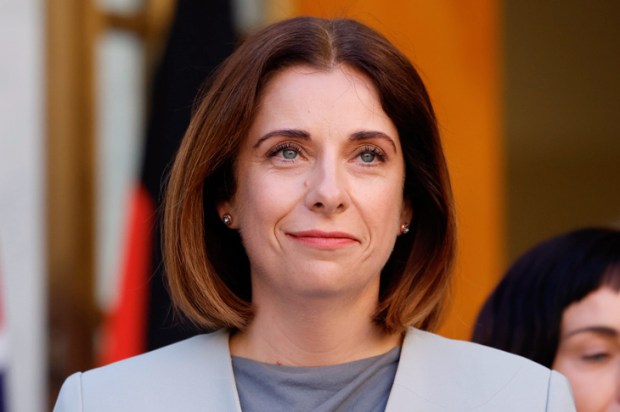
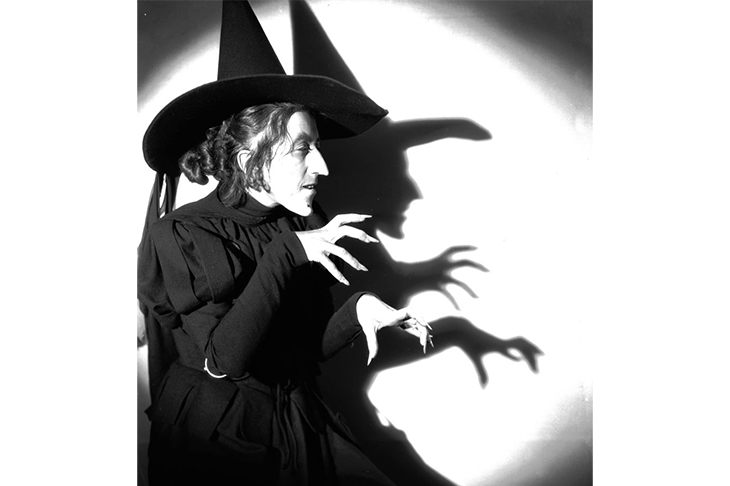
Melbourne is presently engaged in one of those uniquely Melburnian controversies where everyone has an opinion on some allegedly moral issue of right and wrong. This time, the outrage is directed at the propriety of dressing up a truck with placards denouncing the Premier of Victoria, Jacinta Allan, and using it as a piece of mobile advertising, with an obvious eye on the coming state election. And the most combustible spark that has ignited this controversy is that one of the placards on the truck has an unbecoming picture of Ms Allan wearing a witch’s hat, with a large dollar sign and the provocative war cry ‘Ditch the Witch’.
The reaction of virtually all of the media and the public commentariat has been to condemn these clearly political advertisements.
The grounds on which the mobile advertising campaign has been criticised are threefold. First, it is said that it is personalised, directed at a woman and therefore clearly sexist. Secondly, and moving up the thermometer of outrage, the next criticism is the use of the expression ‘Ditch the Witch’, because it allegedly incites the public to use violence to get rid of the Premier, up to and including hanging and drowning, as that was the punishment meted out to witches in ancient times. The third and most trenchant criticism is that the advertising illustrates a disturbing trend in politics and public debate towards extremism, demonisation of opponents and disrespect.
Let us have a look at each of these grounds to see if they have any substance. And I may as well say at the outset that for my part I find them confected, exaggerated, hypocritical and a sustained attack on free speech; indeed, it is the criticism of the advertising campaign, not the advertising itself, that should be condemned. The advertisements are a legitimate, and vigorous campaign against an unpopular political leader standing for re-election and hence are entirely legitimate. They were intended to be provocative and have been a success, for in politics provocation attracts attention and generates debate.
The first ground, that the advertisements are sexist and discriminatory, because Ms Allan is a woman, is complete nonsense. They were directed against a politician who happens to be a woman. Politics today, fortunately, has an increasing number of women in its ranks; indeed, at Ms Allan’s own press conferences, she is usually surrounded by a bevy of nodding supporters, most of whom are women, to the extent that they are themselves being used as political props. It is ludicrous to suggest that half of the political community should be a protected species and immune from criticism simply because of their gender. In any case, if men can be pregnant, as we are told by our illustrious Human Rights Commission, women should at least be as open to the same political argument and criticism as men. And left-wing critics have poured distasteful and personalised venom on male politicians like Tony Abbott and Donald Trump for years, presenting them as barely human and going far beyond the harmless debunking of Ms Allan. Pauline Hanson has been specifically denounced as a witch and no one has run to her defence as a woman, because she is resilient enough not to need it. Nor was there any outrage when Margaret Thatcher died and the BBC pumped out the song ‘Ding Dong the Witch is Dead!’. Of course, Mrs Thatcher was a conservative and Ms Hanson likewise and, as we know, there are different rules for abuse when the target is on the right, rather than the left.
Secondly, as to the argument that the advertisements are exhorting violence to get rid of the Premier, this is equally nonsense. The word ‘ditch’ as in ‘Ditch the Witch’ has a clear meaning, verified in the dictionaries and common parlance, as being to discard or abandon, a fitting and legitimate political proposition. So, it is precious in the extreme to say that any normal, thinking person would read the expression as an injunction to kill or drown Ms Allan. It is a gross exaggeration to distort language in that way.
The third ground, that the campaign against the Premier is extreme and disrespectful, certainly shows a disturbing trend, as the media claims. But the trend it shows is one designed to stifle legitimate debate. Naturally, Anthony Albanese has put himself into the righteous camp, asserting that the political temperature should be ‘turned down’, meaning that people should stop criticising him in terms that are effective and reach their mark. It was apparently acceptable for him to brand Grace Tame as ‘difficult’, which the elites say is ‘a code word to silence strong women’, and to launch a highly personalised attack on fund manager Geoff Wilson for criticising the changes in the capital gains tax. Caught up in this litany is the allegation that it is all the fault of the internet and populism, as if any view that is popular must be wrong.
Chief among the censors is the ultra-sensitive commentator for the Age on women’s issues, Jacqueline Maley. She has gone full throttle, condemning the advertisements as ‘Maga-like’, and in bad taste for using a photograph of Ms Allan taken while she was frowning, as it implied she was ‘wicked’ and that the advertising had denigrated women for their looks. This criticism comes right on cue after her sustained criticism of ‘irony and satire’, that they are unacceptable because they are ‘AI-powered disinformation’, an ‘arc of trolling’, and allegedly adopt a ‘meme-ified, ironic internet avatar’ and nothing but ‘emotive language.’
The foregoing will, I hope, explain why I say that our most valuable commodity in public life is free speech and open political debate. We should encourage it and not stifle it. In that regard there should be no more of the intimidation that we see today in Melbourne of those who use their own original language to stimulate debate, including colourful and trenchant criticism of politicians. And I especially hope that the victims of this intimidation will keep using the satire, irony and memes that the misery police find so distasteful.
Got something to add? Join the discussion and comment below.
You might disagree with half of it, but you’ll enjoy reading all of it. Try your first month for free, then just $2 a week for the remainder of your first year.