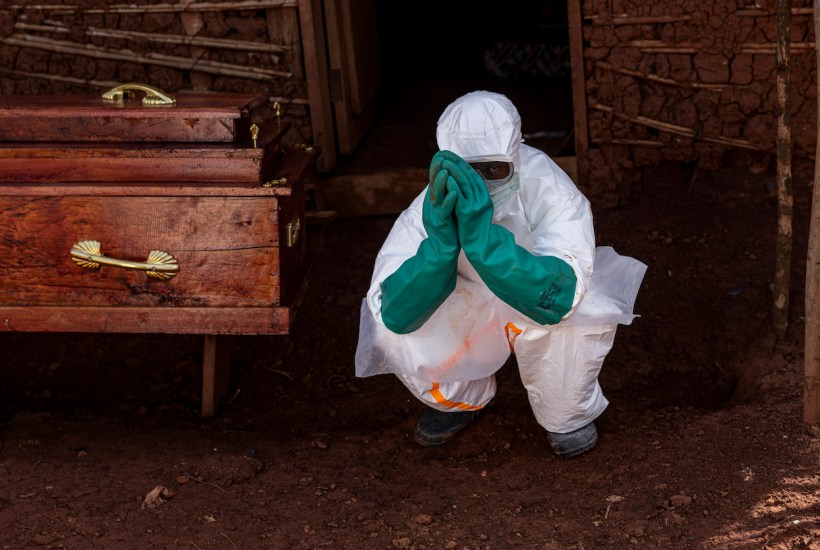
Ebola is a very scary disease, the sort of nightmarish plague seen in a Hollywood disaster movie with gruesome symptoms and terrifying death rates. It starts with a fever and headache, confusingly similar to malaria or typhoid, but all too often ends with bleeding gums, diarrhoea and vomiting before a disoriented patient suffers chronic organ failure. Now it has erupted again in the heart of Africa. Medics on the Congolese frontline fear their efforts to contain this lethal haemorrhagic virus are floundering, with official warnings that it could spread to nine more countries.
There are grim echoes of the 2014 outbreak, when almost 30,000 people in three West African nations were infected. Early warning signs have again been missed, including the death more than one month ago of a nurse in Mongbwalu, a remote gold mining town thought to be the epicentre that saw a spate of similar fatalities among health workers and within families. Cases are surging with frightening speed and cropping up in multiple sites, including over the border in Uganda. There are at least 1,000 suspected cases – with 400 in Mongbwalu alone – and 246 confirmed deaths. The World Health Organisation has declared a public health emergency of international concern. ‘The virus knows no borders, it knows no race, it knows no tribe,’ said Roger Kamba, Democratic Republic of Congo’s health minister. ‘The virus affects us all.’
This is the seventeenth outbreak in his country since discovery half a century ago of this disease, which spreads from infected animals such as fruit bats. But it has already become the third worst Ebola incidence on record, just a fortnight after its official declaration. Congo’s previous worst Ebola explosion was eight years ago; it took two years to quell and caused 2,229 deaths. But this strain is the much rarer Bundibugyo strain, not the usual Zaire, complicating the response: since standard tests do not pick it up, patients often die in the time it takes to receive results in such an area and there is no vaccine. ‘We are back in a similar situation to 2014 where there is not capacity to reduce the mortality rate with treatment or through prevention with a vaccine,’ said Chris Hook, emergency team leader with Médecins Sans Frontières.
It is horrible to see this cruel disease carving through families and close-knit communities – as I witnessed in Liberia in 2014. The virus is hard to catch but devastating in impact, especially when it erupts in a place such as Mongbwalu, a haven for 150,000 people surrounded by rebel-held terrain in a region riven with conflict and warlords. I will never forget the terror it spreads – as expressed by one distraught father who had lost his wife already and stood with four sick children trying to get into a clinic overflowing with Ebola patients while his trembling oldest daughter whispered her fears of death to me. Or indeed, seeing smouldering ash with shards of human bones sticking out, the grisly remnants of 700 human beings.
Banks and borders are closing in north-eastern parts of Congo while humanitarian groups battle transport curbs to rush in medical teams. But it is hard to spread their safety messages in places where years of conflict, ethnic tensions, predatory officials and scores of prowling militia – including one tied to Islamic State – fuel conspiracies and shatter trust in authorities. Crowds, incensed over being denied access to bodies for traditional funeral practices, have torched two treatment units. ‘People are very afraid but some young people do not respect information or say Ebola does not exist,’ said Julienne Lusenge, president of a women’s aid group whose hospital in Bunia came under attack.
Such groups are struggling with shortages of supplies such as protective clothing and body bags to bury contaminated corpses, while the virus intensifies economic pain. And predictably, the aid industry instantly blamed the recent wave of western aid cuts in Washington and several key European donor nations including Britain for worsening this crisis. The International Rescue Committee insists funding cuts led to delayed detection, Save The Children says ‘none of us have enough funding’ and patsy media push claims that the response was hindered by funding reductions for the WHO and Washington’s Centers for Disease Control and Prevention.
Benjamin Black, a British obstetrician, gynaecologist and author who works for MSF, responded to both the 2014 and 2018 Ebola outbreaks. He argued that initial testing would not have picked up the Bundibugyo virus since formulated for the more common strain. ‘Even if they were testing, there would have been false readings saying there was no Ebola,’ he said. ‘No-one can say that this ebola outbreak is the result of aid cuts, the fault of the WHO or even of local health services.’ Black added that he ‘shuddered’ to think about the impact of Ebola – a disease that disproportionately impacts on women as primary carers – in such countries without emergency humanitarian groups such as MSF, although said rightly that there is a big difference between development and humanitarian aid.
So perhaps those charities bleating about shortages of funds might examine their own priorities when the IRC is led by Britain’s former foreign secretary David Miliband on a seven-figure annual salary and Save The Children has some 100 staff based in London on six-figure packages. Sources at the Centers for Disease Control and Prevention tell me there was no reduction in baseline staffing in DRC since funding shifted from USAid to the State Department. And when I put the claim to a leading European figure in the response, he said it was ‘absolute nonsense’, since all key charities were operational in the field. ‘There’s not been a big reduction in support here,’ he said. ‘It took too long to detect but it is super difficult in this part of the world.’
In the last big Congolese outbreak, there was rampant fraud
If the aid industry wants to use Ebola for debate, however, there are many issues to discuss about wasted funds or flawed policies. In 2014, local health services were riddled with corruption; just £2.5m out of £19m given by the European Union to Liberia’s health ministry reached its destination, for instance, although Brussels kept quiet. There were scandals over missing vaccination funds and patients forced to pay bribes to access a British-funded programme proclaimed as delivering free care for pregnant women. The sacred WHO initially slapped down MSF for flagging up alarm, then took four months to admit there was a crisis in what was branded ‘the most egregious failure’ in a later inquiry. And when I was in Liberia the following month, only one other western charity was operational alongside MSF before others eventually joined them – then Oxfam was caught using images of an MSF worker to raise funds while others made hollow boasts about their key roles.
Sadly, these are far from isolated examples. In the last big Congolese outbreak, there was such rampant fraud and blatant abuse that a ‘sex for jobs’ scandal was labelled an open secret by Westminster. ‘We fear that what happened during the 2018-2020 Ebola response in the DRC could continue to occur in humanitarian aid settings around the world,’ reported the International Development Committee. Or indeed, ask why Britain handed £900m to support Paul Kagame’s toxic dictatorship in Rwanda when his hands are so covered in blood from killing, looting and funding of murderous militia in afflicted parts of neighbouring Congo.
The focus should be on ensuring rapid and effective support for all the heroic health workers and local volunteers fighting this horrible virus, not the posturing of a self-serving aid lobby wedded to failed policies from the past.