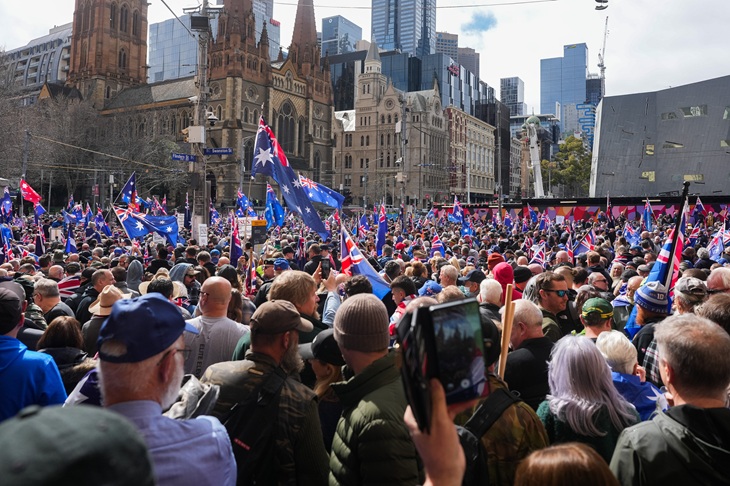
Australia’s rapid population growth is often linked to the sheer size of Asia’s population. Look how many people there are up there! Surely it’s inevitable that we will have to fit a lot of them down here…
Recent trends support this intuition. Data just published by the Australian Bureau of Statistics show Australia’s population increased by 3.8 million people between 2015 and 2025. Around 1.7 million of those extra people – 45 per cent of the total increase – were born in Asia. Foreign-born residents rose from 28 percent of the population to 32 percent over this period, with the Asian-born share up from 11 percent to 15 percent.
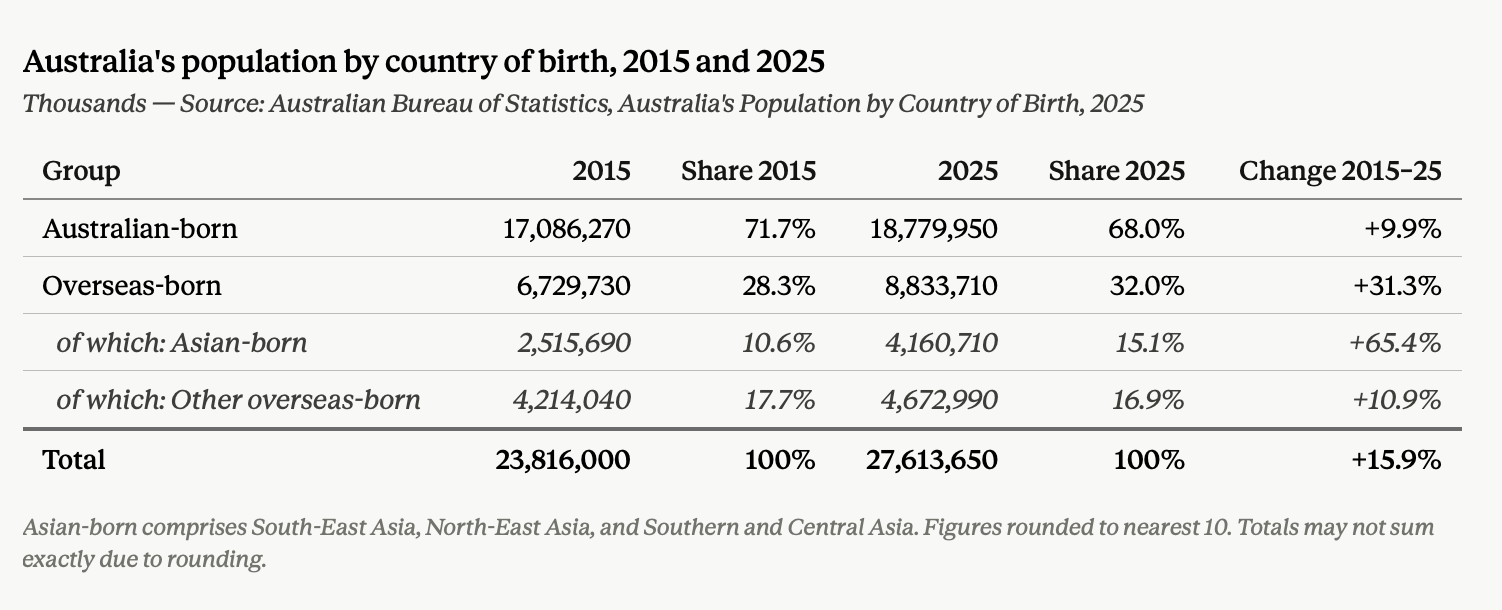
Low birth rates mean that whenever Australia’s population increases, the foreign-born share is almost certain to increase too. And given that Australia’s population growth is largely driven by Asian immigration, a bigger Australia is a more Asian Australia.
But something momentous will happen in Asia in the next few decades – its population will start to fall. By 2100, Asia’s population is projected to fall by 225 million people. So why is Australia’s population projected to increase by 16 million over the same period? Why so big?
The reason is policy, not destiny. It is a choice.
Once Asia’s population starts to fall around mid-century, this source of growth for Australia’s population will likely become harder to sustain. That means that the decisions we make in the next thirty years will play a decisive role in shaping the size and foreign-born share of Australia’s population for future generations.
Fewer in the Region but Many More Here
The United Nations publishes historical estimates and future projections of each country’s population every two years in its World Population Prospects dataset. Those projections include the ‘best guess’ – the median variant – based on assumptions about fertility, mortality and immigration flows.
Australia’s share of the combined Asia and Oceania population has stayed within a narrow band of 0.5 percent and 0.6 percent since 1950. Our share of the world population has been even more stable, between 0.31 per cent and 0.34 per cent. The regional and global population has surged, but our share of it has stayed steady.
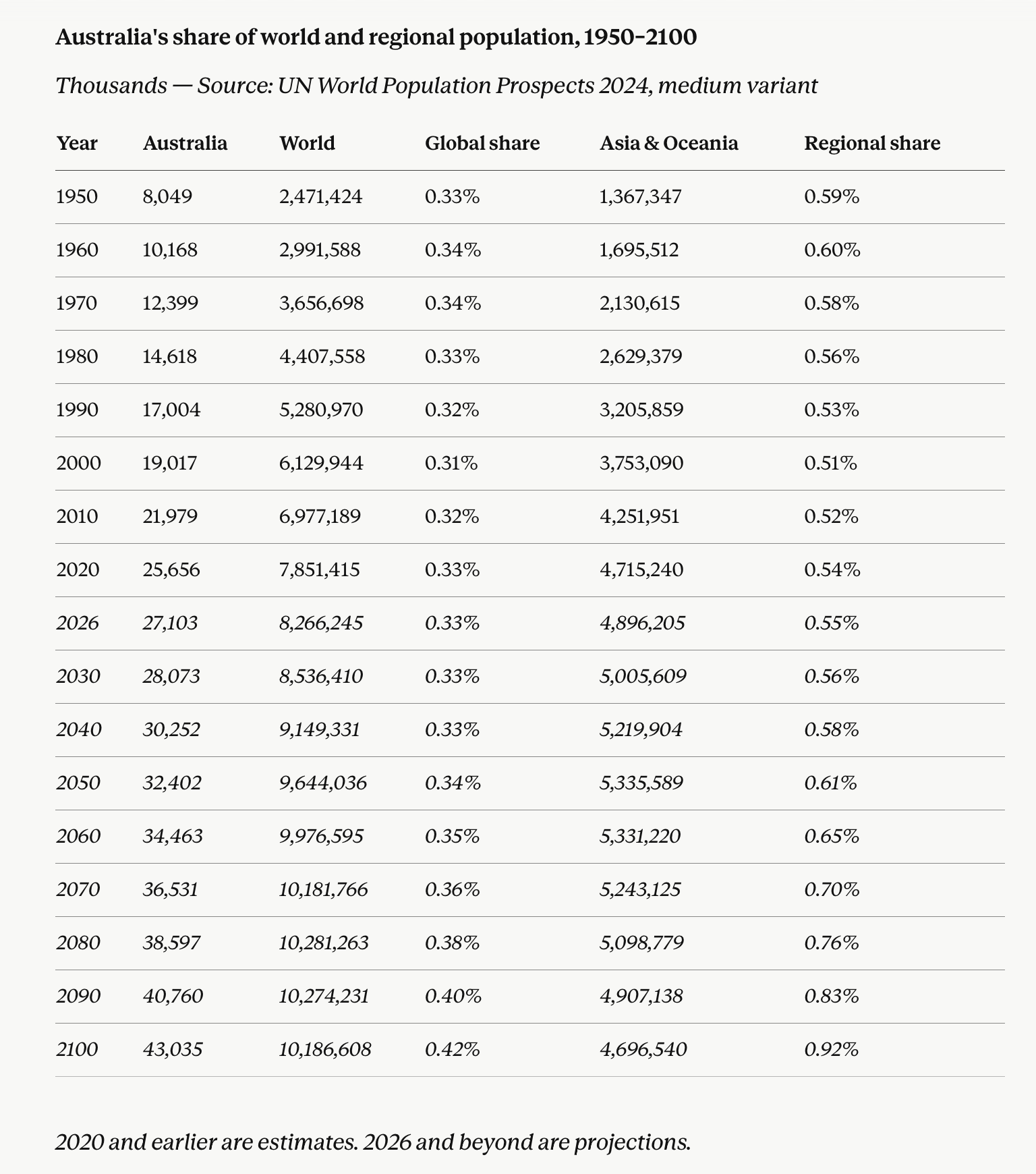
The UN projections show the Asia–Pacific population peaking around mid-century. From 4.9 billion in 2026, the combined population of Asia and Oceania is expected to increase to 5.3 billion in 2050 and then fall to 4.7 billion by 2100. There will be far fewer people in this part of the world in 2100 than there are now.
But Australia’s population, in contrast, is expected to keep expanding right through to the end of the century. And not by a little – from around 27 million now to just on 43 million in 2100. That’s an increase of nearly 60 per cent.
Australia is not only an outlier in the region but also among other Western nations. Western Europe’s population is projected to fall by the end of the century, while the United Kingdom, Canada, and the United States are all expected to record much slower growth than Australia.
With the Asia-Pacific population set to decline, an increase in Australia’s population implies an increase in our share of the regional total. If the UN’s best guess is correct, that share will rise from 0.55 per cent in 2026 to 0.92 per cent in 2100, well above its long-term range. Australia’s share of the global population is also projected to increase from 0.33 percent to 0.42 per cent.
Although Australia would remain less than 1 per cent of the population in the Asia-Pacific region, an extra 16 million people living on this continent would still be a very big deal. And the impact of this increase would be particularly transformative because it would be driven almost entirely by immigration.
43 Million People in 2100 Is a Choice
Australia’s birth rate has been below replacement for decades and is unlikely to recover anytime soon. That means any future increase in Australia’s population will be driven by immigration. The trajectory shown in the UN projections is not inevitable – it is set by immigration policy.
The UN’s medium variant assumes Australia’s migration rate will continue in line with the long-run historical average – around five net arrivals per thousand residents per year. This is one of the highest rates in the world, a bit below Canada’s but well above other Western nations.
If Australia decides to do that, our population will get much bigger, the foreign-born share of our population will get much bigger, and our share of the regional population will get much bigger. Most of that growth will likely rely on immigration from Asia.
But that growth would be a choice. And with Asia’s population set to fall, that choice would involve recruiting people from a pool that’s getting smaller.
The Next Thirty Years Will Be Decisive
Japan’s population peaked decades ago. China, a major source of Australia’s recent migrant intake, is estimated to have peaked in 2021. After Asia peaks around 2050, India – now the largest single source of Australia’s intake – is projected to follow in the 2060s.
Asia will get richer in coming decades, reducing the incentive for its middle-class to emigrate. And as their populations begin to shrink, Asian governments will likely become less willing to see their working-age populations recruited abroad. Efforts to encourage their respective diasporas to ‘come back home’ may also emerge.
Thirty years from now, the major driver of Australia’s population growth – Asian immigration – will likely be much harder to sustain. This means that the next thirty years will play a huge role in shaping Australia’s future.
If you want a much bigger Australia, the next thirty years will be the time to act. Maintaining high immigration from Asia over this period will lock in a much bigger population, while also resulting in a much higher foreign-born share of the population. That would likely get harder to achieve once Asia’s population starts to decline.
The next thirty years are equally crucial if you don’t think it’s a good idea to increase the size and foreign-born share of Australia’s population significantly. If immigration is scaled back over the next few decades before Asia’s population peaks, it will get much easier to sustain both a smaller size and a more stable foreign-born share of the population.
Whatever decisions are made – or not made – in the next thirty years will be difficult to reverse after that.
Debate the Future
An Australia of 43 million would not just be a scaled-up version of an Australia of 30 million or 35 million. The bigger you want Australia to become, the higher immigration will need to be – and the higher the foreign-born share of the population will get. That share is already just under a third. If Australia’s population were to increase by another 16 million by 2100, close to half of all residents would likely have been born overseas. Maybe even more.
A very big Australia would be a very different Australia. Apart from the impact a much larger population would have on our cities, economy and environment, a much higher foreign-born share of the population would likely impact our institutions and culture profoundly. Whatever your views about the costs and benefits of such a transformation, it is clearly consequential and should be debated.
But that debate should not assume this transformation is inevitable. For several decades, Australia has maintained a steady share of the Asia-Pacific population. If we want to, we can maintain that stability for the next thirty years and beyond by choosing an immigration policy that delivers population growth more in line with the rest of the region.
What Australia will be like in 2100 will not be determined by UN projections. It will largely be shaped by decisions current Australians will make in coming years. That is a debate Australia should have.