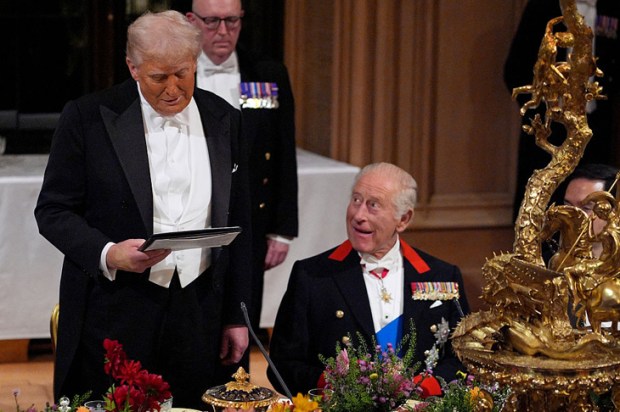
The Royal Visit to Washington, DC has been nothing short of a diplomatic triumph, with King Charles III and President Donald Trump emerging with their reputations significantly enhanced.
It was King Charles III who, with a mixture of dry wit and deep historical perspective, truly captured the American capital’s and therefore the world’s attention.
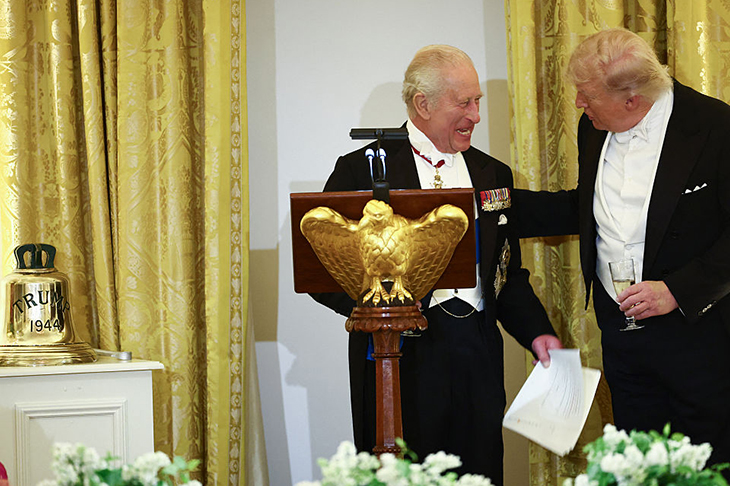
To Australia’s great benefit, Charles made a point of drawing the attention of Washington to the nation in a way no Australian president ever could – even one of the eminence of a President Rudd or a President Turnbull. Charles particularly told Congress of his pride in being our King. As the Sydney Morning Herald’s Michael Koziol wrote, while the ‘special relationship’ was the focal point at the exclusive White House dinner that evening, Charles had ensured Australia had the most memorable moment. This was through his personal gift, the beautiful original bell from HMS Trump which had spent most of its life in Australia playing a ‘critical role’ in the second world war.
Linking his gift to the Australian alliance, Charles wittily described it as from ‘an Aukus predecessor’.
Proposing it stand as a testimony to ‘our nations’ shared history and shining future’, he added, in his inimitable way, ‘And should you ever need to get hold of us, just give us a ring.’ Charles thus ensured the evening and the visit was not just a diplomatic success; for ‘le tout Washington’, it was the social event of the decade.
As to President Trump, he was not backwards in describing the essentially British origin of what was to become the United States. He confirmed the historical proposition that the American Revolution was not a rejection of British values, but rather, a fierce defence of them. As the President insisted, Americans have had ‘no closer friends’ than the British, sharing the same roots, speaking the same language, and holding the same values. Together, he said, ‘our warriors have defended the same extraordinary civilisation’. Before ever proclaiming our independence, Americans carried within them, he declared, ‘the rarest of gifts – moral courage – and it came from a small but mighty Kingdom from across the sea.’
This touches on a profound truth: the Americans fought for independence only because they were already the freest people in the world.
Meanwhile, the King, with a twinkle in his eye, had reminded the room that, but for the British, the language of the day might have been very different. To even the contributions between the colonists and the home country after the long war against France, Britain had attempted to raise funds through taxation. They had not realised their free colonies had actually grown up and should have been consulted first.
The colonists’ appeals to the hitherto respected King George III fell on deaf ears; he was unconditionally committed to the sovereignty of parliament – a principle settled after the bloody Civil War which had culminated in the trial and the execution of a king and the flight of another. By the time of the American Revolution, the extra-constitutional shift of a dynasty had ensured that parliament, not the king, held ultimate power in what would be thereafter an evolving constitutional monarchy.
Nor was the dispute limited to ‘no taxation without representation’. Other, less ‘noble’ issues were at play, such as the 1763 Great Proclamation forbidding colonists from settling on Indian land west of the Appalachian Mountains. London viewed existing colonial land as ample and wished to avoid further conflict with Native American nations. Furthermore, the landmark Somerset v. Stewart (1772) case had effectively ruled that slavery had no basis in the English common law. The barrister’s summary of the case – that ‘the air of England is too pure for a slave to breathe; let the Black go free’ – terrified colonial slave owners, who feared staying under the Crown would lead, as it did, to the abolition of the slave trade and of slavery itself.
Indeed, it even led to Britain’s long, expensive and noble campaign through the Royal Navy against the slave trade, as well as the extraordinary parliamentary abolition of that institution within the whole empire.
Despite an antipodean media suggestion that the King’s address to Congress was ‘clearly scripted’ by the UK Prime Minister, the performance told a different story. While a constitutional monarch naturally aligns with government policy and agrees with the Prime Minister on essential matters, there is no justification for the claim that the King merely read a Whitehall product. Senator Ted Cruz was so struck by the rare eloquence displayed, he even wondered whether special outside talent had been engaged in the drafting. Yet, the brilliant stories chosen and the magisterial style in which they were relayed – including the link between house renovations and the War of 1812 – bear precisely the King’s personal hallmark. Recalling the British attempt to burn down the White House in August 1814, the King noted:
‘I cannot help noticing the readjustments to the East Wing, Mr President, following your visit to Windsor Castle last year. And I’m sorry to say that we British, of course, made our own small attempt at real estate redevelopment of the White House in 1814.’
Meanwhile, the response in the Congress had been unprecedented with the King receiving multiple standing ovations, leading to Trump’s amazed observation:
‘He got the Democrats to stand… I’ve never been able to do that!’
While some observers harbour an irrational and blinding hatred of Donald Trump, the King’s visit bypassed the noise. By giving Australia ‘top billing’ and presenting the bell from HMS Trump, he drew the world’s attention to the Aukus treaty.
This was a style and a quality of communication of a rare class headed by those other masters of English, Churchill and our own Sir Robert Menzies. These contributions are being, and will long be, studied around the world.
In an age of division, the King proved that a sovereign can command a level of respect and attention that no partisan politician ever can. It was, by every measure, a royal triumph and thanks to him, one for Australia too.
Got something to add? Join the discussion and comment below.
You might disagree with half of it, but you’ll enjoy reading all of it. Try your first month for free, then just $2 a week for the remainder of your first year.