For some reason it took nearly a decade for the news of a revolution in the restaurants of France to reach the British media. The Americans were much quicker off the mark. In March 1972, Raymond Sokolov reported in the New York Times that a chef near Lyon named Paul Bocuse, along with several of his colleagues, including Michel Guérard and Alain Senderens, were serving their customers ‘a radical simplification of the grand cuisine of the 19th century, the heavy, formal style of cooking codified by Escoffier’. Luke Barr, whose latest book is a compelling history of this culinary earthquake, last wrote about the crook, embezzler and fraudster who curiously remains the patron saint of professional cooks in Ritz & Escoffier (2018).
It was only in 1980, when I joined the Observer, that the British national press ran my pieces introducing ‘la nouvelle cuisine’, as it was dubbed by two French gastronomic journalists and restaurant guide publishers, Henri Gault and Christian Millau. The new style promoted flour-free sauces, shorter cooking and storage times for fish, meat and, above all, vegetables, and a Japanese-influenced presentation of food, plated by chefs in the kitchen and no longer arranged at the table by a waiter. I was able to write authoritatively about this because the Observer sent me to almost all the restaurants that then had the supreme accolade of three stars in the Michelin guide, though its own authority was now undermined by the Guide Gault/Millau. The only other British journalist I was aware of who spotted Bocuse and his mates was Quentin Crewe writing in Vogue.
By 1984, when Ann Barr (no relation of Luke) and I wrote The Official Foodie Handbook, the movement was so entrenched that 11 nouvelle cuisine chefs were present for the book’s launch at Anton Mossiman’s Terrace restaurant at the Dorchester. At my table, Iris Murdoch was seated between Pierre Troisgros and Terence Conran. Another guest, Camellia Panjabi, knowing that the assembled chefs had little knowledge of Indian food and that Ann and I had a problem about entertaining them the next day, invited them all to her Bombay Brasserie. The Foodie launch was covered by the world media, but that paled in comparison to Camellia’s next gesture, which was to invite the whole party to India. So off we went the following January.
As Barr, a great nephew of the celebrated American food writer M.F.K. Fisher, says, much depends on who you know. One person knew everybody. Yanou Collart (who arranged much of the Foodie launch), was, according to Barr, ‘at the nexus of press, glamour and post-1960s French pop culture, and had caught on to the significance and cachet of the new generation of chefs early on’. (Full disclosure: Collart introduced me to the physically imposing Bocuse – who called me ‘petit Paul’ – and to most of the nouvelle cuisine gang, as well as to the leading food journalists Gael Greene, Craig Claiborne and Gilles Pudlowski, all of whom figure in Barr’s story.) Thanks to Yanou, the Bande à Bocuse received prodigious press coverage and promotion all over America.
It is odd that Bocuse became the movement’s leader. A glance at his 1977 cookbook reveals that he was not a revolutionary like Guérard but someone who refined and simplified many of the traditional dishes of cuisine bourgeoise. He was often criticised for not being in the kitchen of his restaurant. (Q: ‘Who does the cooking when you are not in the restaurant? A: The same person who does it when I am there.’ In fact this was his executive chef Roger Jaloux.) But Bocuse was a good, unselfish friend, giving help and credit to his confrères. When he was paired up by Collart with Disney’s new Epcot Florida theme park, he immediately recruited his pals Roger Vergé and Gaston Lenôtre, and the three co-owned the French restaurant there, whose takings, Barr tells us, were ‘astronomical’.
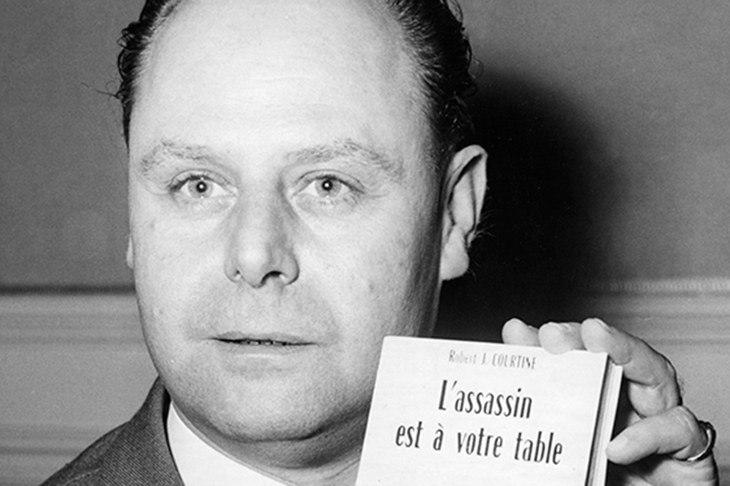
The juicy bits of Barr’s book are in the second half. The chief French food critic Robert Courtine, who wrote a weekly column for Le Monde as ‘La Reynière’, had long delighted his readers by slagging off the Michelin guide. He strongly supported female chefs, highlighting how few there were in Michelin-starred kitchens, although French cooking was traditionally done by women. One of them, Annie Desvigne, had been barred from the trade organisation the Maître Cuisiniers de France solely because she was a woman. In December 1975, she brought together several colleagues, pointing out that all-male kitchens meant no apprenticeships (stages) for female cooks and thus no structure for the profession. So they founded the ARC, the Association des Restauratrices-Cuisinières. Bocuse and co. scoffed – he himself was a famous womaniser. Having done its job, ARC was disbanded in 1998: the Maître Cuisiniers de France had begun accepting women the year before.
Courtine’s campaigning had been invaluable to women chefs, but he was ‘forcibly retired from Le Monde in 1993’ and died five years later. It was revealed that he had been a ferocious anti-Semite, rabidly pro-Hitler and had even blackballed Pudlowski from serving on a prize-giving jury. Le Monde had forbidden him to write about anything to do with politics but had allowed him to write about food. They finally apologised in 2004.
Got something to add? Join the discussion and comment below.
You might disagree with half of it, but you’ll enjoy reading all of it. Try your first month for free, then just $2 a week for the remainder of your first year.