Everyone I have met who has read Belchamber, Howard Sturgis’s novel of 1904, would endorse Edith Wharton’s judgment that this was a book which was ‘very nearly in the first rank’. I can still vividly remember the week – half a lifetime ago – when my wife and I discovered the little blue World’s Classics edition in a secondhand bookshop and were lost to the world for days. It is Henry James with the gloves off – in some ways quite unbearably vivid. Country house adultery and the sexual mores of London society during the 1890s are upsettingly, even crudely, laid bare. ‘Sainty’ the English aristocrat, an aesthete whose favourite pastime is knitting, fails to satisfy his coarse-grained wife, who provides him with a baby even though the marriage is, of course, unconsummated.
It was a book which only enjoyed post-humous fame. When Sturgis died, there would have been no obituaries had not Percy Lubbock published a notice in the Times. The beady-eyed diarist A.C. Benson once recorded with some pain the sight of Lubbock and Sturgis engaging in a passionate lover-like kiss. Benson, who was enraptured by Sturgis’s brilliance as a conversationalist, his charm as a man clad in sky-blue silk suits and his sweetness of nature, was unutterably bored, as was everyone else, by ‘the Babe’, the moustachioed Etonian city man, 26 years Sturgis’s junior, who shared the novelist’s life for 18 years.
In Sturgis’s lifetime, the celebrated member of the family was his elder brother Julian, whose novels wowed the reading public of the 1890s as much as his opera of Walter Scott’s Ivanhoe, set to music by Sir Arthur Sullivan. But, as Matthew Sturgis, a great nephew, shows in this delightful study, Howard has become the better known. Even his novel Tim, a more feeble production, has enjoyed a revival in the ‘Gay Classics’ series printed in New York.
The other main characters in Relative Failures, Willie Wilde and Mabel Beardsley, were also outshone in their lifetimes by their more famous brothers. When the two Wilde boys, the children of a distinguished Dublin physician and his engagingly preposterous wife ‘Speranza’, started out on life’s tragi-farce, both seemed brilliant. Willie’s style set Trinity, Dublin ablaze, and he looked destined for a distinguished career as a playwright and a lawyer at the English bar. Yet by the time his younger brother Oscar has won the Newdigate prize for poetry at Oxford, we sense the waning of Willie’s star. Whereas Oscar’s bons mots are worth repeating, those of ‘Wuffalo Will’ are achingly unfunny. A good pipe is like a good actress – ‘sure to draw without extravagant puffing’. As a journalist and playwright he once earned £1,000 a year, but the booze got to him, as an inadequate consolation for his brother’s genius.
After a series of disastrous failed relationships and dud literary ventures, Willie married the much-wed Mrs Frank Leslie, a wealthy American magazine proprietress. She sacked him for being hopeless, speaking openly of his charmlessness in the bedroom, his erectile dysfunction and his habit of leaving false teeth on the bedside table. ‘I have opened every door for Mr Wilde to succeed in journalism or literature, but so far he has not entered,’ she reflected. When he returned from the States to work as a journalist in London, he could not resist writing a catty review of one of Oscar’s successful plays, A Woman of No Importance. When Willie died, Oscar, by then living down his disgrace abroad, said to Robbie Ross: ‘Between him and me there had been wide chasms for many years.’
On his return from the States, Willie Wilde could not resist writing a catty review of one of Oscar’s plays
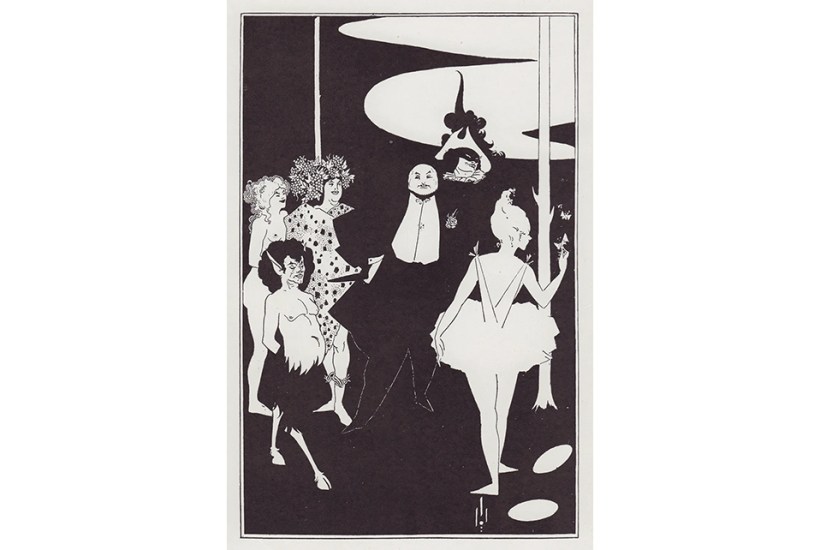
The relationship between the theatrical redhead Mabel and her inspired brother Aubrey Beardsley was more harmonious, but more tragic, since the great illustrator of The Yellow Book was to die, aged 25, in Menton in 1898. He was clutching his rosary and begging his publisher, Smithers, to destroy all his obscene drawings. Mabel’s career on the stage reached a zenith when she played the Duchess of Strood in Pinero’s The Gay Lord Quex. When the tour reached Hull, an awestruck reviewer remarked on the exquisite beauty of her naked shoulders in the boudoir scene. She married in 1902, in Westminster Cathedral, a fellow actor called George Beally Wright, who was rich and of a much higher class. She was never well, and she inspired Yeats to write his haunting poem ‘Upon a Dying Lady’ before the excruciating pain of cancer of the uterus killed her, aged 45.
While this touching book’s theme might be sibling relations, it is also a portrait of the 1890s. The reader is led, as it were, into an overheated, palm-fringed, incense-laden drawing-room where the women – the Lady Bracknell-esque Speranza; or witty Ada Leverson, the Sphinx; or Mabel herself – inhabit a world in which men reserve their most passionate yearnings for younger versions of themselves. Here love is choked by epigram and paradox; Eros is found in cheap theatrical dressing rooms and smoky bars or smokier churches; and Death itself, like many of the characters, nurses a sinister, ungovernable preference for the young.
Got something to add? Join the discussion and comment below.
You might disagree with half of it, but you’ll enjoy reading all of it. Try your first month for free, then just $2 a week for the remainder of your first year.