Author Donald Horne explained how Australia was ‘the Lucky Country’ since it became successful despite the fact it was run by second-rate people.
It seems, though, that the consequences of being presided over by a confederacy of dunces means that this country’s luck is about to run out, if it hasn’t already.
Institute of Public Affairs (IPA) research revealed earlier this year that in 2004, Australia was ranked the 4th most competitive economy in the world, behind only the US, Singapore, and Canada. This was according to the International Institute for Management Development’s (IMD) World Competitiveness Yearbook. Since then, competitiveness and dynamism in the Australian economy have collapsed. Australia’s overall competitiveness ranking has fallen from 4th place in 2004 to 18th in 2025 as the public sector plays an increasingly greater role in the economy.
As outlined in IPA research, data from the Australian Bureau of Statistics for the September 2025 quarter indicates government spending contributes about 29 per cent of GDP, up from 21 per cent in 2000. This is directly a result of government policy. Much of that spending falls within the welfare system, which is now demonstrably unsustainable. The exponential growth of the NDIS is one such manifestation, along with numerous other boondoggles (Snowy Hydro 2.0, for example).
Indeed, Australia is exhibiting all the hallmarks of a command-and-control economy. The same IPA research demonstrates that, since 2000, government spending has increased by 165 per cent in real, inflation-adjusted dollar terms, while private investment and net exports only increased by 40 per cent.
Moreover, Australia’s rankings in key economic competitiveness metrics reinforce these trends. For example, in 2025, Australia’s rank in entrepreneurship fell from 11th in 2004 to 68th (of 69 countries surveyed by the IMD).
I believe it was Albert Einstein who declared that the definition of insanity is doing the same thing repeatedly but expecting a different result.
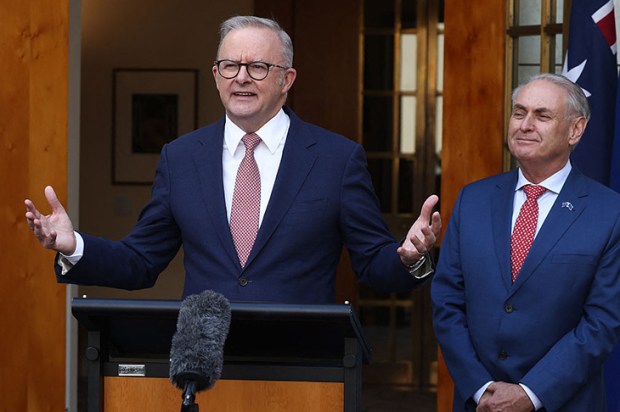
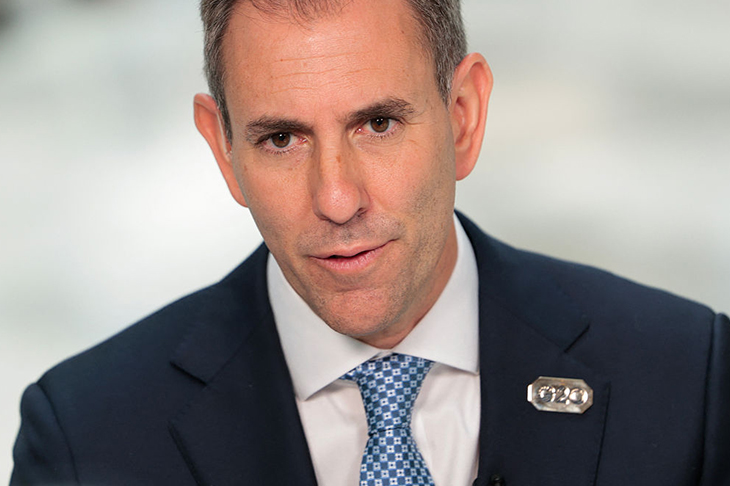
Cue Anthony Albanese and Jim Chalmers, whose plan to ‘remake capitalism’ in this country means that their insatiable appetite for never-ending rounds of new and increased taxes will manifest itself in the forthcoming budget, which taxes are in large part a spitting image of those proposed by then opposition leader Bill Shorten at the 2019 election.
Albanese went to the 2022 election telling everyone how he wasn’t Bill Shorten. However, a leopard never changes its spots. Increased taxes, rather than much needed spending cuts, will be the order of the day on the basis of addressing ‘intergenerational equity’.
Let’s call this out for what it really is, a perverted ‘Robin Hood’ policy that doesn’t hit the rich, but the very people it claims to help, while killing the aspirational middle class (which Labor has always hated).
When Dr Chalmers (for indeed a doctor he is) talks about intergenerational equity, what he really means is that if you are able and willing to work, to succeed, and so to improve your condition in life, that is in itself deemed a kind of unfair advantage. As Janet Daley wrote recently in the UK Telegraph, ‘even if (indeed, especially if) you started at the bottom and had to work your way up using your own talent and resourcefulness, you will now be cast as a class enemy: an inheritor of the bourgeois guilt that once belonged to those who were born into wealth and prestige’.
‘The very traits which enabled you to climb out of disadvantage become culpable: aspiration, perseverance and the refusal to resign yourself to failure are not virtues which deserve the rewards they earn. They are lucky gifts bestowed on you in some kind of random life lottery which the state must rectify. Therefore, the tax system must penalise you.’
On the contrary, it is this communist attitude that has created the so-called ‘intergenerational inequity’, which will only be exacerbated by changes to the capital gains tax and negative gearing.
Most commentators and economists have predicted that these expected budgetary changes will drive a surge in rents in most major markets if the changes are not matched by a drastic drop in migration intake. They warn that the removal of these concessions will stop investors from buying in suburbs with low rental yields, stalling the supply of new rental homes at a time of surging population growth due to migration. This will be most devastating for lower-income renters, unable to save for a deposit and who will have to rely on a shrinking pool of available rentals and thus pay higher amounts for a roof over their heads.
In effect, a higher CGT rate will mean existing investors simply hold onto their properties for much longer rather than selling, so there will not necessarily be more homes on the market. Negative gearing changes will mean property investors (most of whom are ‘mum and dad’ investors) can only do one thing to recoup their losses: increase rents. When Chalmers’ mentor, Paul Keating, removed negative gearing in the 1980s, rents rose as much as 30 per cent over two years in some cities and rental availability became virtually non-existent. Consequently, the concession was re-instated after only 18 months.
What was that definition of insanity?
If governments were really interested in addressing intergenerational equity, they would address excessive spending. Of course, this is difficult because it means switching off the vote-buying tap, but the numbers don’t lie.
Twenty years ago this week, Australia became debt-free.
This outcome was only possible because government became smaller, unleashing economic growth that actually was productive since it was produced mainly by the private sector.
Now, Australia is $1 trillion in the red. This profligacy is threatening essential government responsibilities such as defence spending as well as creating an unfair burden on taxpayers that is morally reprehensible, especially since our children and their children will have to bear this burden, as well as rendering economic growth impossible by punitive costs on business.
Even though the productive sector underwrites the non-productive one, the latter imposes ever-more stringent restrictions on the former driven by fake moralising.
We are back where we were in the 1970s, when the policy consensus was that command and control was the order of the day, it just had to be managed better, meaning an economic death spiral.
However, the low point of the 1970s led to a revolution in thinking and an economic revival. It can, and must, happen again.
Got something to add? Join the discussion and comment below.
You might disagree with half of it, but you’ll enjoy reading all of it. Try your first month for free, then just $2 a week for the remainder of your first year.