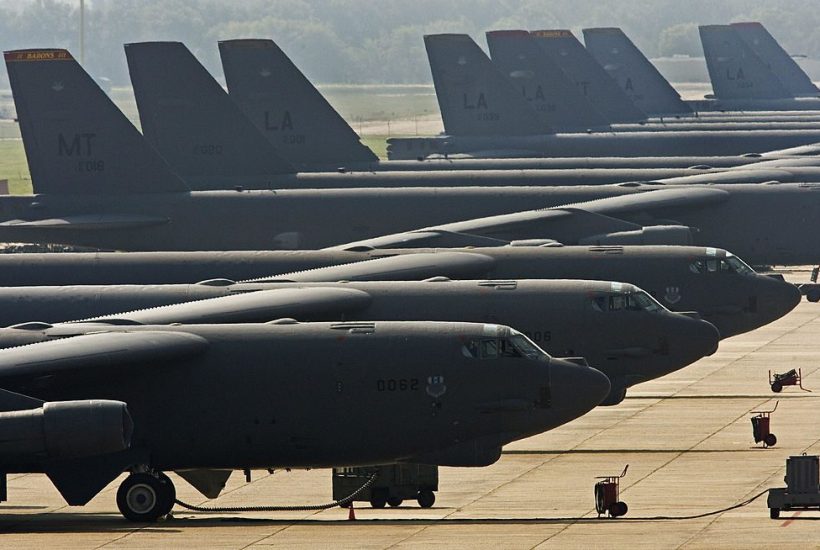
A lockdown at Barksdale Air Force Base in Louisiana triggered by a mysterious drone swarm last month didn’t last long. Nothing was damaged and none of the 40 B-52 bombers or their cruise missiles with nuclear warheads were hit. At least not this time.
To understand what might happen next, it is important to recognize that modern wars no longer begin with a formal declaration. Russia’s invasion of Ukraine, for example, was labeled a “special military operation,” while in reality it became the largest war in Europe since World War Two. In today’s world, the moment a war begins is blurred. It is not impossible that the start of a third world war will only be defined by historians, years after it ends. And it is entirely possible that it has already begun.
The early signs of modern war are not necessarily an open attack or a missile-and-drone strike, but rather hybrid actions: cyberattacks, information and psychological operations in social media, GPS disruptions, damage to undersea communication cables and, increasingly, drone incursions into military and critical infrastructure sites.
Modern drone warfare tends to follow a pattern. It starts with probing: testing detection systems, response times and coordination. This is followed by analysis: identifying vulnerabilities and blind spots in the defense of key sites. Only after that come targeted strikes, which, depending on the tactics, may take the form of isolated, low-signature incursions or large-scale attacks designed to overwhelm air defense systems.
That is why the incursion at Barksdale and similar events should be seen as serious signals, not isolated anomalies. In 2023 mysterious drone swarms violated restricted airspace over Langley Air Force Base, Virginia, for 17 nights and forced F-22 stealth fighters to be moved to nearby bases.
These incidents, and others, undermine a basic assumption that has shaped military thinking for decades: that distance from the line of contact or from an adversary’s territory provides reliable protection. Long-range strike drones that can fly up to 1,200 miles are already in use in the war between Russia and Ukraine and in the Middle East. They carry meaningful payloads, can be produced at scale and are becoming more accurate with each iteration.
Operation “Spiderweb”, in which Ukrainian drones destroyed or seriously damaged a significant number of Russian strategic bombers deep inside Russian territory last year, demonstrated this fundamental shift. The incident at Barksdale may have been a warning to the US that an adversary is capable of a similar attack.
Such drone attacks create a clear challenge for Western militaries. Traditional air defense systems are not suited to counter large numbers of small, cheap targets, especially those flying at low altitude. And cheap drones being intercepted by expensive Patriot missiles is not a viable economic model.
What matters now is who can scale effective and affordable solutions faster – both for attack and defense. It is entirely possible that future wars will be won by those who can mass-produce and deploy simple, effective systems.
Ukraine is going through this evolution in real time, building a functioning system to counter drone attacks. The response is not a single solution, but a layered approach: low-cost detection systems, electronic warfare, passive protection of equipment and infrastructure, the use of aviation, and relatively cheap but effective interception drones. A key factor behind this rapid progress is the short feedback loop between the battlefield and manufacturers, combined with relatively low levels of bureaucracy, allowing effective solutions to be deployed quickly.
Since the start of operations in Iran, demand for low-cost interceptor drones has increased significantly. Air defense systems cannot cover all required targets. And Iran’s approach – striking both military and civilian infrastructure – greatly expands the number of objects that need protection. In terms of cost-efficiency and military effectiveness, interceptor drones are currently one of the most promising defensive tools. Both Ukraine and Russia are scaling this capability rapidly.
At the same time, traditional protective measures remain relevant. Hardened storage facilities, anti-drone nets against small FPV drones, and the dispersal of assets are becoming as important as active defense. Looking ahead, some countries are investing in laser weapons for counter-drone use, but so far such systems have not demonstrated proven effectiveness.
What is happening in Europe and the Middle East does not necessarily mean that incidents like Langley or Barksdale represent immediate escalation. But the events do highlight something important: the continental United States is already encountering early signs of a form of warfare that is actively evolving elsewhere.
The problem is that these events do not yet look like war. And that is precisely why they are easy to underestimate.
Ukraine is often described as a battlefield. But it is also a laboratory, a place where new approaches, systems and tactics are tested in real conditions. Effective solutions evolve and scale quickly. Today, Ukraine, Russia and Iran are rapidly learning the lessons of hybrid warfare and drone technology. America must do so too, before it is too late.