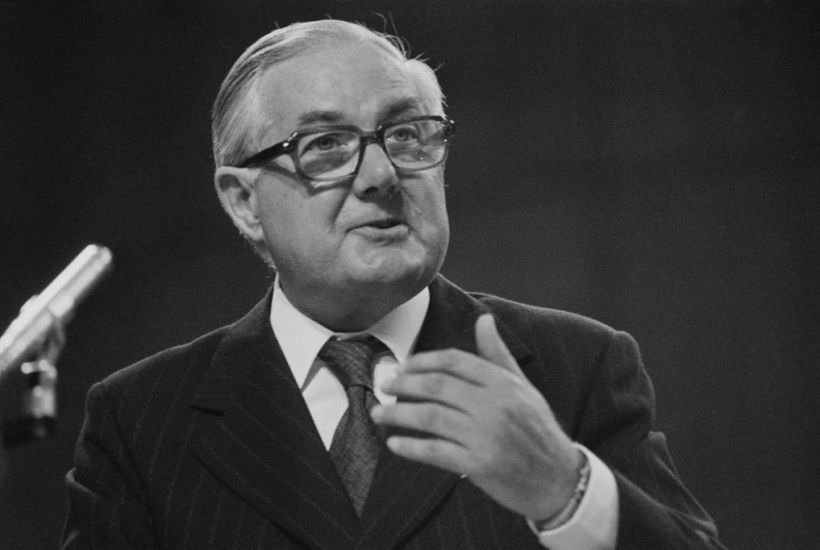
The famous dictum – that all political lives end in failure- was certainly true of James Callaghan. The man who became Prime Minister exactly 50 years ago today, will be forever associated with the so-called Winter of Discontent – a disastrous wave of strikes in late 1978 and early 1979 which effectively brought down his minority Labour government. This left the door of Number 10 wide open for Margaret Thatcher, who then – according to the dominant narrative – sorted the whole thing out. Indeed, people’s memories of that period – and its vivid imagery of the rubbish piling up high in Leicester Square, and pickets here, there and everywhere – were such that it was nearly 20 years before the electorate trusted Labour to govern again.
Had Callaghan called and won an election in October 1978 then the 1980s would have been very different
Yet if ‘that winter’ is all that we remember Callaghan for it’s rather sad. Because in many ways he was a highly effective premier who in just over two years turned the nation’s fortunes around and introduced a number of practical reforms which benefited millions, such as the State Earnings Related Pension Scheme, a valuable addition to the basic state pension.
Indeed, if we look at the period from 1976-78 Callaghan’s administration has serious claims to be the most successful since the second world war – particularly when you consider that for most of its term it didn’t have a parliamentary majority.
Callaghan – the first and to date only man to hold all four great offices of state – could hardly have become Prime Minister at a more inauspicious time. Inflation was still around 16 per cent – from a peak of 29.6 per cent in 1975, while sterling was continuing to slide against the dollar. Unemployment stood at around 1.2 million. Harold Wilson had had enough – and now it was ‘Sunny Jim’s’ turn. Straight away there was a new sense of purpose in government. Wilson, increasingly tired and demoralised, had opined that a decision deferred was still a decision. Callaghan by contrast was determined to try and deal with Britain’s problems – particularly that of productivity – head on. ‘No one owes Britain a living… we are still not earning the standard of living we are enjoying,’ he declared.
Formally breaking with Keynesian orthodoxy at the 1976 Labour conference he announced that controlling inflation would be the number one priority. Whether or not the $3.9 billioni loan from the IMF that autumn was strictly necessary remains a matter of debate (less than half was actually used and the rest was paid back ahead of schedule), but the fact of the matter – which both right and left don’t give enough credit for – is that Callaghan and his Chancellor Denis Healey did turn things round.
Callaghan did cut public spending – but without causing social unrest or a new recession – and did introduce cuts in VAT and taxes. The ‘social contract’, the deal whereby unions agreed to moderate wage demands in return for social benefits, was working. By the time of the April 1978 Budget the economic outlook was radically different. Inflation was down to single figures. The balance of payments showed a healthy surplus of £1 million. The pound had climbed again against the dollar. Sensible governance and North Sea oil revenues – flowing into the Exchequer’s coffers from 1976 – had transformed the situation. Strikes? As Andy Beckett notes in When the Lights Went Out: What really happened to Britain in the Seventies, in 1978 the number of working days lost to industrial action was down by three-quarters from its early 70s peak. And for those who accuse Callaghan of being a Labour ‘sell-out’, it’s worth noting that inequality in Britain was the lowest it had ever been in 1977-78, and it has never been so low since. We tend to forget just how popular Callaghan was in 1978. ‘Love is in the Air’ by John Paul Young was a big hit in the spring of that year, and you could say it captured the optimistic public mood about how things were going.
But then, at the height of his success, ‘Sunny Jim’ made his fatal mistake. With Labour ahead in the polls, it was fully expected that the Prime Minister would call a general election that autumn to get a working majority. Indeed, the date of 5 October was already provisionally pencilled in. But Callaghan – against the advice of almost all his advisers – delayed. He wanted one more year, to get inflation down still further. The rest, as they say, is history.
His 5 per cent pay policy came under attack and the strikes spread like wildfire. The great irony is that it was Trotskyist and ‘ultra-leftist’ militants, who loathed Callaghan’s old-fashioned, patriotic, old Labour social conservatism, helped the Thatcherites come to power.
The election that never was on 5 October 1978 remains one of the greatest ‘what if’ moments in British political history. In 2023 I interviewed the late Lord David Lipsey, a key adviser to Callaghan who said his boss had been worried about one poll which suggested Labour might not win. But the odds would have strongly favoured a Labour victory. Andy Beckett quotes Callaghan’s press secretary Tom (now Lord) McNally who told him: ‘To my dying day I believe we could have won an election on 5 October’. Beckett notes that Margaret Thatcher too came close to endorsing that view. Internally the Conservatives were worried that Labour had regained the upper hand in 1978. But the ‘Winter of Discontent’ changed all that.
Had Callaghan called and won an election in October 1978 then the 1980s would have been very different. There would have been no large-scale privatisation (arguably a cause of many of our problems today, especially high energy costs), and Britain’s long-standing industrial problems might have been solved without the deindustrialisation which ensued. How Callaghan approached the problems at British Leyland, the state-owned car manufacturer is instructive. By 1977, BL had become something of a joke, with terrible productivity issues, management failing to manage and some workers literally sleeping on the job. To try and turn things round Michael Edwardes, a no-nonsense businessman from South Africa Africa, was brought in as chairman. The move was controversial, but it worked. ‘I can think of few people easier to work with than the last Labour Prime Minister. James Callaghan is a relaxed and formidable man’, Edwardes said. He also praised Callaghan and his ministers for backing him up when difficult decisions had to be taken. Now we have no British-owned car industry left but it – and lots of other things too – might have been different had ‘Callaghanism’ survived.