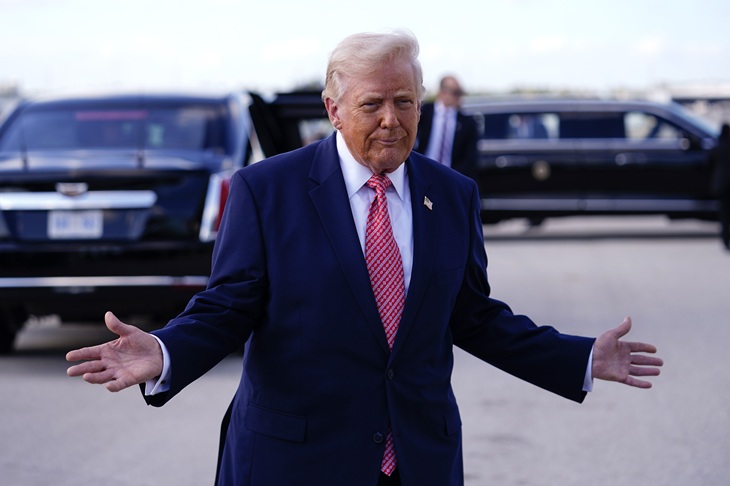
Don’t bite the hand that feeds you. In geopolitics, the vice is uglier still: entire governments now bite the hand that shields them.
That is the modern Western arrangement in one line: America is the wealthy, capable, relentlessly active grandfather who still pays the bills, still fixes the roof, still shows up when danger turns financial or physical, and still serves as the family’s emergency backstop. Europe, Britain and Australia are the adult children who mismanaged their own households, neglected their own responsibilities, and now spend their time lecturing the one relative still keeping the lights on.
That is not an alliance at its healthiest. It is a dependency with an attitude and accountability problem.
That is the real story behind the convulsions over Iran. The issue is not merely whether Donald Trump is abrasive or disliked in political-class diplomatic circles. He is. The deeper story is that too many ‘allied’ governments have become structurally dependent, strategically incapable, and morally evasive. Nato’s own Secretary General more or less admitted as much last week: European allies and Canada lifted defence spending by 20 per cent in 2025, but only after years of leaning shamelessly on American power. The United States still accounted for around 60 per cent of Nato defence spending in 2025. That is not a balanced alliance. It is a family of overgrown children still running tabs through grandad’s account while pretending they are financially independent. It is also a representation of a clear pattern.
Now put Iran in the middle of that picture and the pattern repeats. This is not some misunderstood regional actor unfairly maligned. Iran has consistently been the largest state sponsor of terrorism. Human Rights Watch has documented arbitrary arrests, enforced disappearances, torture, and a severe domestic crackdown. Reuters has also reported on US cases involving alleged Iranian-linked plots targeting Donald Trump and dissidents on Western soil. None of that is ambiguous. None of it is fringe. It should not be remotely controversial to state the obvious: Iran has long been a grave and growing threat. The fact that this basic context all but disappeared from so much mainstream commentary over the last month tells you everything about the moral vanity and intellectual dishonesty of the modern media class.
Nor was the threat theoretical. Before the latest strikes, the IAEA reported that Iran had accumulated 440.9 kilograms of uranium enriched to 60 per cent purity, perilously close to weapons grade if enriched further. Inspectors also made clear that access remained urgently needed and that they could not fully verify the status of parts of the stockpile after repeated strikes and Iranian obstruction. Even cautious reporting now accepts the core point: Iran’s nuclear infrastructure has been degraded, but not all of its leverage has disappeared. That is precisely why sustained pressure matters. A regime with less money, less reach, fewer proxies, and less nuclear ambiguity is plainly a lesser threat than the same regime flush with cash, reach and impunity. Only in the decadent political culture of the modern West does this have to be argued as though it were somehow novel.
And then came Operation Midnight Hammer. The strategic lesson was unmistakable. When Washington chooses to act with force and clarity, it can still impose serious costs on a regime most Western leaders prefer to discuss in the soothing language of ‘de-escalation’ and dead-end diplomacy rather than deterrence and action to realise real outcomes. It was another reminder that the competent relative in this family still knows how to pick up the tools and do the hard job (that many Presidents and powerful leaders have put off or failed to act whilst the threat only grew stronger) while the weak, ineffective allied leaders of nations who benefit, opt to grandstand, criticise and complain about lack of diplomacy (as if that was a viable option) or the nuances of how it was done, from the comfort of their armchair.
The broader regional picture matters too, and here Trump’s defenders have a far stronger case than his many loud critics care to admit. The Abraham Accords were not meaningless pieces of paper – they were a real diplomatic rupture with the old order. Israel normalised relations with the United Arab Emirates, Bahrain, Morocco, and Sudan during Trump’s first term. Saudi Arabia still sits outside the accords formally, but has clearly come into a new, powerful, positive alliance. Look at the recent noises out of the Middle East’s key players: the UAE is willing to join an international force to reopen the Strait of Hormuz, while Bahrain has pushed for a UN resolution to protect commercial shipping. Other Gulf states, especially Saudi Arabia, the UAE, and Bahrain, have urged the United States not merely to end the war, but to degrade Iran’s capabilities for good. That is not a Middle East uniformly aligned against the West. It is a Middle East in which key Sunni Arab powers increasingly see Iran as the central menace and the US as the force for good. That is a major strategic achievement, and it did not happen by accident. Very few in the mainstream media have bothered to even consider the magnitude of this feat because it is politically inconvenient.
Gratitude for the many wins is nowhere to be found. Instead, Trump is mocked for boasting, sneered at for his style, and dismissed as though the only thing that matters in foreign policy is whether the commentariat finds a leader aesthetically pleasing. This is the great fraud of the contemporary West: results are minimised, risks are memory-holed, and the one leader willing to impose costs on enemies is treated as the real embarrassment. The Abraham Accords were real. Gulf alignment against Iran is real. Nato burden-sharing has risen under pressure. Iran’s nuclear program has come under more direct strain than at any point in recent memory. Many global conflicts have been resolved by Trump. Aggression by adversaries has been minimal whilst he’s been in touch – again, not a coincidence. By contrast, the frailty and weakness of the US and its allies under Biden coincided with catastrophe after catastrophe: the Afghanistan withdrawal, Russia’s invasion of Ukraine, and October 7 and the Middle East disaster that followed. Adversaries notice weakness. They exploit hesitation. They respect force. That is not ideology. It is the oldest rule in international politics. The inconvenient truth for detractors is that peace through strength has worked and will be a defining legacy of the Trumpian era.
Britain, for its part, has become a masterclass in second-rate moralising. Keir Starmer now speaks of a ‘new and dangerous world’ while nudging Britain closer to Europe and biting the American hand that feeds. The UK initially blocked the US use of British bases for strikes and later permitted only limited defensive missions. Yes, Britain has shown ‘delayed courage’ as Trump aptly put it and has since modestly bolstered its defensive posture in the Gulf. But that is the point: it is managing fallout and only reacting late because his constituents are being adversely impacted – the consistent failure is not being willing to solve the problem and be a real ally when the situation demands leaders to stand up. It is trying to insulate itself from the consequences while scolding the ally still carrying the strategic weight. That is not leadership. It is risk aversion disguised as principle. And it fits Starmer perfectly: a weak leader’s favourite habits are moralising, finger-pointing and hoping nobody notices that he is doing neither the leading nor the lifting. Fortunately, Britain has seen past the facade as Starmer’s record low approval ratings since polling began attest but unfortunately, Britain has suffered from this latest weak leadership page in what has been a fairly dire chapter in the country’s rich history.
Australia looks no better. Anthony Albanese has delivered the kind of managerial, anaemic rhetoric that passes for leadership in a complacent political culture: stay calm, conserve fuel, brace for disruption, use public transport, do not panic-buy. That is not statecraft. That is late-stage crisis management in an energy-rich country that somehow still imports almost all of its fuel and remains vulnerable to precisely the sort of geopolitical shock any serious government should have spent years preparing for. Australia imports about 90 per cent of its fuel and currently holds roughly 30 days of petrol and 30 days of diesel and jet fuel. In other words, a resource-rich country adopted self-weakening policies, hollowed out its own resilience, and then acted scandalised when geography and supply chains exposed the stupidity of those choices. And in the middle of that self-inflicted frailty, the Australian Prime Minister’s posture has remained predictably timid: minimal defensive support and a few carefully crafted words but no appetite for bearing any meaningful burden in confronting the very problem now hitting Australians in the pocket. The family equivalent is the unemployed middle-aged son living in the parents’ basement demanding another handout.
The economic objection is real and reasonable, but for countries like Australia and Britain to wave vaguely at ‘the war’ being the root of all their problems while ignoring their own obvious policy failures is lazy and arrogant. Of course voters care about petrol, inflation and power bills. They should. But voters should also have the full picture of why these actions were taken and equally, why their own nation’s policy failures have been exposed by recent developments in the Middle East.
That is why Trump’s fury at Nato should surprise nobody. The problem is not merely that allies disagree with him. Serious allies disagree all the time. The problem is that too many of them have turned dependency into a governing philosophy: rely on American deterrence, American naval power, American intelligence, American markets and American risk tolerance, then sneer at the Americans for being insufficiently delicate while performing the burdens everyone else quietly outsourced. It is the brat’s posture in its purest form: entitlement without gratitude, dependence without humility, and endless criticism of the one adult doing the heavy lifting.
The sharpest argument for Trump on foreign policy is not that he is saintly or subtle. It is that he understands a civilisational truth much of the modern West is too vain, too soft or too dishonest to admit: order survives when somebody is willing to enforce it. If Iran’s power is broken down, its proxies weakened, its nuclear ambiguity narrowed and its ability to blackmail the world through terror and chokepoints reduced, that will not be a tragedy. It will be a major gain. And the allied governments that stand to benefit most from that gain should stop behaving like spoiled children rolling their eyes at the grandfather while waiting for him to pay the next bill.