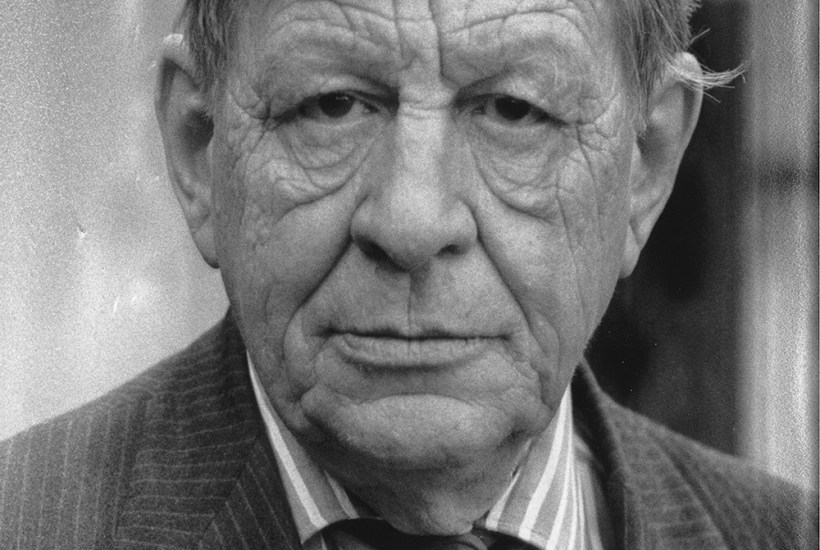
‘Begin with the name,’ begins Peter Ackroyd. ‘Wystan is singular and arresting. Auden himself… confessed that he would be furious if he found that anyone else possessed it.’ It is certainly a name on which much ink has been spilt. Ackroyd’s biography comes barely 18 months after Nicholas Jenkins’s The Island, an exhaustive study of the poet and his work up to 1939 and his flight to America.
Unlike Jenkins’s book, Ackroyd’s has the advantage of being a life rather than a half-life, though it accelerates through the later years as Auden tipped into ‘premature old age’. The frequent quotations also help the pacing, though we might have wanted chunkier extracts from, say, ‘September 1st 1939’. (But even the ten lines we do get would have been too many for Auden, who subjected the poem to an anthology purge.) Sometimes Ackroyd quotes in order to show some development in Auden’s style, such as his young infatuation with T.S. Eliot: ‘Sweet lust runs softly by. Dissolute man/ Thinks ‘‘Dare I drink it?’’ and decides he can.’ Mostly, though, the poetry is used to illustrate the life and the decisions that defined it:
… If we try
To go southern, we spoil in no time, we grow
Flabby, dingily lecherous, and
Forget to pay bills…
Auden’s beloved north-south paradigm is taken too much at face value throughout the book; but the paying of bills really was an article of faith. As he grew more boozy and nicotine-stained, Auden inversely obsessed over being restrictively punctual and respectably solvent. Though he trashed every flat he rented, he was anything but bohemian – if we go by Clive James’s view that ‘a bohemian’s ability not to worry about money always starts with your money rather than his’. Another poem, ‘The Common Life’, says that ‘the homes I warm to,/ though seldom wealthy, always convey a feeling/ of bills being properly settled/ with cheques that don’t bounce’.
These lines are often used to argue Auden’s postwar decline, both poetic and political. He was aiming, he said, to ‘keep the diction and rhythm within a hairsbreadth of being prose without becoming it’ – the guilty techne of a poet for whom poetry came all too easily. Sometimes it seems that he emerged from the womb speaking in verse: ‘I like to see the various types of boys’ was a juvenile pentameter meant to shock his school matron. But as time went on he ditched the sonnet sequence for reams of haiku and other syllabic forms that flaunted themselves less as poetry. Ackroyd mentions the recruitment of Alan Ansen, a Harvard graduate who was paid to be Auden’s ‘prosodic conscience’ and scan his verse for rhythmic shortcomings.
As time went on, Auden ditched the sonnet sequence for forms that flaunted themselves less as poetry
For his part, Ackroyd generally writes in a style that is decently sober. He eschews the cliffhanger and ends most chapters with bracing flatness, none more so than the very last one. Auden’s partner Chester Kallman ‘died at the age of 54, from damage to his heart, brain, kidneys and liver, on the morning of 18 January 1975. He may also have died of grief.’ And that is that. We get no Afterword on Auden’s legacy, maybe because Ackroyd takes it for granted that it’s taken for granted. Back in 1980, the American poet John Ashbery thought it strange that interviewers were asking him about Auden’s influence: ‘Forty years ago when I began to read modern poetry no one would have asked – he was the modern poet.’ Perhaps Ackroyd despaired of knowing where to start, and preferred to limit himself to the empirical. As Auden wrote in an early poem: ‘A shilling life will give you all the facts.’
In fairness, Auden does a bit more than that. Ackroyd is good at giving the floor to those who actually knew the man, perhaps most poignantly the philosopher Hannah Arendt, to whom he proposed his second mariage blanc in 1970. Arendt wrote that she
finally saw the misery… and still found it difficult to understand fully what made him so miserable, so unable to do anything about the absurd circumstance that made everyday life so unbearable to him.
Not that Auden ever pleaded the privilege of the tortured artist. He was constantly minimising the role of art in life. But it played a great part in his own, even if just a palliative one; and though Ackroyd makes us feel like we know Auden the man, he gives us little sense of Auden the craftsman. Despite a mention of his ode to his study, ‘The Cave of Making’, the cave remains largely unexplored. The book reads like the finished article, crisp and polished, but it almost asks us to believe that the poems were born as the finished article, too. As Auden often said, quoting Paul Valéry: ‘A poem is never finished, only abandoned.’<//>
Got something to add? Join the discussion and comment below.
You might disagree with half of it, but you’ll enjoy reading all of it. Try your first month for free, then just $2 a week for the remainder of your first year.