Whenever the legacy of colonialism comes up for debate, a Monty Python sketch springs to mind. It’s the one from Life of Brian in which Reg, the leader of the People’s Front of Judea, exclaims: ‘What did the Romans ever do for us?’ Corrected, he eventually concedes: ‘OK, apart from the sanitation, the medicine, education, wine, public order, irrigation, roads, a fresh water system, and public health, what have the Romans ever done for us?’
It’s a brilliant exchange. But as Simukai Chigudu’s beautifully written memoir testifies, one that misses an essential point, in that colonialism’s bequest extends beyond infrastructure and administrative systems. Its most abiding – if tantalising – legacy has been psychological and emotional. And just like the railways, roads, universities and hospitals, those traces have been passed down through the generations, often barely definable to those inheriting them, yet undeniably there.
Chasing Freedom is a bellow of ancestral pain written by a man who, while moving from the privileged private schools of the former Rhodesia to the boozy student halls of Newcastle and quads of Oxford, attempts to digest and reconcile the contradictions of his family history. He often fails, repeatedly hovering on the verge of breakdown.
For those who don’t share the author’s skin colour, very particular experience or political views, this account could easily have felt like a hectoring sermon. Amazingly, Chigudu manages to avoid that trap, perhaps because he’s as merciless on himself as the long-dead colonial figures and occasional Reform supporters he encounters.
He was born in Zimbabwe only six years after the end of that country’s war of independence. His father, Tafi, is a war veteran, who fought against white-run Rhodesia’s army and still cannot bear to hear a bad word said about Robert Mugabe. His Ugandan mother, who met Tafi while studying at Makerere University, belongs to a generation of budding African feminists who believed that education held the key to freedom. She was determined that her son should grow up fully ‘exposed’: ‘My child must get everything I didn’t get… You must travel, you must see the world.’ Chigudu was already boarding international flights, solo, at the age of six.
An anxious-to-please only child, he became the most dogged of academic high achievers, getting marks that won him acceptance into schools once earmarked for white ‘Rhodies’. There he was taught by masters whose views Nigel Molesworth would have recognised. His parents assumed they were equipping him for middle-class life in a proud postcolonial African state. In fact, Chigudu now recognises, ‘my education was priming me for life outside Zimbabwe’.
As Mugabe’s rift with the British government over compensation for the appropriation of white farms widened, Zimbabwe’s economy collapsed and inflation soared to stratospheric levels. Chigudu’s path out of the country is set – first to a private school in Lancashire, then to Newcastle University, where he is flabbergasted by the student body’s yobbishness and feels ‘like a misplaced peppercorn in a bowl of salt’. Lost and bewildered, he is swallowed up by a Christian group – ‘I doubled down on my commitments to Christ, the way a closeted gay man might perform hypermasculinity’ – before realising his fervour was just one in a series of attempts to blank out his underlying malaise.
From there he moves to the University of Oxford. Shifting from medicine to political science, he plays a key role in the unsuccessful campaign to topple the statue of Cecil Rhodes overseeing Oriel College, deemed by Chigudu and fellow campaigners an unacceptable glorification of empire.
Chigudu convincingly conveys how historic repression worms its way into the mindset of succeeding generations
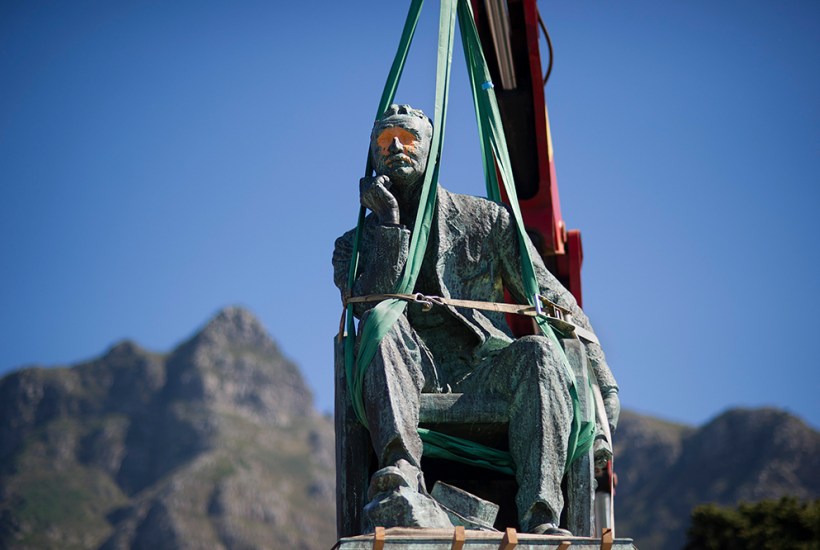
While the removal of a Cecil Rhodes statue from its plinth in Cape Town in 2015 always seemed both fitting and overdue, the attempt to extend the ‘Rhodes Must Fall’ campaign to Oxford felt – to me, at least – like a case of arrogant overreach. I reassessed that view after reading Chigudu’s memoir, so convincingly does he convey how historic repression and inherited trauma worm their way into the mindsets of succeeding generations.
Honesty is key to his tale. While he lacerates Rhodes and his contemporaries, Chigudu is under no illusions as to more recent horrors perpetrated by his father’s liberation heroes. Those include Gukurahundi, the massacres committed in Matabele in the 1980s by a Zimbabwean army unit, and the slum clearances in 2005 which left at least 700,000 homeless and 2.4 million facing starvation and disease. Chigudu readily admits that he only learned about many of these crimes once abroad, such is the sanitising of history practised by Mugabe aficionados inside Zimbabwe.
His reckoning extends to his parents, whose loveless and at times abusive relationship is exposed to the same nuanced but remorseless gaze as his own obsessive-compulsive personality. That’s brave, given that both these ‘flawed and astonishingly scarred’ individuals were still alive at the time this book went to press, and none too happy about his approach.
‘What I’ve been investigating is how personal history is linked to larger history,’ he explains at the end; ‘how political liberation from oppressive rule is not the same as freedom of the self from the burdens of the past.’
Great biographers need to be both lacerating and humane: Chigudu certainly has those qualities. To understand all is not necessarily to forgive all; it is simply, well, to understand. The even-handed empathy he displays throughout to all the players in his life’s story makes this a truly compelling read.
Got something to add? Join the discussion and comment below.
You might disagree with half of it, but you’ll enjoy reading all of it. Try your first month for free, then just $2 a week for the remainder of your first year.